
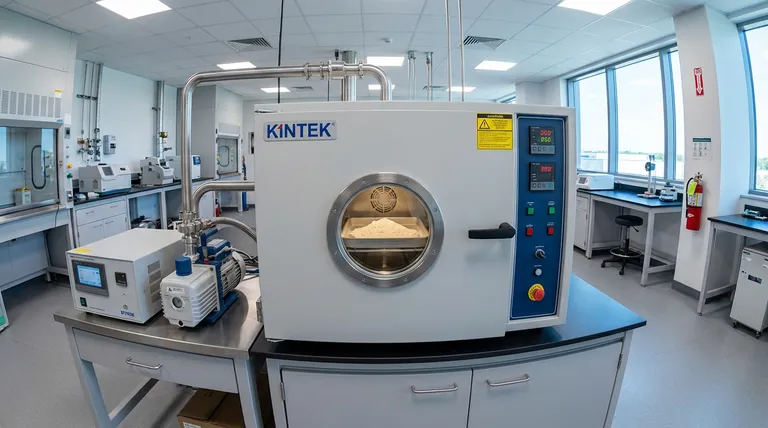
The primary process advantage of using a vacuum drying oven lies in its ability to lower the boiling point of solvents, allowing for rapid evaporation at significantly lower temperatures. For high-entropy ceramics, this is superior to conventional drying as it eliminates the need for high heat, thereby preventing thermal oxidation and inhibiting the formation of hard agglomerates that compromise the material's final quality.
The Core Insight Vacuum drying decouples evaporation speed from high temperature. By removing thermal stress during the drying phase, you preserve the precursor powder’s "active" state, ensuring the chemical purity and particle morphology required for successful densification during the critical sintering stage.
The Thermodynamic Advantage
Lowering the Boiling Point
The fundamental mechanism of a vacuum oven is pressure reduction. By creating a negative pressure environment, the system significantly lowers the boiling point of organic solvents such as ethanol.
This allows the slurry to dry rapidly without subjecting the ceramic particles to the high thermal energy required in a conventional oven. This is particularly effective for removing solvent residues from the interior of nanomaterials.
Protecting Chemical Integrity
Preventing Thermal Oxidation
High-entropy ceramic powders are often sensitive to oxygen, especially at elevated temperatures. Conventional ovens, which rely on hot air, introduce a high risk of unwanted chemical reactions.
Vacuum drying operates in an oxygen-deprived environment. This effectively prevents thermal oxidation and phase transformation, ensuring the powder maintains its original stoichiometry and purity before the next processing step.
Preserving Surface Activity
The reactivity of the powder surface is the engine of the sintering process. High heat during drying can "deaden" this activity prematurely.
By drying at low temperatures, the vacuum process preserves the high reaction activity of the original powder. This maintenance of surface energy is a critical factor in facilitating densification during subsequent sintering steps.
Optimizing Physical Structure
Minimizing Hard Agglomeration
In conventional drying, high temperatures and slow evaporation can lead to strong "liquid bridge forces" between particles, resulting in hard agglomerates that are difficult to break down.
Vacuum drying mitigates this issue. It prevents unnecessary agglomeration and hard clustering, ensuring the ultra-fine powders remain loose. This preserves the material's porosity and prevents structural collapse caused by capillary forces.
Enhancing Uniformity
For slurries involving binders or mixed components, rapid, low-temperature volatilization prevents the segregation of materials.
This ensures a uniform distribution of components within the dried powder. It avoids the formation of a "crust" or surface cracking that can occur when the surface dries too quickly relative to the interior, a common issue in ambient pressure heating.
Common Pitfalls to Avoid
The Risk of Conventional Drying
It is critical to understand that using a conventional oven for these materials is not merely "less efficient"—it can be actively detrimental. High-temperature air drying creates a distinct trade-off: to remove solvents thoroughly, you risk degrading the powder.
If the temperature is too high, you induce oxidation. If the temperature is too low (to avoid oxidation), solvent removal is incomplete, leading to defects during sintering. Vacuum drying eliminates this compromise.
Process Control Sensitivity
While vacuum drying is advantageous, it requires precise control of pressure and time. An uncontrolled vacuum rate can lead to "bumping" (violent boiling) of the solvent, which may disrupt the slurry homogeneity. The process must be tuned to balance evaporation speed with the structural stability of the powder bed.
Making the Right Choice for Your Goal
To maximize the quality of your high-entropy ceramics, apply the drying method that aligns with your specific downstream requirements:
- If your primary focus is Sintering Density: Prioritize vacuum drying to preserve high surface activity and prevent hard agglomeration, as these are the primary barriers to full densification.
- If your primary focus is Chemical Purity: Rely on the vacuum environment to eliminate oxygen, which prevents thermal oxidation and ensures the elemental composition remains unchanged.
- If your primary focus is Structural Homogeneity: Use vacuum drying to ensure uniform solvent removal, which maintains a loose, porous morphology and optimized gas diffusion channels within the material.
Summary: Vacuum drying is not just a drying step; it is a preservation strategy that protects the chemical and physical potential of high-entropy ceramic powders for high-performance applications.
Summary Table:
| Feature | Vacuum Drying Oven | Conventional Oven |
|---|---|---|
| Mechanism | Pressure reduction; low-temp evaporation | Hot air convection; high-temp evaporation |
| Oxidation Risk | Minimal (Oxygen-deprived environment) | High (Heat + air exposure) |
| Particle Structure | Loose, porous; prevents hard agglomeration | Prone to hard clustering & liquid bridges |
| Surface Activity | Preserved for better sintering | Reduced due to thermal stress |
| Solvent Removal | Rapid & thorough for internal residues | Slower; risk of surface crusting |
Elevate Your Ceramic Processing with KINTEK
Don’t compromise the purity of your high-entropy materials with inferior heating methods. KINTEK provides industry-leading vacuum drying solutions designed to preserve surface activity and prevent thermal oxidation. Backed by expert R&D and manufacturing, KINTEK offers a full suite of Muffle, Tube, Rotary, Vacuum, and CVD systems, all customizable to meet your unique laboratory or industrial needs.
Ready to optimize your sintering density and chemical integrity? Contact our experts today to find your custom solution!
References
- Shigeo Fukumoto, Nobuhisa Ebihama. Solidification Characteristics and TiC Formation Behaviour in Alloy 800H. DOI: 10.2355/isijinternational.isijint-2025-097
This article is also based on technical information from Kintek Furnace Knowledge Base .
Related Products
- Vacuum Heat Treat Sintering and Brazing Furnace
- Vacuum Heat Treat Sintering Furnace Molybdenum Wire Vacuum Sintering Furnace
- Dental Porcelain Zirconia Sintering Ceramic Vacuum Press Furnace
- Molybdenum Vacuum Heat Treat Furnace
- Vacuum Hot Press Furnace Machine Heated Vacuum Press
People Also Ask
- What is one of the most important uses of vacuum heat treating furnaces in aerospace? Achieve Superior Strength in Aircraft Alloys
- What are the benefits of using vacuum heat treating furnaces for metal alloys? Achieve Superior Metal Properties and Performance
- How does vacuum heat treating affect the grain structure of metal alloys? Achieve Precise Microstructure Control
- What is the temperature of a vacuum furnace brazing? Optimize Your Joint Strength and Cleanliness
- What are the steps involved in a typical vacuum brazing treatment? Master the Process for Strong, Clean Joints












