
Using a hydrogen reducing atmosphere is the definitive method for ensuring the quality of stainless steel Metal Injection Molding (MIM) parts. It serves as a potent chemical agent that actively strips residual oxygen from powder surfaces and strictly regulates carbon levels. By protecting the essential chromium oxide layer and preventing carbide formation, hydrogen guarantees the final components achieve the necessary corrosion resistance and mechanical strength.
Core Takeaway Hydrogen provides a "strong reducing potential" that acts as a chemical safeguard during sintering. Its primary function is to eliminate oxygen and control carbon; without this specific atmosphere, the stainless steel loses the chemical stability required for both its structural integrity and its resistance to rust.
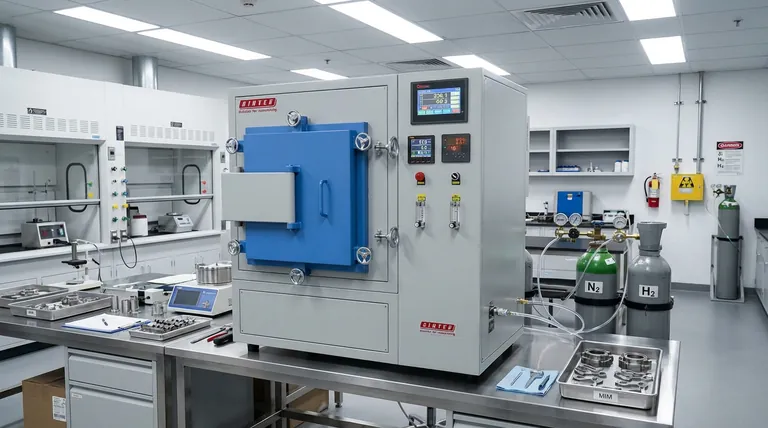
The Chemistry of Surface Protection
Eliminating Residual Oxygen
Stainless steel powders used in MIM often carry residual oxygen on their surfaces.
Hydrogen chemically removes this oxygen. By reacting with surface contaminants, it cleans the powder particles, which is a prerequisite for successful sintering and particle bonding.
Preserving the Passive Film
The defining feature of stainless steel is its chromium oxide passivation film, which prevents corrosion.
A hydrogen atmosphere protects this film from thermal degradation. The atmosphere's reducing potential ensures that the chromium remains effective, maintaining the material's protective properties even after high-temperature processing.
Controlling Microstructure and Composition
Maintaining Low Carbon Levels
Carbon control is critical in stainless steel processing to prevent brittleness and corrosion susceptibility.
Hydrogen helps maintain extremely low carbon levels within the part. It acts to scrub excess carbon from the sintering environment, ensuring the alloy composition remains within specification.
Preventing Carbide Segregation
When carbon levels are uncontrolled, carbides can form and segregate at grain boundaries.
The use of hydrogen prevents carbide segregation. By stopping these precipitates from forming, the atmosphere ensures the material remains homogenous, which is vital for the mechanical integrity of the finished part.
The Consequences of Poor Atmosphere Control
Compromised Corrosion Resistance
If the reducing potential of the atmosphere is insufficient, the protection of the chromium oxide film fails.
This directly leads to a loss of corrosion resistance. The part may look sound initially but will lack the chemical durability required for its intended application.
Structural Weakness
The absence of hydrogen's carbon-regulating effects leads to unwanted microstructural changes.
Specifically, unchecked carbide segregation creates weak points in the metal matrix. This undermines the mechanical strength of the component, leading to potential failure under load.
Making the Right Choice for Your Goal
To maximize the performance of your MIM parts, focus on how the atmosphere aligns with your specific material requirements:
- If your primary focus is Corrosion Resistance: Ensure your sintering process utilizes hydrogen's reducing potential to chemically strip oxygen and preserve the chromium oxide passivation layer.
- If your primary focus is Mechanical Integrity: Rely on the atmosphere to maintain low carbon levels, specifically to prevent the segregation of carbides that weaken the part structure.
The correct sintering atmosphere is not just a processing medium; it is a chemical tool that defines the final quality of the stainless steel.
Summary Table:
| Feature | Benefit of Hydrogen Atmosphere | Impact on MIM Part |
|---|---|---|
| Surface Chemistry | Active reduction of residual oxygen | Ensures clean powder bonding and sintering |
| Carbon Control | Prevents carbide segregation at grain boundaries | Maintains material homogeneity and ductility |
| Passivity Protection | Preserves chromium oxide passivation film | Guarantees long-term corrosion resistance |
| Compositional Purity | Maintains ultra-low carbon levels | Prevents brittleness and structural failure |
Elevate Your MIM Precision with KINTEK
Don’t let poor atmosphere control compromise the integrity of your stainless steel components. At KINTEK, we specialize in providing high-performance thermal solutions designed for the rigorous demands of Metal Injection Molding. Backed by expert R&D and world-class manufacturing, we offer a comprehensive range of Muffle, Tube, Rotary, Vacuum, and CVD systems, as well as specialized lab high-temperature furnaces—all fully customizable to your unique sintering requirements.
Whether you are prioritizing maximum corrosion resistance or peak mechanical strength, our team is ready to help you optimize your process. Contact us today to find the perfect sintering solution for your lab!
References
- Jorge Luis Braz Medeiros, Luciano Volcanoglo Biehl. Effect of Sintering Atmosphere Control on the Surface Engineering of Catamold Steels Produced by MIM: A Review. DOI: 10.3390/surfaces9010007
This article is also based on technical information from Kintek Furnace Knowledge Base .
Related Products
- Controlled Inert Nitrogen Hydrogen Atmosphere Furnace
- Mesh Belt Controlled Atmosphere Furnace Inert Nitrogen Atmosphere Furnace
- Vacuum Heat Treat Sintering Furnace with Pressure for Vacuum Sintering
- High Temperature Muffle Oven Furnace for Laboratory Debinding and Pre Sintering
- Vacuum Induction Melting Furnace
People Also Ask
- How does hydrogen furnace annealing assist in preparing mechanically alloyed powders for compaction?
- How does atmospheric annealing in a controlled hydrogen furnace affect the cold compaction behavior of metal powders?
- What are the characteristics and uses of hydrogen atmosphere in furnaces? Achieve Superior Surface Purity and Bonding
- What are the characteristics and uses of hydrogen atmospheres in furnaces? Unlock Clean Metal Processing
- What controlled-atmosphere furnace conditions are required for sintering powder metallurgy copper alloy compacts? Ideal Setup


















