
The primary operational advantages of a controlled atmosphere furnace are the ability to prevent oxidation, achieve superior product quality, and increase overall process efficiency. By replacing ambient air with a specifically managed gas mixture, these furnaces give you direct command over the chemical reactions that occur during heat treatment, leading to fewer defects and reduced post-processing requirements.
The true value of a controlled atmosphere furnace is not just in what it prevents, but in what it enables. It transforms heat treatment from a simple heating process into a precise metallurgical tool, giving you the power to dictate a material's final surface chemistry and integrity.
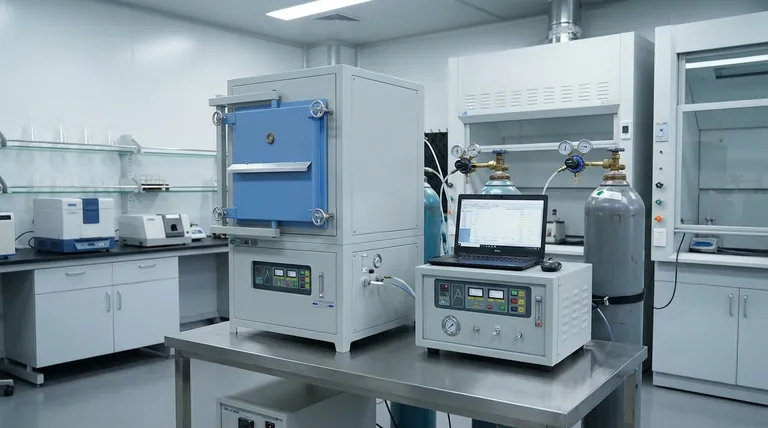
Why Control the Atmosphere? The Core Principle
A standard furnace heats materials in the presence of air, which is roughly 21% oxygen. At high temperatures, this oxygen aggressively reacts with most metals, causing scaling and discoloration. A controlled atmosphere furnace eliminates this variable.
Preventing Oxidation and Contamination
The most fundamental advantage is the prevention of oxidation. By purging the furnace chamber and introducing an inert gas like nitrogen or argon, oxygen is displaced.
This process ensures the material's surface remains clean and bright, preserving its integrity and dimensions. This is critical for parts with tight tolerances or those requiring a pristine surface finish.
Enabling Specific Surface Modifications
Beyond preventing unwanted reactions, controlled atmospheres can be used to induce desirable ones. This is known as active heat treatment.
By introducing reactive gases—such as hydrogen for reduction (cleaning) or hydrocarbon-based gases for carburizing—you can intentionally alter the material's surface chemistry to enhance properties like hardness and wear resistance.
The Foundation: Sealing and Uniform Flow
These advantages are only possible because of the furnace's design. A tightly sealed chamber is essential to prevent ambient air from leaking in and contaminating the controlled environment.
Furthermore, an engineered uniform atmosphere flow ensures every part within the furnace is exposed to the exact same gas composition, guaranteeing consistent and repeatable results across an entire batch.
Translating Control into Operational Gains
The ability to precisely manage the furnace environment directly translates into tangible benefits for your operation, affecting everything from product quality to your bottom line.
Superior Product Quality
By eliminating oxidation and other unwanted chemical reactions, parts emerge from the furnace with a clean, impurity-free surface.
This not only improves the cosmetic appearance but also enhances the material's structural integrity, leading to a higher quality and more reliable final product.
Increased Efficiency and Throughput
A significant amount of time in manufacturing can be lost to secondary operations like sandblasting, grinding, or chemical cleaning to remove scale.
Because controlled atmosphere processing yields cleaner parts, these post-treatment steps are often drastically reduced or eliminated entirely. This shortens the total production cycle, increasing factory throughput.
Reduced Operating Costs
While there is an upfront cost for gases, the overall operating costs are often lower. This is driven by improved energy efficiency and a reduction in rework or scrap material.
Compared to the alternative for high-purity processing—a vacuum furnace—an atmosphere furnace typically represents a lower capital investment and can offer faster cycle times.
Understanding the Trade-offs and Requirements
Achieving these benefits requires a clear understanding of the operational commitments. The furnace is a precision instrument, not a simple oven.
The Criticality of Gas Management
The success of any process hinges on the careful selection and management of gases. You must have the right gas or mixture for your material and desired outcome.
This involves sourcing, storing, and accurately regulating the flow of gases into the chamber, which adds a layer of complexity compared to heating in air.
The Demand for Process Precision
The furnace's capabilities are only realized through a well-defined and repeatable process. Precise temperature control must be paired with precise atmospheric control.
Achieving specific outcomes like brazing or sintering requires developing and adhering to strict process parameters to ensure consistent results batch after batch.
Adherence to Safety Protocols
Handling industrial gases—some of which can be flammable (hydrogen) or asphyxiants (nitrogen)—demands rigorous adherence to safety protocols.
Modern furnaces are equipped with advanced safety systems, but your team must be trained on proper handling procedures to prevent accidents and ensure a safe operating environment.
Making the Right Choice for Your Goal
To determine if a controlled atmosphere furnace is the correct tool, align its capabilities with your primary operational objective.
- If your primary focus is material purity and surface finish: A controlled atmosphere is non-negotiable for preventing oxidation and producing clean, bright parts.
- If your primary focus is reducing total production costs: The reduction in post-processing labor and material scrap often provides a compelling return on investment.
- If your primary focus is enhancing material properties: This furnace is the only way to perform active heat treatments like carburizing or nitriding to improve surface hardness.
- If your primary focus is process consistency: The ability to precisely control all variables ensures a level of repeatability that is impossible to achieve in an air furnace.
By mastering the furnace's atmosphere, you gain direct control over the quality and cost of your final product.
Summary Table:
| Advantage | Key Benefit |
|---|---|
| Prevents Oxidation | Eliminates scaling and discoloration for clean surfaces |
| Improves Product Quality | Enhances structural integrity and reduces defects |
| Increases Efficiency | Reduces post-processing and speeds up production cycles |
| Lowers Operating Costs | Cuts energy use and minimizes scrap and rework |
| Enables Surface Modifications | Allows carburizing or nitriding for better hardness |
Ready to elevate your laboratory's heat treatment processes? At KINTEK, we leverage exceptional R&D and in-house manufacturing to provide advanced high-temperature furnace solutions tailored to your needs. Our product line includes Muffle, Tube, Rotary, Vacuum & Atmosphere Furnaces, and CVD/PECVD Systems, all backed by strong deep customization capabilities to precisely meet your unique experimental requirements. Contact us today to discuss how our controlled atmosphere furnaces can deliver superior quality, efficiency, and cost savings for your operations!
Visual Guide

Related Products
- 1200℃ Controlled Inert Nitrogen Atmosphere Furnace
- 1400℃ Controlled Inert Nitrogen Atmosphere Furnace
- 1700℃ Controlled Inert Nitrogen Atmosphere Furnace
- Mesh Belt Controlled Atmosphere Furnace Inert Nitrogen Atmosphere Furnace
- Controlled Inert Nitrogen Hydrogen Atmosphere Furnace
People Also Ask
- What Roles Do a Controlled Atmosphere Furnace and Oil Quenching Tank Play in AISI 5140 Steel Heat Treatment?
- What are the key benefits of precise temperature control in a controlled atmosphere furnace? Unlock Superior Quality and Efficiency
- What are the operational considerations for a controlled atmosphere furnace? Master Key Factors for Material Processing
- How does a vacuum or controlled atmosphere furnace facilitate sessile-drop experiments? Optimize Alloy Wetting Analysis
- What types of gases are used in controlled atmosphere furnaces? Optimize Material Protection and Transformation



















