
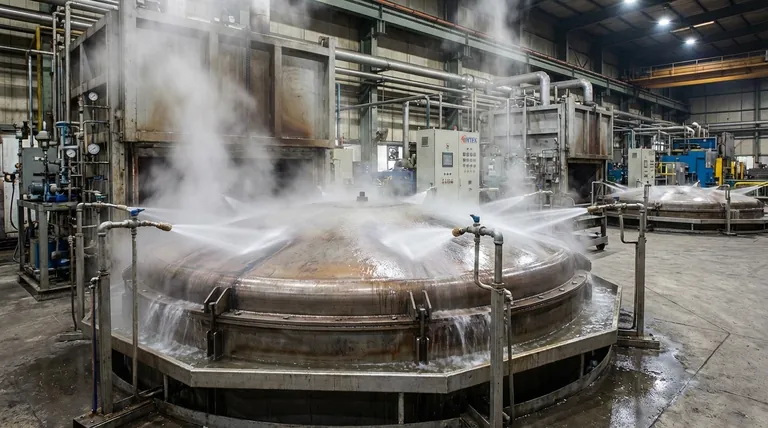
A water-cooling spray system is implemented specifically to forcibly extract heat from the outer wall of the inner cover, creating a cooling intensity significantly higher than air cooling alone. By spraying room-temperature water, operators can drastically shorten the cooling cycle to improve equipment turnover rates while simultaneously regulating the protective gas temperature to prevent mechanical defects in the steel.
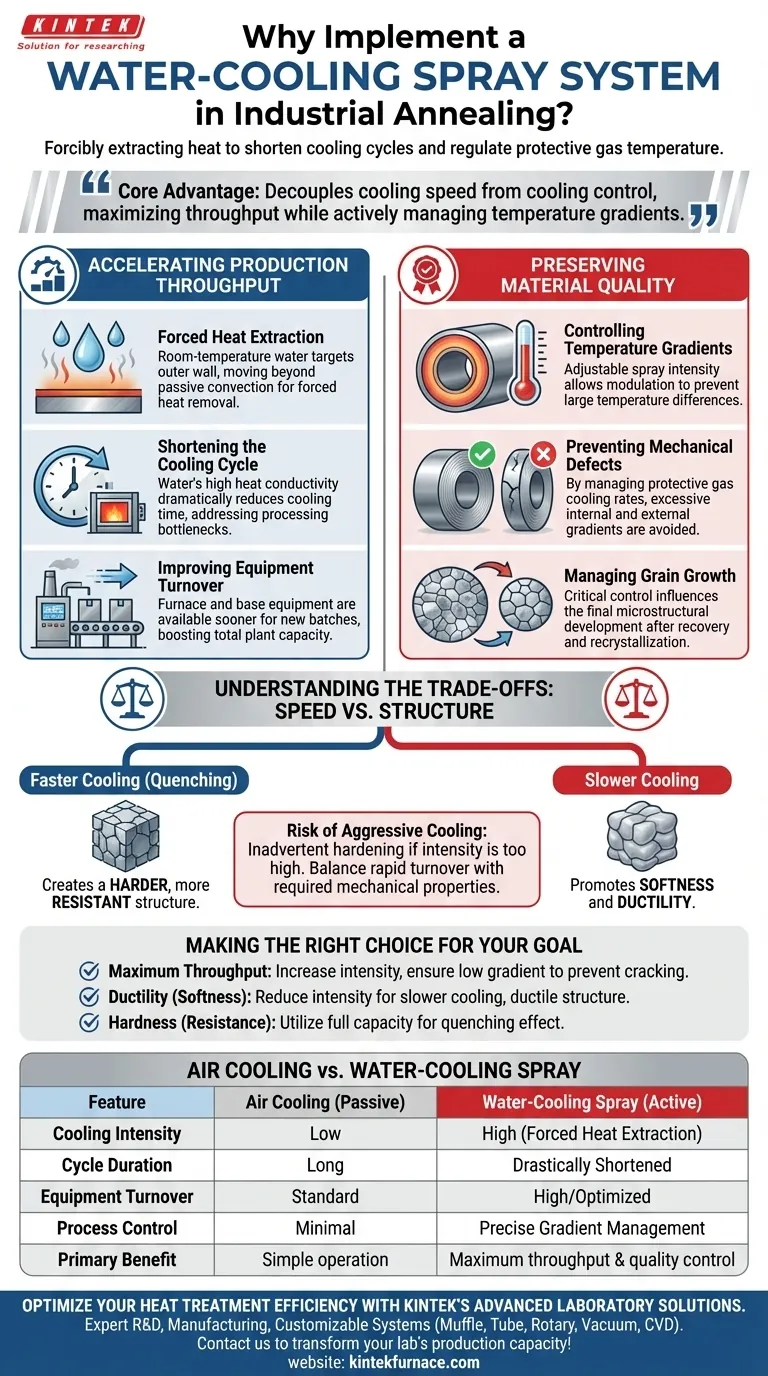
The core advantage of water-cooling spray is its ability to decouple cooling speed from cooling control; it allows for maximized throughput while actively managing temperature gradients to preserve the steel's structural integrity.
Accelerating Production Throughput
Forced Heat Extraction
The primary mechanical function of the spray system is to target the outer wall of the inner cover with room-temperature water. This method moves beyond passive convection, forcibly removing heat from the system.
Shortening the Cooling Cycle
Because water conducts heat more efficiently than air, the system dramatically reduces the time required for the cooling phase. This reduction directly addresses the bottleneck of long processing times common in annealing.
Improving Equipment Turnover
By shortening the cycle, the furnace and base equipment become available for new batches much sooner. This increases the overall equipment turnover rate, boosting the plant's total production capacity without adding new machinery.
Preserving Material Quality
Controlling Temperature Gradients
Rapid cooling carries risks, specifically the creation of large temperature differences between the inner and outer parts of the steel coil. The spray system is designed to be adjustable, allowing operators to modulate intensity.
Preventing Mechanical Defects
By adjusting the spray intensity, operators ensure the cooling rate of the protective gas remains within safe limits. This prevents excessive internal and external temperature gradients, which are the primary cause of mechanical property defects in steel coils.
Managing Grain Growth
The cooling phase is critical for the grain growth stage, which occurs after recovery and recrystallization. The spray system provides the control necessary to influence this final microstructural development.
Understanding the Trade-offs: Speed vs. Structure
The Implication of Cooling Speed
While the primary reference highlights efficiency, the supplementary data clarifies the metallurgical impact. Fast cooling (quenching) creates a harder, more resistant structure, whereas slow cooling promotes softness and ductility.
The Risk of Aggressive Cooling
If the water spray intensity is set too high solely for the sake of speed, you risk inadvertent hardening. You must balance the desire for rapid turnover against the specific mechanical properties required by the end-user.
Balancing Gradients
Even with a spray system, thermal gradients are a physical reality. The system mitigates them, but aggressive use can still lead to uneven cooling if the spray intensity outpaces the material's thermal conductivity.
Making the Right Choice for Your Goal
To optimize your annealing process, you must align the spray intensity with your specific production targets:
- If your primary focus is maximum throughput: Increase spray intensity to shorten the cycle, but ensure the gradient remains low enough to prevent cracking.
- If your primary focus is ductility (softness): Reduce the spray intensity to mimic a slower cooling curve, allowing for a more ductile crystalline structure.
- If your primary focus is hardness (resistance): Utilize the full capacity of the water spray to achieve a quenching effect for a harder material structure.
Ultimately, the water-cooling spray system transforms the cooling phase from a passive wait time into an active, controllable process variable.
Summary Table:
| Feature | Air Cooling (Passive) | Water-Cooling Spray (Active) |
|---|---|---|
| Cooling Intensity | Low | High (Forced Heat Extraction) |
| Cycle Duration | Long | Drastically Shortened |
| Equipment Turnover | Standard | High/Optimized |
| Process Control | Minimal | Precise Gradient Management |
| Primary Benefit | Simple operation | Maximum throughput & quality control |
Optimize your heat treatment efficiency with KINTEK’s advanced laboratory solutions. Backed by expert R&D and manufacturing, KINTEK offers Muffle, Tube, Rotary, Vacuum, and CVD systems—all customizable for your unique material needs. Whether you are targeting maximum throughput or specific ductile properties, our high-temp furnaces provide the precision you require. Contact us today to discover how our custom-engineered systems can transform your lab's production capacity!
Visual Guide
References
- Yang Xiao-jing, Yu-Ren Li. Study of heat transfer model and buried thermocouple test of bell-type annealing furnace based on thermal equilibrium. DOI: 10.1038/s41598-025-97422-4
This article is also based on technical information from Kintek Furnace Knowledge Base .
Related Products
- Controlled Inert Nitrogen Hydrogen Atmosphere Furnace
- Small Vacuum Heat Treat and Tungsten Wire Sintering Furnace
- High Temperature Muffle Oven Furnace for Laboratory Debinding and Pre Sintering
- Vacuum Heat Treat Sintering Furnace with Pressure for Vacuum Sintering
- 1200℃ Controlled Inert Nitrogen Atmosphere Furnace
People Also Ask
- What are the characteristics and uses of hydrogen atmospheres in furnaces? Unlock Clean Metal Processing
- What are the characteristics and uses of hydrogen atmosphere in furnaces? Achieve Superior Surface Purity and Bonding
- Mechanism of Fe81Ga19 Secondary Recrystallization? High-Precision Furnace Control for Goss Grain Growth
- How does a controlled atmosphere furnace contribute to energy efficiency? Lower Costs with Advanced Thermal Management
- Why is controlled atmosphere capability important in an atmosphere furnace? Unlock Precise Material Processing



















