
Switching atmospheres prevents catastrophic structural failure. In industrial debinding, using a nitrogen environment during the initial heating stage prevents the rapid, violent oxidation of resin binders that causes cracking. Once the temperature stabilizes, switching to flowing air allows for the gentle, complete burn-off of remaining carbon, ensuring the final ceramic component is free of pores and micro-cracks.
The Core Insight Optimizing ceramic post-processing requires a "protective then distinct" strategy. The process must transition from an inert environment to an oxidative one to balance the physical stability of the green body with the chemical necessity of total binder removal.
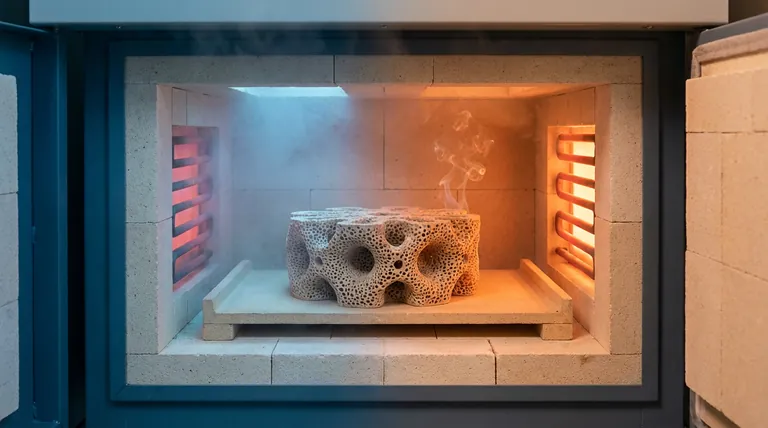
The Role of the Inert Atmosphere
Preventing Rapid Oxidation
The initial stage of debinding is the most volatile. If air were introduced immediately, the organic binders (resins) within the ceramic "green body" would react violently with oxygen.
Protecting Structural Integrity
This rapid reaction would cause sudden gas expansion and thermal spikes. By utilizing Nitrogen, an inert and non-reactive gas, manufacturers create a safe environment where binders can degrade thermally without burning. This prevents the formation of cracks caused by internal pressure.
The Transition to Air
Removing Residual Carbon
While nitrogen prevents cracking, it cannot remove all contaminants. After the initial stage, residual carbon often remains trapped within the ceramic matrix.
The Necessity of Oxygen
To eliminate this residue, the furnace atmosphere is switched to flowing air at higher temperatures. The oxygen in the air reacts with the residual carbon, converting it into gas (CO or CO2) that can be exhausted from the furnace. This step is critical for achieving a pure, high-density final product.
The Importance of Process Control
Precise Temperature Curves
Atmosphere control does not work in isolation. The switching of gases must coincide with specific temperature points over a cycle that often lasts several days.
Eliminating Micro-Defects
This combination of staged atmosphere and slow heating ensures the gradual release of binders. The result is a ceramic component free of micro-cracks and pores, which are the leading causes of part failure in industrial applications.
Understanding the Risks and Trade-offs
The Danger of Rushing
There is often pressure to speed up industrial cycles, but debinding is the bottleneck that cannot be rushed. Introducing air too early in the cycle optimizes for carbon removal but almost guarantees structural fracturing.
The Risk of Incomplete Processing
Conversely, maintaining a nitrogen-only environment for the entire cycle preserves the structure but leaves carbon deposits. This results in a ceramic part with poor mechanical properties and compromised electrical or thermal insulation.
Making the Right Choice for Your Goal
To ensure high-yield ceramic production, align your atmosphere settings with your specific quality metrics:
- If your primary focus is Structural Integrity: Prioritize the duration and stability of the initial nitrogen phase to ensure gentle binder breakdown.
- If your primary focus is Material Purity: Ensure the high-temperature air phase is sufficient to fully oxidize all residual carbon.
- If your primary focus is Defect Prevention: Strictly adhere to the multi-day temperature curve, regardless of atmosphere switching, to minimize thermal shock.
Atmosphere control is not just about cleaning the part; it is about preserving the physics of the material during its most vulnerable state.
Summary Table:
| Debinding Stage | Atmosphere | Primary Function | Outcome Focus |
|---|---|---|---|
| Initial Heating | Nitrogen (Inert) | Prevents rapid oxidation of resin binders | Structural Integrity |
| Stabilization | Transition | Controlled gas exchange | Thermal Stability |
| Final Burn-off | Flowing Air (Oxidative) | Complete removal of residual carbon | Material Purity |
| Entire Cycle | Controlled | Gradual release of binders | Defect Prevention |
Elevate Your Ceramic Production with KINTEK
Don't let debinding bottlenecks compromise your material integrity. Backed by expert R&D and manufacturing, KINTEK offers high-performance Muffle, Tube, Rotary, Vacuum, and CVD systems—all fully customizable to master complex atmosphere transitions from nitrogen to air. Whether you are scaling industrial production or refining lab-scale research, our precision-engineered high-temp furnaces ensure the exact temperature curves and gas control needed to eliminate micro-cracks and maximize yield.
Ready to optimize your thermal processing? Contact our technical experts today to design a furnace solution tailored to your unique needs.
References
- Víctor Meana, Susana Martínez-Pellitero. Additive Manufacturing of Ceramic Reference Spheres by Stereolithography (SLA). DOI: 10.3390/app14177530
This article is also based on technical information from Kintek Furnace Knowledge Base .
Related Products
- High Temperature Muffle Oven Furnace for Laboratory Debinding and Pre Sintering
- Vacuum Dental Porcelain Sintering Furnace for Dental Laboratories
- Custom Made Versatile CVD Tube Furnace Chemical Vapor Deposition CVD Equipment Machine
- Dental Porcelain Zirconia Sintering Ceramic Vacuum Press Furnace
- Multi Heating Zones CVD Tube Furnace Machine for Chemical Vapor Deposition Equipment
People Also Ask
- What thermal phenomena occur during polymer binder burnout in ceramic green bodies? Lab Furnace Guide
- Why is controlled heat treatment in a muffle furnace necessary for calcined clay? Achieve Optimal Pozzolanic Activity
- What role does a high-temperature muffle furnace play in STFO synthesis? Achieve Pure Perovskite Results
- How does a high-temperature muffle furnace facilitate the formation of LaNbxAl1−xO3+δ perovskite structures? Key Roles
- What role does a high-temperature muffle furnace play in the formation of biochar catalysts? Master Catalyst Synthesis













