
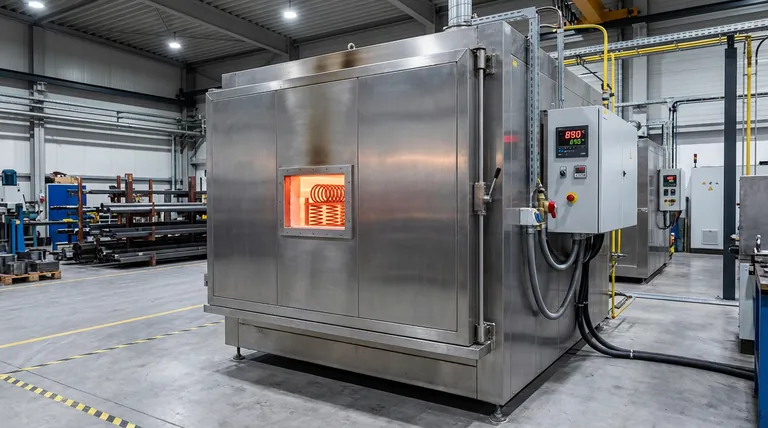
A box resistance furnace serves as the critical thermal control unit during the heat treatment of ultra-high-strength spring steel, specifically driving the austenitization and tempering processes. Its primary function is to provide a stable, precise temperature environment that ensures alloying elements fully dissolve and microstructures are optimized for a balance of durability and elasticity.
Core Takeaway The value of a box resistance furnace lies in its ability to decouple thermal intensity from thermal instability. By maintaining a rigorous constant temperature, it allows for the precise precipitation of carbides and the recovery of martensite, which are the fundamental mechanisms that give spring steel its high strength without improved brittleness.
Facilitating Precise Austenitization
The first critical function of the furnace is preparing the steel's internal structure for hardening through a high-temperature soak.
Creating a Homogeneous Solution
The furnace must maintain a temperature range typically between 860 °C and 950 °C. In this specific thermal window, the furnace ensures that alloying elements are fully dissolved into the austenite phase.
Enabling Solid-State Diffusion
By holding this high temperature steadily, the furnace allows for solid-state diffusion. This ensures that the chemical composition of the steel matrix becomes uniform, eliminating segregation that could lead to weak points in the final spring.
Controlled Tempering for Mechanical Balance
Once the steel has been quenched, the box resistance furnace performs its second vital function: tempering. This stage transforms the steel from a hard, brittle state into a usable, resilient spring.
Recovery of Quenched Martensite
The furnace provides a controlled thermal environment that allows for the moderate recovery of quenched martensite. This process relaxes the highly stressed lattice structure created during quenching, reducing the risk of sudden fracture.
Precipitation of Dispersed Carbides
Precise temperature control is paramount here to trigger the precipitation of finely dispersed carbides. These microscopic structures act as anchors within the steel, significantly enhancing strength while maintaining the necessary toughness for repeated loading.
The Critical Role of Thermal Uniformity
Beyond simply heating the material, the furnace functions as a stabilizer to prevent microstructural inconsistencies.
Preventing Localized Defects
The resistance furnace is designed to minimize thermal gradients. Excellent temperature uniformity ensures that no part of the spring steel experiences localized overheating or insufficient heating, which is essential for consistent performance across the entire component.
Relieving Residual Stresses
Similar to processes used for high-entropy alloys, the furnace facilitates the release of residual stresses generated during forming or quenching. By holding a constant temperature, it promotes the transformation of dislocation structures, enhancing the material's fatigue life.
Understanding the Constraints
While box resistance furnaces are essential for precision, they function based on specific operational principles that carry inherent constraints.
The Requirement for Thermal Soak Time
Unlike induction heating which generates heat internally, resistance furnaces rely on radiation and convection. This requires adequate "soak time" to ensure the core of the material reaches the same temperature as the surface, making cycle times longer.
Sensitivity to Atmosphere
While the furnace controls temperature, standard box furnaces may not inherently control oxidation unless equipped with specific atmosphere controls. Without this, surface scaling can occur during the high-temperature austenitization phase.
Making the Right Choice for Your Goal
To maximize the utility of a box resistance furnace for spring steel, tailor your process parameters to your specific mechanical requirements.
- If your primary focus is Maximum Toughness: Prioritize the precision of the tempering phase, ensuring the furnace holds a steady temperature long enough for full martensitic recovery.
- If your primary focus is Maximum Strength: Focus on the austenitization uniformity (860–950 °C) to ensure complete dissolution of alloying elements before quenching.
Success in heat treating ultra-high-strength spring steel is defined not just by reaching a temperature, but by the stability and uniformity with which that temperature is maintained.
Summary Table:
| Heat Treatment Phase | Primary Furnace Function | Key Temperature Range | Resulting Microstructure |
|---|---|---|---|
| Austenitization | Homogeneous dissolution of alloying elements | 860°C - 950°C | Uniform Austenite |
| Tempering | Controlled recovery & carbide precipitation | Process Specific | Tempered Martensite |
| Stress Relief | Thermal gradient minimization | Constant Hold | Stabilized Dislocation Structure |
Elevate Your Material Performance with KINTEK
Precision is the difference between high-performance spring steel and material failure. Backed by expert R&D and manufacturing, KINTEK offers high-performance Muffle, Tube, Rotary, Vacuum, and CVD systems, all customizable for your unique lab and industrial needs.
Our advanced box resistance furnaces ensure the thermal stability and uniformity required for critical austenitization and tempering cycles. Don't settle for inconsistent results—partner with a leader in high-temperature technology.
Contact KINTEK Today for a Professional Consultation
Visual Guide

References
- Fang Shi, Liqing Chen. Heat Treatment Process, Microstructure, and Mechanical Properties of Spring Steel with Ultra-High Strength and Toughness. DOI: 10.3390/met14020180
This article is also based on technical information from Kintek Furnace Knowledge Base .
Related Products
- Mesh Belt Controlled Atmosphere Furnace Inert Nitrogen Atmosphere Furnace
- 1200℃ Controlled Inert Nitrogen Atmosphere Furnace
- High Pressure Laboratory Vacuum Tube Furnace
- Multi Zone Laboratory Quartz Tube Furnace Tubular Furnace
- 1700℃ Controlled Inert Nitrogen Atmosphere Furnace
People Also Ask
- How is a controlled atmosphere furnace used in material research? Achieve Precise Material Synthesis and Heat Treatment
- What are the two main purposes of controlled atmosphere conditions in furnaces? Protect or Transform Materials for Peak Performance
- How does a controlled atmosphere furnace improve product quality and consistency? Master Precise Heat Treatment for Superior Results
- What types of gases can a controlled atmosphere furnace handle? Master Inert and Reactive Gases for Your Lab
- What types of furnaces have controlled atmosphere furnaces largely replaced? Boost Metallurgical Precision & Safety











