Precision temperature control is the definitive factor in transforming raw biomass into engineered biochar. An electric furnace equipped with this technology ensures the reaction environment remains stable, typically within ±5 °C, guaranteeing that the material’s physical transformation adheres strictly to optimized process curves rather than fluctuating chaotically.
Core Takeaway The physical properties of biochar, such as specific surface area and pore structure, are highly sensitive to thermal variations. A precision controller acts as the "logical brain" of the operation, eliminating temperature spikes that cause structural defects and ensuring the reproducibility required for high-performance applications.
The Critical Link Between Temperature and Performance
Optimizing Surface Area
The performance of biochar is often defined by its specific surface area. This property does not increase linearly; it frequently peaks at specific temperatures, such as 700 °C.
Without precise control, the furnace temperature may drift outside the optimal window. The controller ensures the reaction sustains the exact thermodynamic conditions required to maximize this surface area.
Preserving the Carbon Skeleton
Temperature regulation is the primary defense against structural degradation. If the temperature overshoots the target, the carbon skeleton can crack or collapse.
By maintaining a steady environment, the furnace prevents overheating. This preservation of the carbon matrix is essential for retaining the ideal adsorption activity needed for filtration or soil amendment applications.
Controlling Volatile Release
During pyrolysis, volatile organic compounds must be released steadily to create useful diffusion paths. This is particularly relevant when processing materials like oil palm shells.
A stable temperature (e.g., 600 °C) ensures these compounds exit the matrix at a controlled rate. This creates primary channels within the biochar, which serve as the foundation for subsequent activation steps.
The Mechanism of Precision Control
The Role of Heating Rates
A programmable controller does more than just hold a static temperature; it dictates the heating rate. This can range from slow rates like 1.2 °C/min to faster rates like 10–20 °C/min.
Strict control over the heating rate is beneficial for the stable carbonization of organic matter. It allows for the gradient transformation of components and prevents rapid, destructive degassing that could rupture the material's internal structure.
PID Logic and Error Correction
The controller functions by constantly comparing the measured temperature from sensors against the reference target.
Using Proportional-Integral-Derivative (PID) algorithms, the system calculates precise instructions to modulate power to the heating elements. This allows the furnace to rapidly compensate for heat loss and eliminate fluctuations before they impact the biochar.
Atmosphere Management
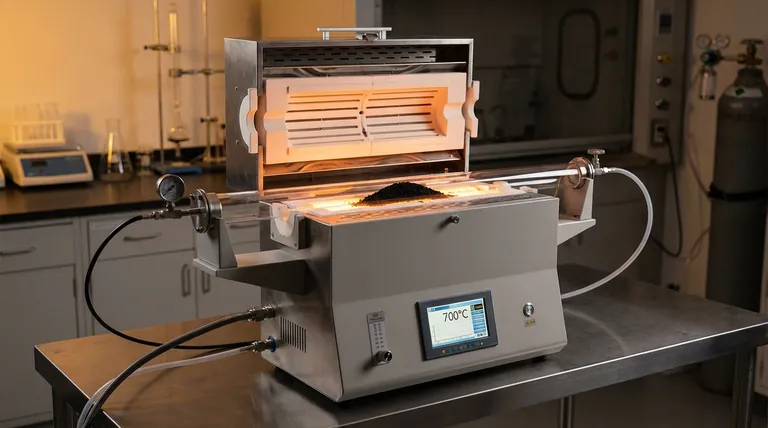
While temperature is the primary variable, tube furnaces often utilize sealed designs to introduce specific gases like high-purity nitrogen.
The controller works in tandem with this atmosphere to create anaerobic or oxygen-controlled environments. This combination determines the final elemental composition and surface functional groups of the biochar.
Understanding the Trade-offs
Process Time vs. Throughput
Achieving high-performance biochar often requires slow, meticulously controlled heating rates (e.g., 1.2 °C/min).
The trade-off is time. While this approach yields superior pore structures and stability, it significantly extends the duration of the pyrolysis cycle compared to faster, less precise methods.
Complexity of Optimization
Precision control reveals that different properties emerge at different temperatures. For example, the volatilization efficiency of heavy metals varies significantly between 400 °C and 600 °C.
This sensitivity means that a single "perfect" temperature does not exist for all applications. Operators must conduct extensive testing to determine the specific process curve that balances yield, surface area, and chemical stability for their specific goal.
Making the Right Choice for Your Goal
To leverage a precision electric furnace effectively, align your programming with your desired material outcome:
- If your primary focus is maximum adsorption capacity: Target a stable temperature around 700 °C to maximize specific surface area, ensuring the controller limits fluctuation to ±5 °C.
- If your primary focus is structural integrity: Program a slower heating rate (e.g., 1.2 °C to 10 °C/min) to allow for the steady release of volatiles without cracking the carbon skeleton.
- If your primary focus is heavy metal study: Utilize the programmable features to isolate specific temperature ranges (400 °C vs. 600 °C) to distinguish volatilization efficiencies.
True high-performance biochar is not merely burnt biomass; it is a material engineered through the rigorous application of stable thermal energy.
Summary Table:
| Parameter | Role of Precision Controller | Impact on Biochar Performance |
|---|---|---|
| Temperature Stability | Maintains ±5 °C accuracy | Prevents structural collapse and maximizes specific surface area |
| Heating Rate Control | Managed ramps (1.2–20 °C/min) | Ensures steady volatile release and avoids internal matrix cracking |
| Thermal Uniformity | Eliminates hot spots/spikes | Guarantees reproducible pore structures and chemical stability |
| Atmosphere Synergy | Works with anaerobic gas flow | Determines elemental composition and surface functional groups |
Elevate Your Biochar Engineering with KINTEK
Precise thermal processing is the bridge between raw biomass and high-performance engineered carbon. KINTEK provides the cutting-edge tools necessary to achieve this transition. Backed by expert R&D and world-class manufacturing, we offer a comprehensive range of Muffle, Tube, Rotary, Vacuum, and CVD systems, all of which are fully customizable to meet your specific pyrolysis and carbonization requirements.
Whether you are maximizing adsorption capacity or researching heavy metal volatilization, our high-temp lab furnaces deliver the ±5 °C stability your research demands. Contact KINTEK today to discuss your unique needs with our technical team and discover how our precision heating solutions can optimize your material outcomes.
References
- Alibek Mutushev, Dauren Mukhanov. Development and application of microcapsules based on rice husk and metallurgical sludge to improve soil fertility. DOI: 10.1038/s41598-024-73329-4
This article is also based on technical information from Kintek Furnace Knowledge Base .
Related Products
- Electric Rotary Kiln Continuous Working Small Rotary Furnace Kiln for Pyrolysis Plant Heating
- 1700℃ Controlled Inert Nitrogen Atmosphere Furnace
- Spark Plasma Sintering SPS Furnace
- 1200℃ Controlled Inert Nitrogen Atmosphere Furnace
- Electric Rotary Kiln Pyrolysis Furnace Plant Machine Small Rotary Kiln Calciner
People Also Ask
- What are the advantages of electric rotary kilns compared to fuel-fired ones? Boost Precision and Efficiency in Your Process
- What materials can be processed in an electric rotary kiln? Versatile Solutions for Advanced Materials
- What advantages do electric rotary kilns offer over fuel-based kilns? Boost Efficiency and Purity in Your Process
- What are the primary applications of electric rotary kilns? Precision Thermal Processing for High-Value Materials
- How do electric rotary kilns achieve high thermal efficiency? Unlock Over 95% Thermal Efficiency