
Beyond acting as a simple vessel for shaping powder, graphite molds serve as the primary mechanical and thermal interface in the hot press sintering process. They function as a critical transmission medium, bridging the gap between external hydraulic forces and the internal microstructure of the material while withstanding extreme environments.
Core Takeaway Graphite molds are active process enablers that drive densification by transmitting significant uniaxial pressure and ensuring thermal uniformity. Their high-temperature strength allows them to convert hydraulic force into particle rearrangement, while their chemical stability generally prevents erosion during the sintering cycle.
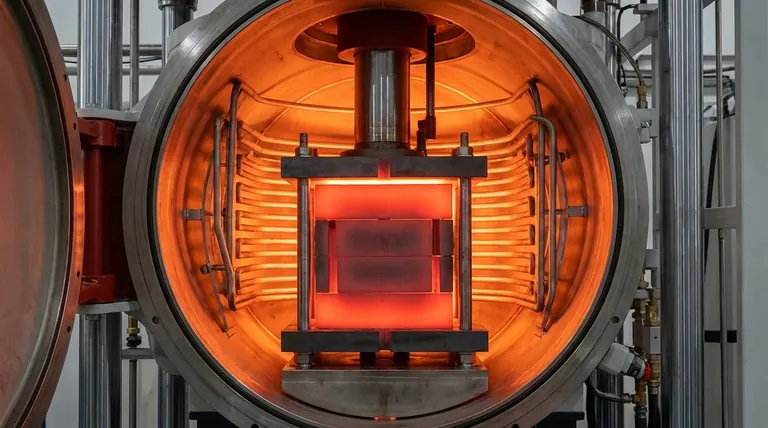
The Mechanics of Densification
Efficient Pressure Transmission
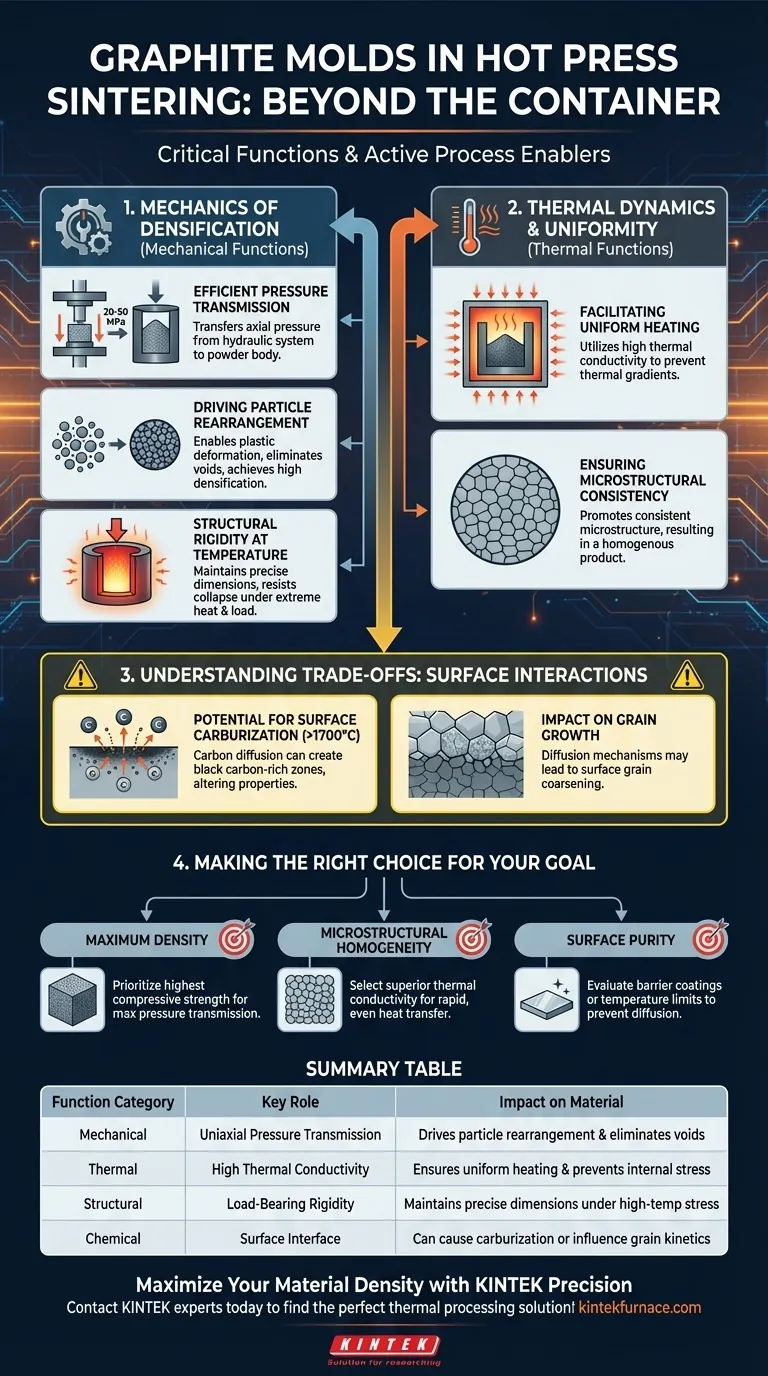
The primary active function of the graphite mold is to act as a load-bearing medium. It directly transfers the axial pressure (typically ranging from 20 MPa to 50 MPa) from the hydraulic system to the powder body within.
Driving Particle Rearrangement
By effectively transmitting this mechanical force, the mold enables the plastic deformation and rearrangement of powder particles. This mechanical action is essential for eliminating voids and achieving the high densification required for high-performance bulk materials.
Structural Rigidity at Temperature
To function correctly, the mold must possess exceptional high-temperature strength. It acts as a rigid constraint that will not deform or collapse under heavy loads, ensuring the final product maintains precise dimensions despite the extreme heat and pressure.
Thermal Dynamics and Uniformity
Facilitating Uniform Heating
Graphite’s excellent thermal conductivity is utilized to transfer heat evenly from the furnace elements to the internal powder sample. This function is vital for preventing thermal gradients that could lead to warping or internal stresses.
Ensuring Microstructural Consistency
By ensuring the sample is heated uniformly, the mold promotes a consistent microstructure throughout the material. This prevents localized disparities in grain growth or density, resulting in a homogenous final product.
Understanding the Trade-offs: Surface Interactions
While the primary reference highlights the chemical stability of graphite, it is critical to recognize specific limitations at the extremes of the process.
Potential for Surface Carburization
At extremely high temperatures (e.g., above 1700°C), the chemical inertness of the mold can degrade. Carbon from the mold may diffuse into the sample surface, creating black carbon-rich zones that can alter thermal and mechanical properties.
Impact on Grain Growth
Direct contact between the graphite and the sample can occasionally influence surface grain kinetics. Diffusion mechanisms at the interface may lead to surface grain coarsening, which requires careful consideration during process design.
Making the Right Choice for Your Goal
To optimize your sintering process, align your mold strategy with your specific material requirements:
- If your primary focus is Maximum Density: Prioritize mold designs and graphite grades with the highest compressive strength to maximize the transmission of uniaxial pressure (up to 50 MPa) without deformation.
- If your primary focus is Microstructural Homogeneity: Select graphite grades with superior thermal conductivity to ensure rapid and even heat transfer to the powder core.
- If your primary focus is Surface Purity at Extreme Temperatures: Evaluate the need for barrier coatings or temperature limits to prevent carbon diffusion and surface carburization.
The graphite mold is not merely a container; it is a sophisticated tool that dictates the mechanical and thermal success of the sintering cycle.
Summary Table:
| Function Category | Key Role of Graphite Mold | Impact on Material |
|---|---|---|
| Mechanical | Uniaxial Pressure Transmission | Drives particle rearrangement and eliminates voids |
| Thermal | High Thermal Conductivity | Ensures uniform heating and prevents internal stress |
| Structural | Load-Bearing Rigidity | Maintains precise dimensions under high-temp stress |
| Chemical | Surface Interface | Can cause carburization or influence grain kinetics |
Maximize Your Material Density with KINTEK Precision
Don't let subpar tooling compromise your research. Backed by expert R&D and manufacturing, KINTEK offers specialized Muffle, Tube, Rotary, Vacuum, and CVD systems, alongside high-performance lab furnaces customizable for your unique sintering needs. Whether you are aiming for maximum density or microstructural homogeneity, our equipment provides the stability and control you require.
Contact KINTEK experts today to find the perfect thermal processing solution for your laboratory!
Visual Guide
Related Products
People Also Ask
- Why are vacuum heat treating furnaces essential for aerospace? Ensure Superior Material Integrity for High-Stakes Applications
- What is the primary application of vacuum heat treating furnaces in aerospace? Enhance Component Performance with Precision
- How does a vacuum heat treating furnace improve the condition of metal alloys? Achieve Superior Metal Performance
- How does vacuum heat treating work in terms of temperature and time control? Master Precise Material Transformations
- What is the process of vacuum heat treating? Achieve Superior Metallurgical Properties
