A vacuum sealing device protects the experimental environment by physically isolating specimens within heat-resistant glass tubes and subjecting them to a critical pre-heating treatment. This preparation ensures that any volatile elements are managed before the actual high-temperature compression test begins.
Core Takeaway: By proactively eliminating residual gases and encapsulating the specimen, vacuum sealing prevents vacuum chamber contamination. This safeguards the pressure stability and atmospheric purity necessary for valid high-temperature experimental data.
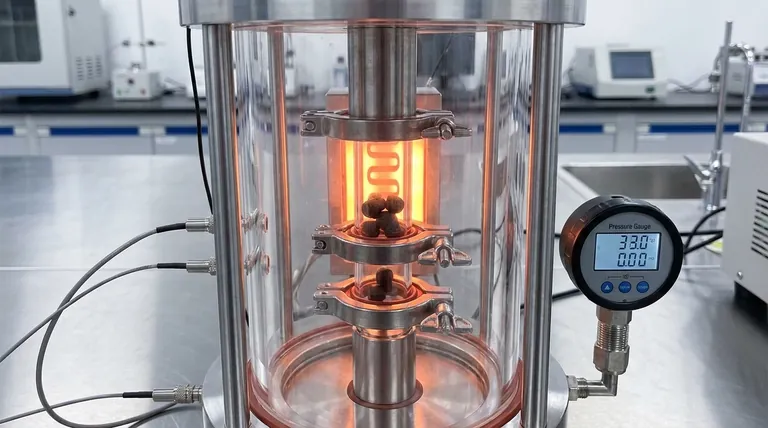
The Mechanism of Protection
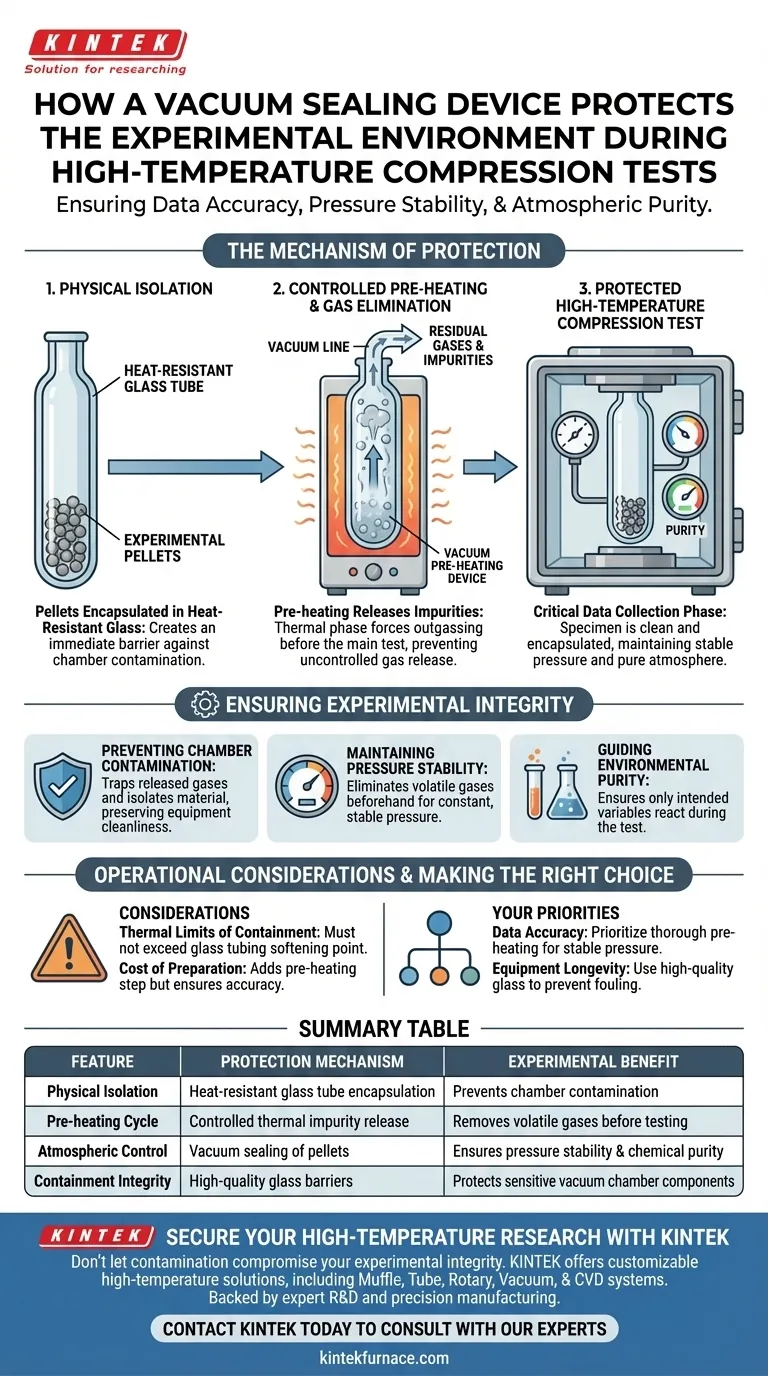
Physical Isolation
The device secures the experimental pellets inside heat-resistant glass tubes. This creates an immediate physical barrier between the raw specimen material and the sensitive internal components of the vacuum chamber.
Controlled Pre-heating
Before the high-temperature compression occurs, the device performs a pre-heating treatment. This thermal phase is designed to activate and release impurities while the specimen is still safely contained.
Elimination of Residual Gases
The primary threat to a high-temperature vacuum environment is outgassing. The sealing and pre-heating process effectively forces the pellets to release residual gases prior to the main experiment. This prevents an uncontrolled release of gas during the critical data-collection phase.
Ensuring Experimental Integrity
Preventing Chamber Contamination
By trapping released gases and isolating the material, the device avoids contamination of the vacuum chamber. This preserves the cleanliness of the equipment for current and future tests.
Maintaining Pressure Stability
High-temperature environments are sensitive to pressure fluctuations. By removing volatile gases beforehand, the device ensures pressure stability remains constant throughout the compression test.
Guiding Environmental Purity
The ultimate goal of this protection is to maintain a pure experimental atmosphere. Sealing ensures that the only variables reacting during the compression test are the ones you intend to measure.
Operational Considerations
Thermal Limits of Containment
The protection relies heavily on the integrity of the heat-resistant glass. Operators must ensure the test temperatures do not exceed the softening point of the glass tubing, or the seal—and the protection—will fail.
The Cost of Preparation
Implementing this protection adds a pre-heating step to the workflow. While this increases the time required per sample, it is a non-negotiable trade-off for data accuracy in high-precision environments.
Making the Right Choice for Your Goal
To maximize the reliability of your high-temperature compression tests, consider the following priorities:
- If your primary focus is data accuracy: Prioritize a thorough pre-heating cycle to ensure all residual gases are eliminated before compression begins, guaranteeing stable pressure.
- If your primary focus is equipment longevity: Use high-quality heat-resistant glass tubes to prevent specimen material from permanently fouling the interior of your vacuum chamber.
Effective vacuum sealing is the fundamental step that transforms a volatile experiment into a controlled, measurable scientific process.
Summary Table:
| Feature | Protection Mechanism | Experimental Benefit |
|---|---|---|
| Physical Isolation | Heat-resistant glass tube encapsulation | Prevents chamber contamination from specimens |
| Pre-heating Cycle | Controlled thermal impurity release | Removes volatile gases before critical testing |
| Atmospheric Control | Vacuum sealing of pellets | Ensures pressure stability and chemical purity |
| Containment Integrity | High-quality glass barriers | Protects sensitive vacuum chamber components |
Secure Your High-Temperature Research with KINTEK
Don't let contamination compromise your experimental integrity. KINTEK offers a full suite of customizable high-temperature solutions, including Muffle, Tube, Rotary, Vacuum, and CVD systems designed for the most demanding lab environments. Backed by expert R&D and precision manufacturing, we provide the tools you need for stable, reproducible, and pure results.
Ready to optimize your lab’s efficiency and data accuracy? Contact KINTEK Today to Consult with Our Experts
Visual Guide
Related Products
- Ultra Vacuum Electrode Feedthrough Connector Flange Power Lead for High Precision Applications
- Vacuum Sealed Continuous Working Rotary Tube Furnace Rotating Tube Furnace
- CF KF Flange Vacuum Electrode Feedthrough Lead Sealing Assembly for Vacuum Systems
- Ultra-High Vacuum Flange Aviation Plug Glass Sintered Airtight Circular Connector for KF ISO CF
- Stainless Steel Quick Release Vacuum Chain Three Section Clamp
People Also Ask
- Why is a high-precision vacuum sealing system necessary for CrSb? Ensure Pure Crystal Growth & Prevent Oxidation
- Why is an Ultra-High Vacuum (UHV) System Required for In2Se3? Achieving Atomic-Level Ferroelectric Clarity
- What is the function of quartz vacuum encapsulation in RhSeCl CVT? Mastering Pure Crystal Growth
- Why is vacuum sealing technology essential for K2In2As3 synthesis? Master High-Purity Solid-State Reactions
- What role do vacuum-sealed high-purity silica ampoules play in phase equilibrium experiments? Enhance Sample Integrity