
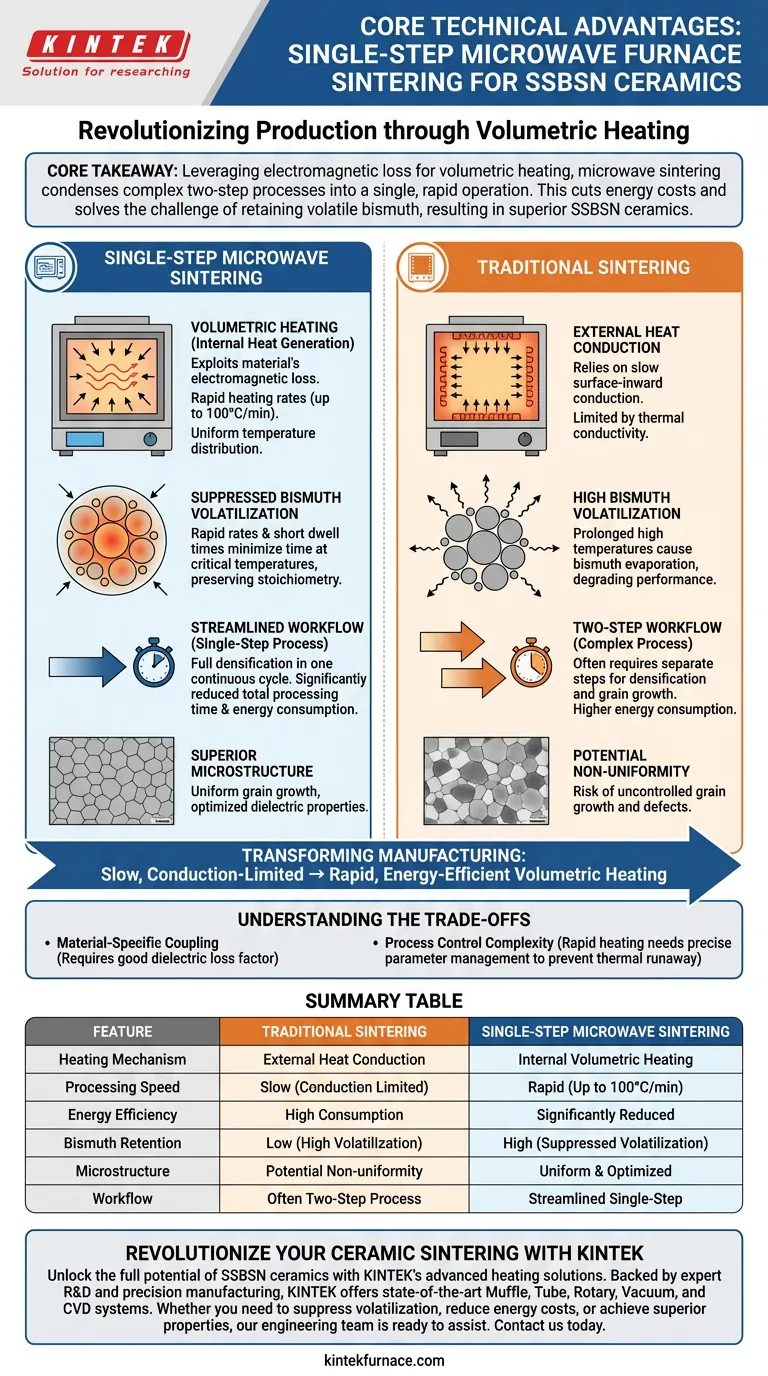
Single-step microwave furnace sintering revolutionizes the production of SSBSN ceramics primarily through volumetric heating. Unlike traditional methods that rely on external heat conduction, this technique utilizes the material's own electromagnetic loss to generate heat internally, resulting in rapid heating rates, significantly reduced energy consumption, and the critical suppression of bismuth volatilization.
Core Takeaway By leveraging electromagnetic loss for volumetric heating, microwave sintering condenses complex two-step processes into a single, rapid operation. This not only cuts energy costs but also solves the specific challenge of retaining volatile bismuth elements, directly resulting in SSBSN ceramics with superior microstructure and dielectric properties.
The Mechanics of Volumetric Heating
Internal Heat Generation
The fundamental technical shift in this process is volumetric heating. Instead of applying heat to the surface, the microwave system exploits the electromagnetic loss of the SSBSN material itself.
This causes the material to generate heat from within via direct coupling with ceramic dipoles. The energy transfer is immediate and permeates the entire volume of the material simultaneously.
Overcoming Thermal Conductivity Limits
Traditional resistance furnaces rely on heat conducting from the surface inward. This is often a slow process limited by the ceramic's thermal conductivity.
Microwave sintering eliminates this bottleneck. Because heat is generated uniformly throughout the material, the system achieves rapid heating rates (potentially up to 100°C per minute) that traditional furnaces cannot safely match without causing thermal stress.
Operational and Microstructural Benefits
Streamlining the Workflow
Standard processing for these ceramics often requires a traditional two-step sintering profile to manage densification and grain growth.
Microwave technology simplifies this into a single-step process. The rapid heating and uniform temperature distribution allow full densification in one continuous cycle, significantly reducing total processing time and energy consumption.
Suppressing Bismuth Volatilization
A critical challenge in sintering SSBSN ceramics is the tendency for bismuth elements to volatilize (evaporate) at high temperatures. Loss of bismuth alters the stoichiometry and degrades performance.
The rapid heating rates and shorter dwell times of microwave sintering effectively suppress this volatilization. By minimizing the time the material spends at critical temperatures, the chemical composition remains stable.
Superior Material Properties
The combination of rapid heating and retained chemical composition leads to a more uniform microstructure.
Because the process inhibits uncontrolled grain growth and preserves bismuth content, the final ceramic exhibits superior dielectric properties. This makes the material more effective for its intended electronic applications compared to traditionally sintered counterparts.
Understanding the Trade-offs
Material-Specific Coupling
Microwave sintering is not universally applicable in the same way a resistance furnace is; it relies on the material's ability to absorb microwave energy.
The efficiency of the process depends heavily on the dielectric loss factor of the specific SSBSN formulation. If the material does not couple well with the microwave frequency, heating may be inefficient or require hybrid heating methods.
Process Control Complexity
While the process simplifies the steps, it increases the need for precise control parameters.
Because heating is so rapid, the window for error is smaller. Operators must strictly manage power input to prevent "thermal runaway," where the material heats uncontrollably in localized hot spots, potentially cracking the ceramic.
Making the Right Choice for Your Goal
When evaluating whether to transition from traditional sintering to single-step microwave sintering for SSBSN production, consider your primary constraints:
- If your primary focus is Compositional Integrity: Choose microwave sintering to suppress bismuth volatilization and ensure consistent stoichiometry.
- If your primary focus is Operational Efficiency: Choose microwave sintering to reduce cycle times and lower energy costs by consolidating two steps into one.
- If your primary focus is Component Performance: Choose microwave sintering to achieve a uniform microstructure with optimized dielectric properties.
Ultimately, microwave sintering transforms the manufacturing of SSBSN ceramics from a slow, thermal-conduction-limited process into a rapid, energy-efficient volumetric heating event.
Summary Table:
| Feature | Traditional Sintering | Single-Step Microwave Sintering |
|---|---|---|
| Heating Mechanism | External Heat Conduction | Internal Volumetric Heating |
| Processing Speed | Slow (Conduction Limited) | Rapid (Up to 100°C/min) |
| Energy Efficiency | High Consumption | Significantly Reduced |
| Bismuth Retention | Low (High Volatilization) | High (Suppressed Volatilization) |
| Microstructure | Potential Non-uniformity | Uniform & Optimized |
| Workflow | Often Two-Step Process | Streamlined Single-Step |
Revolutionize Your Ceramic Sintering with KINTEK
Unlock the full potential of SSBSN ceramics with KINTEK’s advanced heating solutions. Backed by expert R&D and precision manufacturing, KINTEK offers state-of-the-art Muffle, Tube, Rotary, Vacuum, and CVD systems, along with customizable lab high-temp furnaces designed to meet your unique material specifications.
Whether you need to suppress element volatilization, reduce energy costs, or achieve superior dielectric properties, our engineering team is ready to assist. Contact us today to discuss how our tailored furnace technology can enhance your lab's efficiency and material performance.
Visual Guide
References
- Anurag Pritam, Susanta Sinha Roy. Multiple relaxation mechanisms in SrBi2Nb2O9 ceramic tweaked by tin and samarium incorporation in assistance with single-step microwave sintering. DOI: 10.1007/s00339-024-07482-y
This article is also based on technical information from Kintek Furnace Knowledge Base .
Related Products
- 1200℃ Muffle Oven Furnace for Laboratory
- 1400℃ Muffle Oven Furnace for Laboratory
- High Temperature Muffle Oven Furnace for Laboratory Debinding and Pre Sintering
- Laboratory Muffle Oven Furnace with Bottom Lifting
- 1800℃ High Temperature Muffle Oven Furnace for Laboratory
People Also Ask
- How does a high-temperature laboratory muffle furnace affect material properties? Transform Anodic Oxide Films Fast
- What is the primary function of a high-temperature laboratory muffle furnace in chemical synthesis? Achieve Precision.
- How is a laboratory muffle furnace used in 3D-printed PP-CF cross-linking? Achieve Thermal Stability at 150 °C
- How is a laboratory high-temperature muffle furnace used to evaluate porous Co-Al materials? Precision Thermal Analysis
- Why is a laboratory high-temperature muffle furnace used for BaTiO3? Achieve Optimal Tetragonal Crystalline Phases



















