
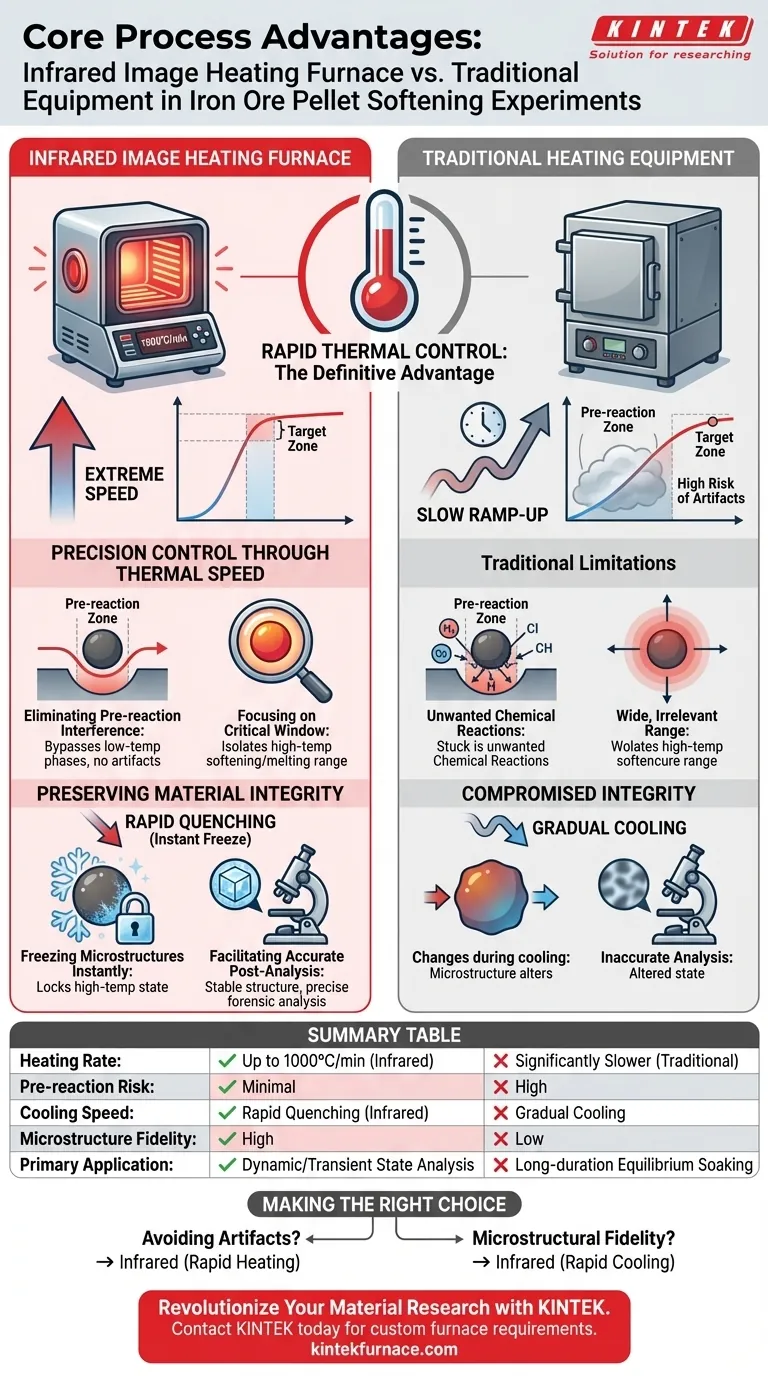
Rapid thermal control is the definitive advantage. An infrared image heating furnace distinguishes itself from traditional equipment through exceptional heating and cooling rates, capable of reaching up to 1000°C/min. This extreme speed allows researchers to bypass irrelevant low-temperature phases and focus entirely on the critical softening and melting behavior of pre-reduced iron ore pellets.
By enabling extreme heating speeds and rapid quenching, infrared furnaces prevent unwanted pre-reactions and "freeze" material states instantly. This ensures that the microstructure analyzed reflects the exact conditions at the target temperature, rather than artifacts formed during slow cooling.
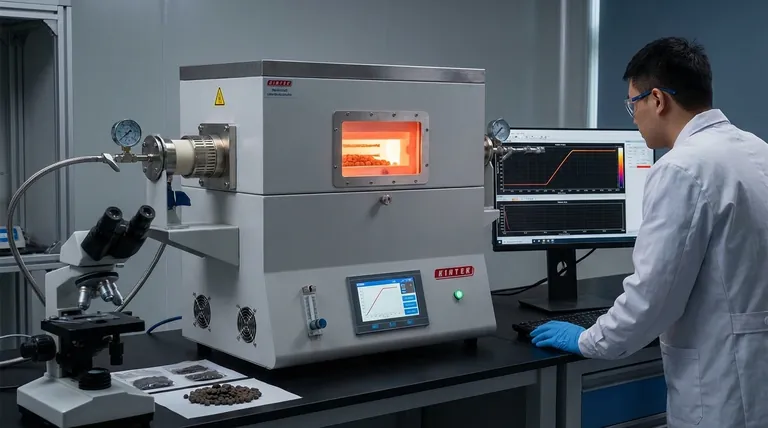
Precision Control Through Thermal Speed
Eliminating Pre-reaction Interference
Traditional heating methods often involve a slow ramp-up in temperature. This creates a window where unwanted chemical reactions can occur before the target zone is reached.
Infrared heating bypasses this issue completely. The rapid heating capability effectively avoids unnecessary pre-reactions. This ensures the pellet reaches the critical softening phase in the exact chemical state intended by the researcher.
Focusing on the Critical Window
Iron ore pellet softening experiments often require data from a very specific, high-temperature range.
This equipment allows you to isolate that range. By accelerating through lower temperatures, the experiment focuses precisely on where pre-reduced pellets soften and melt, maximizing the relevance of the data collected.
Preserving Material Integrity for Analysis
Freezing Microstructures Instantly
The benefits of this technology extend beyond heating; the rapid cooling function is equally critical.
When an experiment concludes, the furnace can drop temperatures quickly. This effectively "locks" the microstructure of the pellets at that specific moment in time.
Facilitating Accurate Post-Analysis
Because the cooling is instant, the physical structure does not change during the cool-down phase.
This stability facilitates accurate subsequent physical structure analysis. Researchers can trust that the sample they examine under a microscope represents the material's state at high temperature, not a state altered by slow cooling.
Operational Considerations
Specificity of Application
While powerful, this technology is specialized. It is designed specifically to capture transient states and high-temperature behaviors.
It is less suited for processes requiring gradual thermal equilibrium or long-duration soaking at lower temperatures. Its primary value lies in dynamic experiments where time and reaction state are critical variables.
Making the Right Choice for Your Experiment
To determine if an infrared image heating furnace is the right tool for your specific iron ore research, consider your primary analytical goals:
- If your primary focus is Avoiding Artifacts: Rapid heating ensures your data is not corrupted by pre-reactions that occur during slow temperature ramp-ups.
- If your primary focus is Microstructural Fidelity: The rapid cooling feature allows you to capture a definitive snapshot of the material's internal structure at the exact moment of melting.
By leveraging these extreme thermal rates, you transform your experiment from a general observation into a precise forensic analysis of material behavior.
Summary Table:
| Feature | Infrared Image Heating Furnace | Traditional Heating Equipment |
|---|---|---|
| Heating Rate | Up to 1000°C/min | Significantly Slower Ramp-up |
| Pre-reaction Risk | Minimal (Bypasses low-temp phases) | High (Slow heating causes artifacts) |
| Cooling Speed | Rapid Quenching (Instant Freeze) | Gradual Cooling |
| Microstructure Fidelity | High (Preserves high-temp state) | Low (Changes during cooling) |
| Primary Application | Dynamic/Transient State Analysis | Long-duration Equilibrium Soaking |
Revolutionize Your Material Research with KINTEK
Don't let slow thermal transitions compromise your experimental data. At KINTEK, we understand that precision in iron ore pellet analysis requires extreme control. Backed by expert R&D and manufacturing, we offer a comprehensive range of Muffle, Tube, Rotary, Vacuum, and CVD systems, including specialized high-temp furnaces customizable for your unique research needs.
Whether you need to freeze microstructures instantly or eliminate pre-reaction interference, our laboratory solutions provide the reliability you demand. Contact KINTEK today to discuss your custom furnace requirements and ensure your next analysis reflects the exact conditions of your target temperature.
Visual Guide
Related Products
- Multi Heating Zones CVD Tube Furnace Machine for Chemical Vapor Deposition Equipment
- 2200 ℃ Graphite Vacuum Heat Treat Furnace
- Laboratory Quartz Tube Furnace RTP Heating Tubular Furnace
- Split Multi Heating Zone Rotary Tube Furnace Rotating Tube Furnace
- Vacuum Heat Treat Furnace with Ceramic Fiber Liner
People Also Ask
- What is the function of a multi-zone tube furnace in CVD synthesis? Master 2D In2Se3 Nanosheet Precision
- What temperature-related capabilities make multi zone tube furnaces valuable for research? Unlock Precision Thermal Control
- Why are multi zone tube furnaces particularly useful for nanomaterial research? Unlock Precise Thermal Control for Advanced Synthesis
- What environmental protection applications utilize multi zone tube furnaces? Unlock Precision in Waste Treatment and Green Tech
- What role do multi zone tube furnaces play in new energy research? Unlock Precise Thermal Control for Innovation



















