
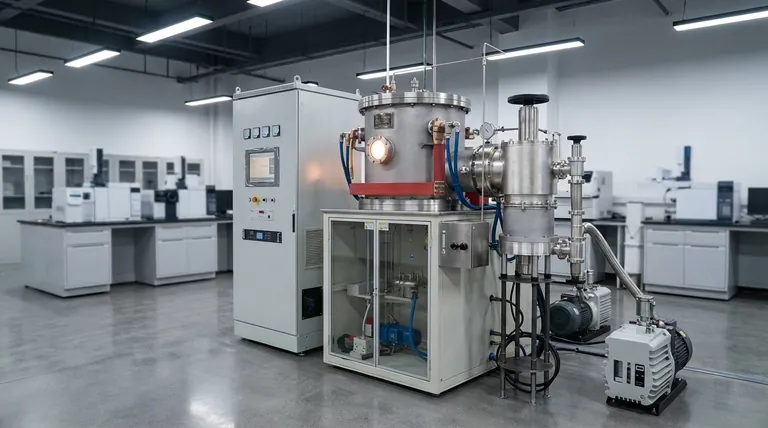
Industrial high vacuum pyrolysis furnaces differ fundamentally from mechanical methods by utilizing thermal decomposition rather than physical force to separate materials. While mechanical stripping relies on abrasion or crushing, vacuum pyrolysis applies precise heat to break down the chemical bonds of binders, allowing for the clean release of active materials from current collectors.
Core Takeaway High vacuum pyrolysis offers a higher quality of material recovery than mechanical methods by effectively eliminating organic impurities and ensuring thorough stripping. However, this method introduces significant technical risks; without precise temperature uniformity, you face the immediate threat of embrittling the aluminum foil and contaminating your material stream.
How Vacuum Pyrolysis Achieves Separation
Thermal Decomposition of Binders
Unlike mechanical methods that physically force materials apart, pyrolysis targets the chemical adhesion.
The furnace uses high temperatures to decompose or carbonize the binders that glue the active materials to the current collectors.
Elimination of Adhesion
Once the binder is chemically altered or destroyed, the adhesion between the layers is effectively eliminated.
This allows the active material to detach naturally without the need for aggressive physical impact that might damage the structure of the materials.
Advantages Over Mechanical Stripping
Superior Stripping Completeness
The primary advantage of pyrolysis is the depth of the separation.
Compared to mechanical techniques, which may leave material clinging to the foil, high vacuum pyrolysis offers more thorough stripping, maximizing the recovery rate of valuable active materials.
Removal of Organic Contaminants
Mechanical separation often fails to address microscopic organic residues.
Pyrolysis excels here by burning off or removing organic impurities, specifically carbon black. This results in a purer end-product compared to the output of purely mechanical lines.
Critical Operational Trade-offs
The Requirement for Temperature Uniformity
The effectiveness of pyrolysis hinges on precision.
The system requires extremely high temperature uniformity throughout the furnace chamber. Inconsistent heating is not a minor efficiency loss; it is a critical process failure mode.
Risk of Aluminum Embrittlement
If temperature control fluctuates or exceeds specific limits, the aluminum foil current collectors can become brittle.
Embrittled foil fragments easily, making it difficult to separate from the active material later, effectively undoing the benefits of the process.
Management of Metallic Impurities
High-temperature processing carries inherent contamination risks.
Poor thermal management can lead to the introduction of excess metallic impurities into the active material. This compromises the purity gained by removing the organic contaminants.
Making the Right Choice for Your Goal
To determine if high vacuum pyrolysis is the correct approach for your facility, weigh the purity requirements against your ability to control thermal variables.
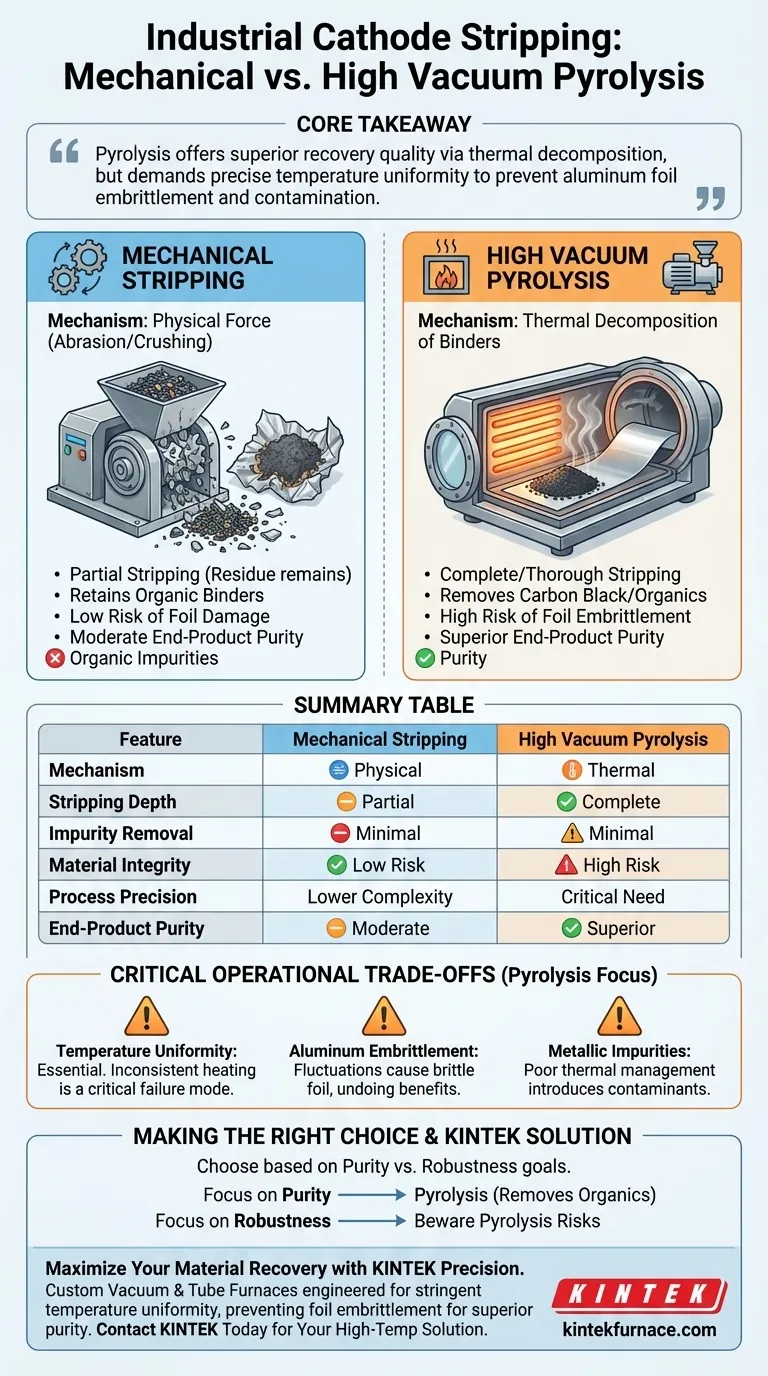
- If your primary focus is Material Purity: Pyrolysis is the superior choice, as it removes organic impurities like carbon black that mechanical methods miss.
- If your primary focus is Process Robustness: Be aware that pyrolysis requires stringent temperature uniformity to avoid the critical pitfalls of foil embrittlement and metallic contamination.
Successful implementation depends less on the furnace's power and more on its ability to maintain a chemically precise thermal environment.
Summary Table:
| Feature | Mechanical Stripping | High Vacuum Pyrolysis |
|---|---|---|
| Mechanism | Physical force (abrasion/crushing) | Thermal decomposition of binders |
| Stripping Depth | Partial (residue often remains) | Complete/Thorough stripping |
| Impurity Removal | Minimal (retains organic binders) | High (removes carbon black/organics) |
| Material Integrity | Low risk of foil damage | High risk of foil embrittlement |
| Process Precision | Lower complexity | Critical need for temperature uniformity |
| End-Product Purity | Moderate | Superior (pure active material) |
Maximize Your Material Recovery with KINTEK Precision
Don't let inconsistent thermal control compromise your cathode recovery. KINTEK provides high-performance, customizable Vacuum and Tube furnace systems engineered specifically for the stringent temperature uniformity requirements of industrial pyrolysis. Our expert R&D and manufacturing team ensures your equipment prevents foil embrittlement while achieving maximum stripping completeness for superior material purity.
Ready to upgrade your battery recycling efficiency?
Contact KINTEK Today to Design Your Custom High-Temp Solution
Visual Guide
References
- Muammer Kaya, Hossein Delavandani. State-of-the-Art Lithium-Ion Battery Pretreatment Methods for the Recovery of Critical Metals. DOI: 10.3390/min15050546
This article is also based on technical information from Kintek Furnace Knowledge Base .
Related Products
- High Pressure Laboratory Vacuum Tube Furnace
- 2200 ℃ Tungsten Vacuum Heat Treat and Sintering Furnace
- Molybdenum Vacuum Heat Treat Furnace
- Vacuum Induction Melting Furnace
- 9MPa Air Pressure Vacuum Heat Treat and Sintering Furnace
People Also Ask
- What role does a high vacuum tube furnace play in Co-Al sintering? Master High-Purity Porous Material Synthesis
- What are the different types of tube furnaces available? Find the Perfect Fit for Your Lab's Needs
- What are the main advantages of vacuum tube furnaces in the market? Achieve Purity and Precision in Material Processing
- What is the role of a vacuum tube furnace during the final thermal treatment stage of Fe3O4@CSAC catalysts?
- What conditions do tube furnaces provide for Au-Seeded TiO2 nanowires? Master Precision Thermal Synthesis



















