
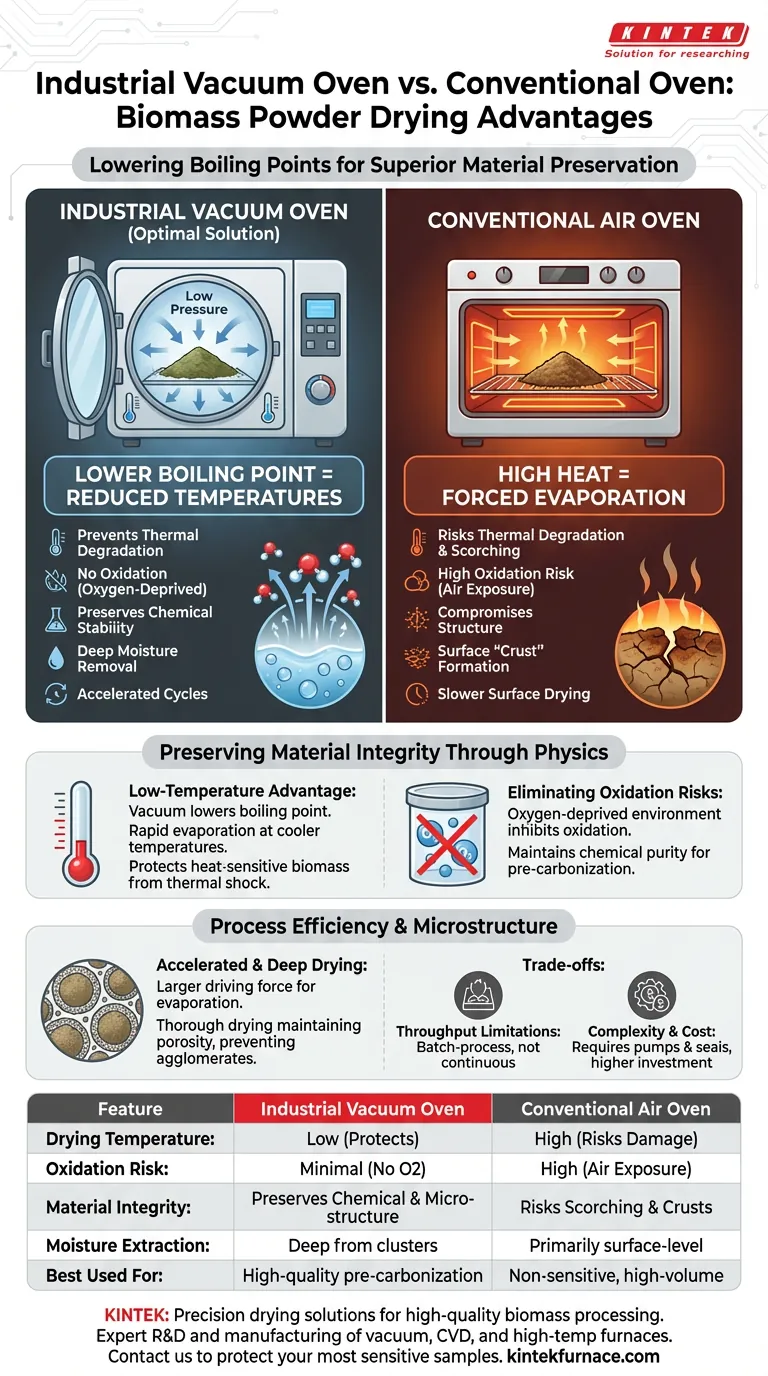
The primary advantage of using an industrial vacuum oven for biomass powders is the ability to lower the boiling point of moisture, enabling evaporation at significantly reduced temperatures. This protects the biomass from the thermal degradation and oxidation associated with conventional high-temperature air ovens, ensuring the material remains chemically stable for subsequent stages like pre-carbonization.
By manipulating pressure rather than just temperature, vacuum ovens decouple drying speed from thermal stress. This allows you to rapidly remove moisture while preserving the delicate chemical structure of biomass materials, a critical requirement for high-quality downstream processing.
Preserving Material Integrity Through Physics
The Low-Temperature Advantage
Conventional ovens rely on high heat to force evaporation, which can be destructive to organic materials. In contrast, a vacuum oven reduces the ambient pressure within the chamber.
This pressure drop lowers the boiling point of water and other solvents. Consequently, moisture evaporates rapidly at much cooler temperatures, protecting heat-sensitive biomass from thermal shock.
Preventing Thermal Degradation
Biomass powders are often susceptible to breaking down when exposed to the high heat required by standard atmospheric drying.
By operating at lower temperatures, vacuum drying prevents the breakdown of the raw material's structure. This ensures that the essential properties of the biomass are retained for the next phase of production.
Enhancing Chemical Stability
Eliminating Oxidation Risks
In a conventional oven, heating powder in the presence of air often leads to unwanted oxidation. This is particularly problematic for biomass intended for carbonization or chemical processing.
Vacuum ovens operate in an oxygen-deprived environment. This mechanism effectively inhibits oxidation and side reactions, ensuring the chemical purity of the powder surface is maintained.
Preparing for Pre-Carbonization
For biomass powders destined for carbonization, surface chemistry is vital. The primary goal of preliminary drying is not just moisture removal, but stabilization.
Using a vacuum oven ensures the material remains chemically stable. This creates a predictable, high-quality baseline for the pre-carbonization stage, leading to better final product consistency.
Process Efficiency and Microstructure
Accelerated Drying Cycles
Despite using lower temperatures, the drying process in a vacuum oven is often faster than conventional methods.
The vacuum environment creates a larger driving force for evaporation. This shortens the overall drying cycle, improving throughput without compromising the material's integrity.
Deep Moisture Removal
Biomass powders can form agglomerates that trap moisture deep within their structure. Standard air drying often forms a "crust" that traps this liquid inside.
The pressure differential in a vacuum oven helps draw moisture and air bubbles out from deep within powder clusters. This ensures a thorough dry and helps maintain porosity, preventing the formation of hard, unusable agglomerates.
Understanding the Trade-offs
While vacuum drying offers superior quality for biomass, it is essential to recognize the operational differences compared to conventional ovens.
Throughput Limitations
Vacuum ovens are typically batch-process units. They generally cannot match the continuous, high-volume throughput of large conveyor-belt air ovens used for less sensitive materials.
Complexity and Cost
These systems require vacuum pumps, seals, and pressure-rated chambers. This results in a higher initial capital investment and slightly more complex maintenance requirements than simple convective heat ovens.
Making the Right Choice for Your Goal
To determine if an industrial vacuum oven is the correct solution for your specific biomass application, consider your end-goals:
- If your primary focus is material quality and purity: Choose a vacuum oven to strictly prevent oxidation and thermal degradation, ensuring the biomass remains chemically stable.
- If your primary focus is process speed for heat-sensitive materials: Utilize the vacuum's ability to lower boiling points, allowing for rapid moisture removal without the risk of scorching or structural damage.
Ultimately, if your biomass powder requires strict chemical stability before carbonization, the vacuum oven is not just an alternative—it is a technical necessity.
Summary Table:
| Feature | Industrial Vacuum Oven | Conventional Air Oven |
|---|---|---|
| Drying Temperature | Low (protects heat-sensitive biomass) | High (risks thermal degradation) |
| Oxidation Risk | Minimal (oxygen-deprived environment) | High (exposure to air at heat) |
| Material Integrity | Preserves chemical & micro-structure | Risks scorching and 'crust' formation |
| Moisture Extraction | Deep extraction from powder clusters | Primarily surface-level drying |
| Best Used For | High-quality pre-carbonization feedstock | Non-sensitive, high-volume materials |
Precision drying is the foundation of high-quality biomass processing. Backed by expert R&D and manufacturing, KINTEK offers specialized vacuum, CVD, and high-temp furnace systems designed to maintain the chemical purity of your materials. Whether you are prepping powders for carbonization or need a customizable solution for unique lab requirements, our team is ready to help. Contact KINTEK today to discover how our advanced vacuum technology can enhance your product consistency and protect your most sensitive samples.
Visual Guide
References
- Rohit Yadav, Kusum Kumari. Synthesis and Electrochemical Characterization of Activated Porous Carbon Derived from Walnut Shells as an Electrode Material for Symmetric Supercapacitor Application. DOI: 10.3390/engproc2023059175
This article is also based on technical information from Kintek Furnace Knowledge Base .
Related Products
- Vacuum Heat Treat Sintering and Brazing Furnace
- Vacuum Heat Treat Sintering Furnace Molybdenum Wire Vacuum Sintering Furnace
- Vacuum Hot Press Furnace Machine for Lamination and Heating
- Dental Porcelain Zirconia Sintering Ceramic Vacuum Press Furnace
- Vacuum Hot Press Furnace Machine Heated Vacuum Press
People Also Ask
- What are the benefits of using vacuum heat treating furnaces for metal alloys? Achieve Superior Metal Properties and Performance
- What is one of the most important uses of vacuum heat treating furnaces in aerospace? Achieve Superior Strength in Aircraft Alloys
- How does vacuum heat treating affect the grain structure of metal alloys? Achieve Precise Microstructure Control
- What is the temperature of a vacuum furnace brazing? Optimize Your Joint Strength and Cleanliness
- What are the steps involved in a typical vacuum brazing treatment? Master the Process for Strong, Clean Joints




