
The primary advantage of using a vacuum freeze dryer is the preservation of the delicate silica gel framework through sublimation. By removing moisture as vapor directly from ice, this method avoids the liquid-phase evaporation forces that typically crush structures in conventional ovens, resulting in spherical silica nanoparticles with smaller diameters (10–20 nm) and significantly higher specific surface areas.
Core Takeaway Conventional drying relies on evaporation, which creates capillary forces that pull particles together, leading to structural collapse. Vacuum freeze drying bypasses the liquid phase entirely, allowing the silica framework to retain its intended shape, porosity, and distribution without undergoing hard agglomeration.
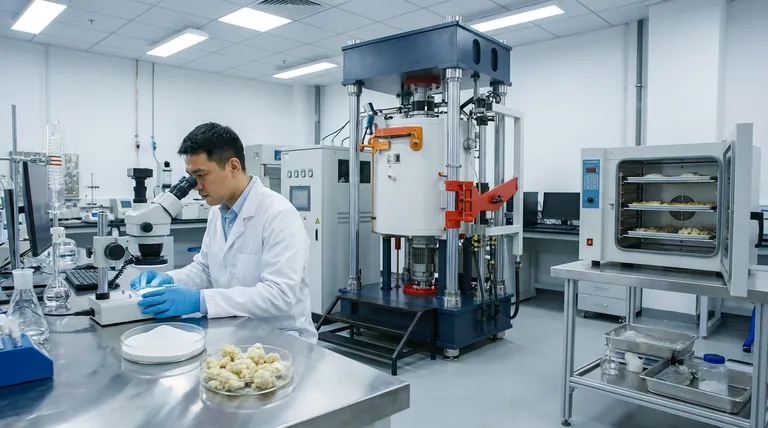
The Mechanics of Morphology Control
Sublimation Over Evaporation
The fundamental difference lies in how moisture is removed. A vacuum freeze dryer operates by sublimating ice directly into water vapor.
This effectively bypasses the liquid state entirely. In contrast, a conventional oven relies on heating liquid water until it evaporates, which subjects the material to a completely different set of physical forces.
Eliminating Capillary Forces
During the liquid-phase evaporation typical of conventional ovens, surface tension creates powerful capillary forces between particles.
These forces pull the solid network together as the liquid recedes. By freezing the structure first and removing the ice via vacuum, freeze drying eliminates these capillary forces, protecting the integrity of the silica pores.
Specific Impact on Silica Characteristics
Prevention of Hard Agglomeration
When capillary forces are active, silica particles tend to bind together tightly, a phenomenon known as hard agglomeration.
Vacuum freeze drying prevents this densification. The result is a powder where particles remain distinct and loosely associated, rather than fused into large, irregular clumps.
Superior Particle Dimensions
The reduction in thermal stress and physical force yields a superior geometric profile.
While oven-dried particles may collapse or grow unevenly, freeze-dried silica nanoparticles typically emerge as uniform spheres. They maintain significantly smaller diameters, specifically in the 10–20 nm range.
Understanding the Trade-offs: The Risks of Conventional Heating
Thermal Stress and Collapse
Conventional ovens introduce significant thermal stress to the material.
The combination of heat and the receding liquid meniscus often leads to the collapse of the gel framework. This results in a material with lower porosity and a reduced specific surface area, which compromises the functional quality of the nanoparticles.
Uniformity Issues
Using a standard oven often leads to irregular drying rates and uneven particle distribution.
Freeze drying ensures a more uniform distribution of particle sizes. This consistency is critical for applications requiring precise surface area interactions or specific packing densities.
Making the Right Choice for Your Goal
To maximize the performance of your silica nanoparticles, select your drying method based on your specific morphological requirements.
- If your primary focus is High Surface Area: Use vacuum freeze drying to prevent pore collapse and maximize the active surface area of the silica.
- If your primary focus is Particle Size Control: Choose freeze drying to achieve ultra-fine, spherical particles in the 10–20 nm range without aggregation.
- If your primary focus is Cost/Speed (and morphology is secondary): A conventional oven may be sufficient, but accept that hard agglomeration and larger particle sizes are likely outcomes.
The choice of drying method is not merely about water removal; it is the final, defining step in engineering the architecture of your nanomaterial.
Summary Table:
| Feature | Vacuum Freeze Drying | Conventional Drying Oven |
|---|---|---|
| Mechanism | Sublimation (Solid to Gas) | Evaporation (Liquid to Gas) |
| Capillary Forces | Eliminated | High (Causes structural collapse) |
| Particle Size | 10–20 nm (Uniform spheres) | Larger, irregular clusters |
| Surface Area | Significantly higher | Reduced due to densification |
| Agglomeration | Loosely associated particles | Hard agglomeration (fused clumps) |
| Structure | Preserved gel framework | Collapsed framework |
Elevate Your Material Engineering with KINTEK
Precision in morphology requires precision in equipment. Backed by expert R&D and manufacturing, KINTEK offers high-performance vacuum freeze dryers and a comprehensive range of laboratory solutions including Muffle, Tube, Rotary, Vacuum, and CVD systems. Whether you are synthesizing 10nm silica nanoparticles or developing complex lab-scale thermal processes, our systems are fully customizable to meet your unique research needs.
Ready to achieve superior particle uniformity and high specific surface areas? Contact KINTEK today to find your perfect drying solution!
References
- Shengwang Yuan, Yunhai Ma. A Comparative Study on Rice Husk, as Agricultural Waste, in the Production of Silica Nanoparticles via Different Methods. DOI: 10.3390/ma17061271
This article is also based on technical information from Kintek Furnace Knowledge Base .
Related Products
- Vacuum Hot Press Furnace Machine for Lamination and Heating
- Vacuum Hot Press Furnace Machine Heated Vacuum Press
People Also Ask
- What are the primary components of a vacuum hot press furnace? Master the Core Systems for Precise Material Processing
- What are the benefits of the vacuum environment system in a vacuum hot press furnace? Unlock High-Density Sintering
- What safety features are incorporated in vacuum hot press furnaces? Ensure Operator and Equipment Protection
- What industries benefit from the use of vacuum hot press furnaces? Unlock High-Performance Materials for Your Industry
- Why is a high vacuum environment crucial when preparing copper-carbon nanotube composites in a vacuum hot press furnace? Achieve Superior Composite Integrity

