
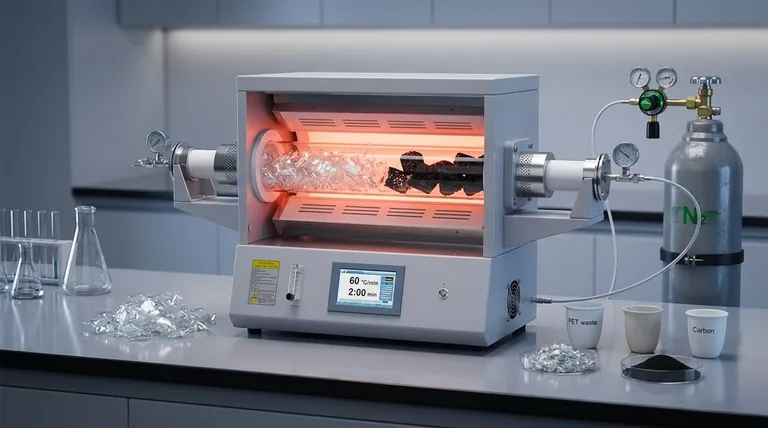
The distinct advantage of using a laboratory infrared heating furnace lies in its superior energy efficiency and processing speed. By utilizing radiation heat transfer, these furnaces achieve heating rates of up to 60 °C/min, reducing the exposure time required for polyethylene terephthalate (PET) conversion to approximately two minutes. Compared to traditional electric furnaces, this method cuts energy consumption by roughly half while facilitating the development of specific porous carbon structures.
Infrared heating transforms the PET upcycling process by shifting from convection to efficient radiation transfer. This creates a high-speed, low-energy thermal environment that not only accelerates production but also enhances the structural quality of the resulting carbon material.
The Mechanics of Rapid Conversion
Harnessing Radiation Transfer
Conventional heating methods often rely on heating the air or a carrier gas to transfer thermal energy to the material. In contrast, infrared furnaces utilize a radiation heat transfer mechanism. This allows energy to be delivered directly to the PET waste, bypassing the inefficiencies of heating the surrounding environment first.
Extreme Heating Rates
The direct nature of infrared radiation enables drastic acceleration in temperature ramp-up. While traditional methods may lag, infrared furnaces can sustain heating rates of up to 60 °C/min.
Minimal Exposure Time
Because the target temperature is reached so quickly, the total processing time is significantly compressed. The exposure time required for the thermal treatment phase drops to approximately 2 minutes. This is a fraction of the time required by conventional thermal treatments.
Energy and Economic Implications
50% Reduction in Energy Use
Speed translates directly to savings. Because the furnace operates for a much shorter duration to achieve the same result, it consumes only about half the energy required by traditional electric furnaces. This makes the conversion of PET waste into value-added carbon significantly more economically viable.
Targeted Efficiency
The efficiency stems from the technology's ability to focus energy. As noted in similar applications like cellulose pyrolysis, infrared technology creates selective heating characteristics. It targets the sample material to reach decomposition temperatures rapidly, rather than wasting energy maintaining high temperatures in the surrounding carrier gas.
Material Quality and Control
Formation of Porous Structures
Speed and efficiency do not come at the cost of quality. The primary reference indicates that infrared heating actively facilitates the formation of specific porous structures within the carbon.
Preventing Secondary Degradation
The physics of infrared heating allows for a beneficial temperature gradient. While the sample heats rapidly, the surrounding environment (such as nitrogen gas) remains at a relatively lower temperature. This helps prevent secondary thermal degradation, ensuring the volatile components evolved during conversion are not destroyed by excessive ambient heat.
Understanding the Process Variables
Precision is Critical
While the heating rate of 60 °C/min is an advantage, it requires precise control. The rapid rise in temperature must be managed carefully to ensure the specific porous structures form correctly without collapsing or over-degrading the material.
Scale of Operation
The technology described is specific to a laboratory infrared heating furnace. While the efficiency gains are massive (50% energy reduction), scaling this radiation-based transfer to industrial volumes often requires complex engineering to ensure uniform heating across larger batches of waste.
Making the Right Choice for Your Goal
To determine if infrared heating is the correct approach for your PET conversion project, consider your primary constraints:
- If your primary focus is Process Efficiency: Infrared heating is the superior choice, offering a 50% reduction in energy consumption and rapid 2-minute processing times.
- If your primary focus is Material Structure: The radiation mechanism is recommended as it facilitates the formation of specific porous networks that conventional heating may not achieve as effectively.
- If your primary focus is Throughput: The high heating rates allow for rapid batch turnover, though you must verify the equipment's capacity for your required volume.
By leveraging the speed and selectivity of infrared radiation, you can convert environmental waste into high-value porous carbon with a fraction of the energy traditionally required.
Summary Table:
| Feature | Infrared Heating Furnace | Conventional Electric Furnace |
|---|---|---|
| Heating Rate | Up to 60 °C/min | Significantly Slower |
| Processing Time | Approx. 2 Minutes | Extended Duration |
| Energy Consumption | ~50% Lower | Higher |
| Heat Transfer | Direct Radiation | Convection/Conduction |
| Material Quality | Facilitates Porous Structures | Risk of Secondary Degradation |
Revolutionize Your Material Research with KINTEK
Maximize your laboratory's efficiency and achieve precision in PET waste upcycling. Backed by expert R&D and manufacturing, KINTEK offers high-performance Muffle, Tube, Rotary, Vacuum, and CVD systems, alongside advanced infrared solutions. All our lab high-temp furnaces are fully customizable to meet your unique research needs.
Ready to cut your energy consumption by 50%? Contact us today to find the perfect thermal processing solution for your lab.
References
- М. Н. Ефимов, Г. П. Карпачева. Application of Infrared Pyrolysis and Chemical Post-Activation in the Conversion of Polyethylene Terephthalate Waste into Porous Carbons for Water Purification. DOI: 10.3390/polym16070891
This article is also based on technical information from Kintek Furnace Knowledge Base .
Related Products
- 1200℃ Muffle Oven Furnace for Laboratory
- 1400℃ Muffle Oven Furnace for Laboratory
- Laboratory Quartz Tube Furnace RTP Heating Tubular Furnace
- 1800℃ High Temperature Muffle Oven Furnace for Laboratory
- 1400℃ Controlled Inert Nitrogen Atmosphere Furnace
People Also Ask
- How does a high-temperature laboratory muffle furnace affect material properties? Transform Anodic Oxide Films Fast
- What is the primary function of a high-temperature laboratory muffle furnace in chemical synthesis? Achieve Precision.
- How is a laboratory muffle furnace used in 3D-printed PP-CF cross-linking? Achieve Thermal Stability at 150 °C
- Why is a laboratory high-temperature muffle furnace required for LaNixFe1-xO3 catalysts? Optimize Two-Stage Synthesis
- What is the role of a laboratory high-temperature muffle furnace in iron analysis? Key to Precise Sample Mineralization











