
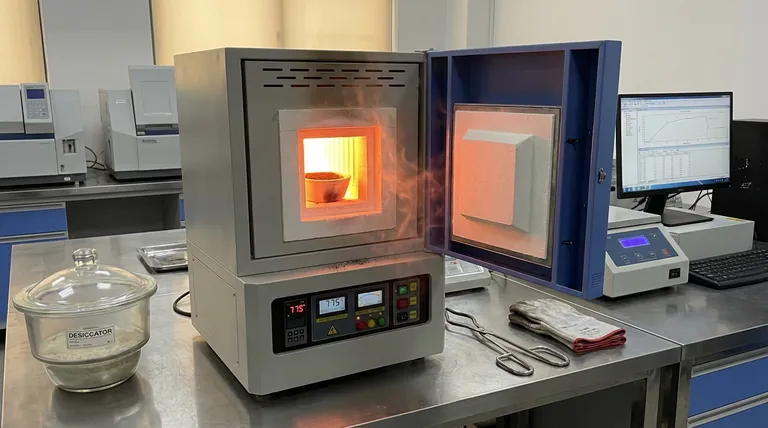
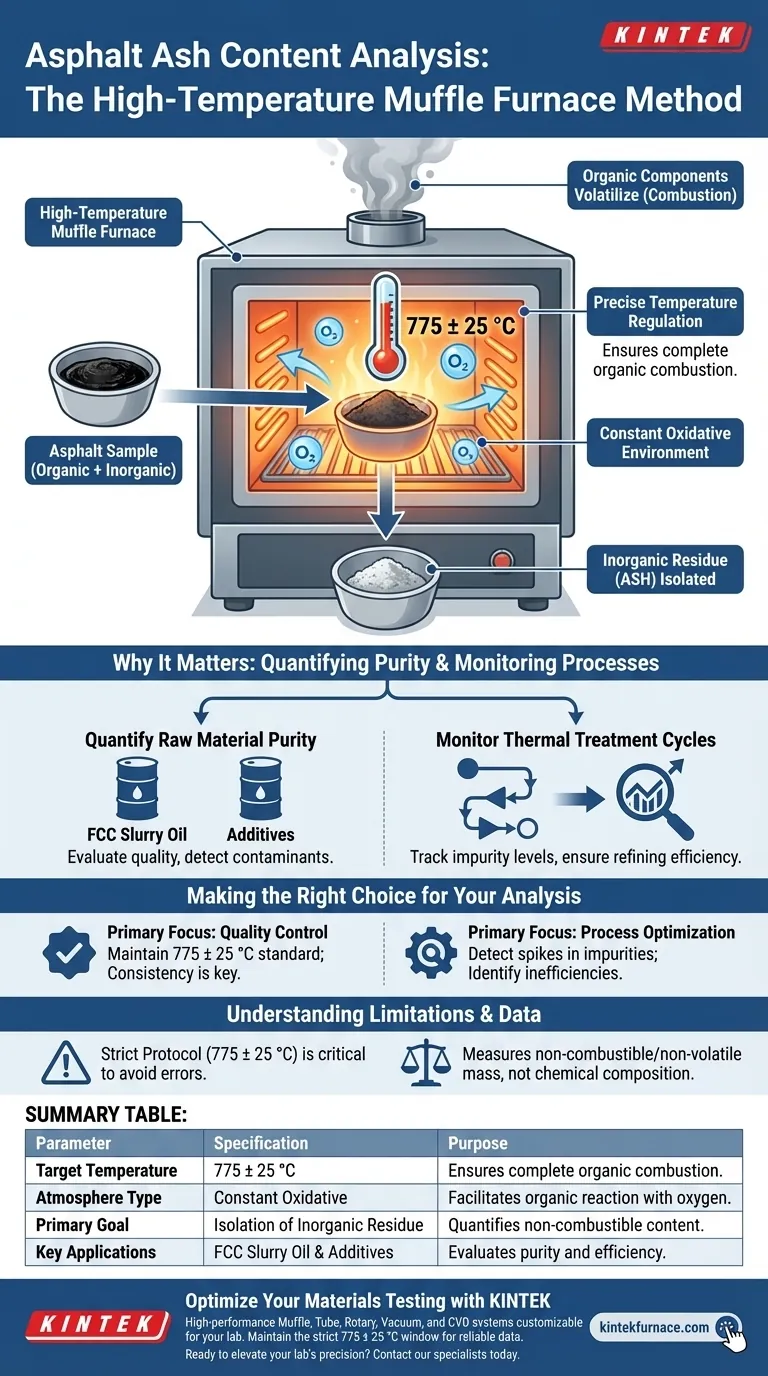
To determine the ash content of asphalt samples, a high-temperature muffle furnace is utilized to create a controlled, constant oxidative environment specifically at 775 ± 25 °C. This intense thermal treatment ensures the complete combustion of all organic components within the asphalt, leaving behind only the inorganic residues required for analysis.
The muffle furnace serves as a definitive separation tool, isolating non-combustible impurities from the organic hydrocarbon matrix to accurately quantify the purity of raw materials.
The Mechanics of Asphalt Ashing
Precise Temperature Regulation
The reliability of this method hinges on strict thermal control.
For asphalt specifically, the furnace must maintain a temperature of 775 ± 25 °C. This specific range is high enough to ensure total combustion of complex hydrocarbons but controlled enough to preserve the integrity of the inorganic residue.
Creating an Oxidative Environment
The muffle furnace is designed to provide a constant oxidative atmosphere.
As the asphalt sample is heated, the organic matter reacts with oxygen and volatilizes. This process continues until every trace of carbon-based material is consumed.
Isolation of Inorganic Residue
The ultimate goal of this thermal cycle is the isolation of "ash."
Once the organic components have been incinerated, only the inorganic residues remain. This residue represents the non-combustible mineral content of the original sample.
Why Asphalt Ash Content Matters
Quantifying Raw Material Purity
This method is essential for evaluating the quality of raw inputs.
It is particularly critical for analyzing materials like Fluid Catalytic Cracking (FCC) slurry oil and various asphalt additives. High ash content often indicates the presence of contaminants that could compromise the performance of the final product.
Monitoring Thermal Treatment Cycles
Beyond initial testing, this process enables continuous quality control.
Researchers use the data derived from ash content to monitor impurity levels throughout the entire thermal treatment cycle. This ensures that the refining or blending processes are functioning within specified parameters.
Understanding the Limitations
Strict Adherence to Protocol
The specific temperature window (775 ± 25 °C) is not a suggestion; it is a technical requirement.
Deviating from this range introduces error. Temperatures that are too low may result in incomplete combustion (false high ash), while excessive temperatures could volatize certain inorganic salts (false low ash).
Non-Volatile vs. Non-Combustible
It is important to distinguish what the furnace actually measures.
The furnace determines which parts of the sample are non-combustible and non-volatile at the set temperature. It does not identify the chemical composition of the ash, only its mass relative to the original sample.
Making the Right Choice for Your Analysis
To ensure your data is actionable, align your procedural focus with your specific analytical goals:
- If your primary focus is Quality Control: Ensure your furnace calibration is verified frequently to maintain the 775 ± 25 °C standard, as consistency is key for tracking FCC slurry oil purity.
- If your primary focus is Process Optimization: Use ash content data to detect spikes in impurities, which may indicate inefficiencies or contamination in your thermal treatment equipment.
By strictly controlling the oxidative environment, you transform a simple heating process into a critical diagnostic tool for asphalt integrity.
Summary Table:
| Parameter | Specification | Purpose in Asphalt Analysis |
|---|---|---|
| Target Temperature | 775 ± 25 °C | Ensures complete organic combustion without residue loss. |
| Atmosphere Type | Constant Oxidative | Facilitates reaction of organic matter with oxygen. |
| Primary Goal | Isolation of Inorganic Residue | Quantifies non-combustible mineral content and impurities. |
| Key Applications | FCC Slurry Oil & Additives | Evaluates raw material purity and refining efficiency. |
Optimize Your Materials Testing with KINTEK
Precise ash content analysis requires equipment that delivers absolute thermal stability. Backed by expert R&D and manufacturing, KINTEK offers high-performance Muffle, Tube, Rotary, Vacuum, and CVD systems, all fully customizable to meet your unique laboratory needs. Whether you are analyzing FCC slurry oil or perfecting asphalt additives, our furnaces ensure you maintain the strict 775 ± 25 °C window necessary for reliable data.
Ready to elevate your lab's precision? Contact our specialists today to find the perfect high-temperature solution for your application.
Visual Guide
References
- Mingzhi Wang, Xiaolong Zhou. The Neglected Role of Asphaltene in the Synthesis of Mesophase Pitch. DOI: 10.3390/molecules29071500
This article is also based on technical information from Kintek Furnace Knowledge Base .
Related Products
- 1700℃ High Temperature Muffle Oven Furnace for Laboratory
- 1800℃ High Temperature Muffle Oven Furnace for Laboratory
- 1400℃ Muffle Oven Furnace for Laboratory
- 1200℃ Muffle Oven Furnace for Laboratory
- High Temperature Muffle Oven Furnace for Laboratory Debinding and Pre Sintering
People Also Ask
- What is the primary function of a high-temperature laboratory muffle furnace in chemical synthesis? Achieve Precision.
- How does a high-temperature laboratory muffle furnace affect material properties? Transform Anodic Oxide Films Fast
- What role does a muffle furnace play in BCZY712 electrolyte powder production? Achieve Perfect Phase Purity
- What is the role of a high-temperature muffle furnace in guava leaf carbonization? Master Precise Pyrolysis Control
- How does the two-stage sintering process contribute to the synthesis of MeCuFeO3 perovskite? Optimize crystal purity.



















