
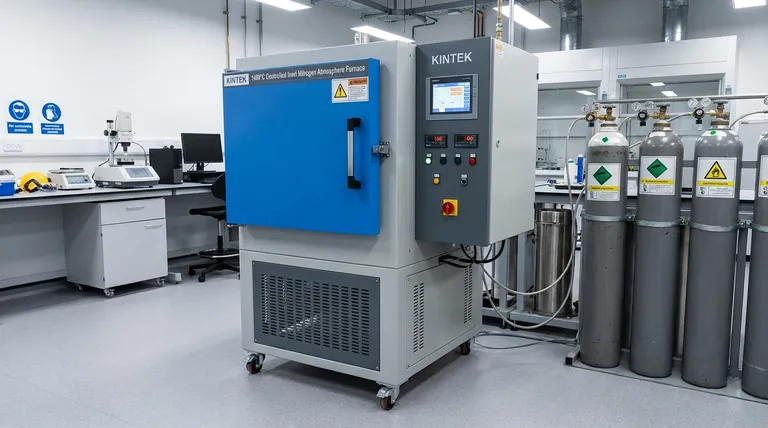
The definitive advantage of an atmosphere protection box furnace is its ability to isolate metal parts from oxygen during high-temperature processing. Unlike standard air muffle furnaces, these units utilize inert gases like nitrogen or argon, or reducing gas mixtures, to create a controlled environment that completely prevents surface degradation. This distinction is the difference between a rough, scaled part and a finished, high-precision component.
By replacing the air in the chamber with protective gas, this furnace eliminates the chemical reactions that degrade metal surfaces, specifically oxidation and decarburization. This not only preserves the structural integrity of the part but also removes the need for costly post-processing steps like acid pickling.
Preserving Surface Quality and Material Chemistry
The most immediate impact of switching to an atmosphere protection furnace is the preservation of the metal's surface condition and chemical composition.
Elimination of Oxidation and Scaling
In a standard air furnace, high temperatures cause metal to react aggressively with oxygen, creating a rough "scale" or oxide layer. Atmosphere furnaces displace oxygen with inert gases. This ensures parts emerge with a smooth, bright surface, identical to how they entered the furnace.
Prevention of Decarburization
Beyond visible scale, standard air annealing can strip carbon from the surface of steel (decarburization), weakening the part's exterior. Accurate atmosphere control preserves the carbon content. This guarantees the workpiece maintains stable structural properties and meets precise hardness specifications.
Operational Efficiency and Cost Reduction
While the equipment itself is more sophisticated, the downstream effects of using a protected atmosphere often lead to significant operational savings.
Removing Post-Processing Steps
Because parts do not oxidize, they do not require cleaning after annealing. You can eliminate labor-intensive and environmentally hazardous steps such as acid pickling or mechanical descaling. This streamlines the production line significantly.
Reducing Resource Consumption
By optimizing the structure of the material and shortening treatment cycles, these furnaces can improve overall production efficiency. Despite the cost of gas, the reduction in wasted material and the elimination of cleaning chemicals often result in lower total energy and consumption costs per part.
Precision Control and Uniformity
Atmosphere furnaces are generally engineered to a higher standard of control to manage the complexities of gas flow.
Precise Atmosphere Management
These units offer intuitive interfaces to manage gas type, flow, and pressure. This allows operators to tailor the environment to the specific alloy being treated, expanding the application scope of the furnace to include materials that require special properties.
Superior Temperature Uniformity
To ensure the atmosphere is effective, these furnaces typically utilize advanced heating element layouts (bottom, top, and sides). This results in highly uniform heat distribution via radiation and convection, ensuring that every part in the batch receives the exact same thermal treatment.
Understanding the Trade-offs
To provide a truly objective recommendation, one must acknowledge the operational differences compared to a standard air furnace.
Increased Complexity
An atmosphere furnace is not a simple "plug-and-play" heat box; it requires gas supply lines, pressure management, and safety protocols for handling pressurized gases. Operators must be trained to manage these variables to ensure safety and reliability.
Operational Consumables
Unlike a standard muffle furnace which utilizes ambient air, this equipment requires a constant supply of nitrogen, argon, or other gases. While you save on post-process cleaning, you must factor the recurring cost of industrial gas into your operating budget.
Making the Right Choice for Your Goal
Selecting the right furnace depends entirely on your tolerance for surface oxidation and your post-processing capabilities.
- If your primary focus is Surface Finish: Choose the atmosphere protection furnace to achieve bright, scale-free parts that are ready for immediate assembly or plating.
- If your primary focus is Structural Integrity: Choose the atmosphere protection furnace to prevent decarburization and ensure the metal retains its intended hardness and strength.
- If your primary focus is Low Initial Cost: A standard air muffle furnace is sufficient only if you have the capacity to mechanically clean or pickle parts after heat treatment.
Ultimately, the atmosphere protection box furnace is an investment in process efficiency, trading the cost of gas for the elimination of cleaning labor and the guarantee of superior material quality.
Summary Table:
| Feature | Standard Air Muffle Furnace | Atmosphere Protection Box Furnace |
|---|---|---|
| Processing Environment | Ambient Air (Oxygen rich) | Controlled Inert/Reducing Gas (N2, Ar, etc.) |
| Surface Outcome | Oxidized, Rough Scale | Bright, Smooth, Scale-free |
| Material Integrity | Risk of Decarburization | Maintains Carbon & Chemical Composition |
| Post-Processing | Requires Pickling or Sandblasting | None - Ready for next stage |
| Heat Uniformity | Standard | High (Advanced Multi-side Heating) |
| Operational Focus | Low initial equipment cost | Process efficiency & material quality |
Elevate Your Heat Treatment Precision with KINTEK
Don't let oxidation compromise your material integrity or inflate your production costs with unnecessary cleaning steps. Backed by expert R&D and manufacturing, KINTEK offers a comprehensive range of Muffle, Tube, Rotary, Vacuum, and CVD systems, along with specialized Atmosphere Protection Box Furnaces—all fully customizable to meet your unique metallurgical needs.
Whether you are annealing delicate components or high-strength alloys, our high-temp lab furnaces ensure superior temperature uniformity and precise atmosphere control. Contact us today to discuss your project requirements and discover how our advanced thermal solutions can streamline your workflow and guarantee high-quality, scale-free results.
References
- Salokhiddin Absattarov, Jamshed Avliyokulov. Dependence establishment of mass transfer coefficient in third kind boundary condition on temperature during vacuum carburizing of steels. DOI: 10.1063/5.0266787
This article is also based on technical information from Kintek Furnace Knowledge Base .
Related Products
- Mesh Belt Controlled Atmosphere Furnace Inert Nitrogen Atmosphere Furnace
- 1400℃ Controlled Inert Nitrogen Atmosphere Furnace
- 1200℃ Controlled Inert Nitrogen Atmosphere Furnace
- Controlled Inert Nitrogen Hydrogen Atmosphere Furnace
- 1700℃ Controlled Inert Nitrogen Atmosphere Furnace
People Also Ask
- What are the two main purposes of controlled atmosphere conditions in furnaces? Protect or Transform Materials for Peak Performance
- How is a controlled atmosphere furnace used in material research? Achieve Precise Material Synthesis and Heat Treatment
- What types of gases can a controlled atmosphere furnace handle? Master Inert and Reactive Gases for Your Lab
- What types of furnaces have controlled atmosphere furnaces largely replaced? Boost Metallurgical Precision & Safety
- How does a controlled atmosphere furnace improve product quality and consistency? Master Precise Heat Treatment for Superior Results








