
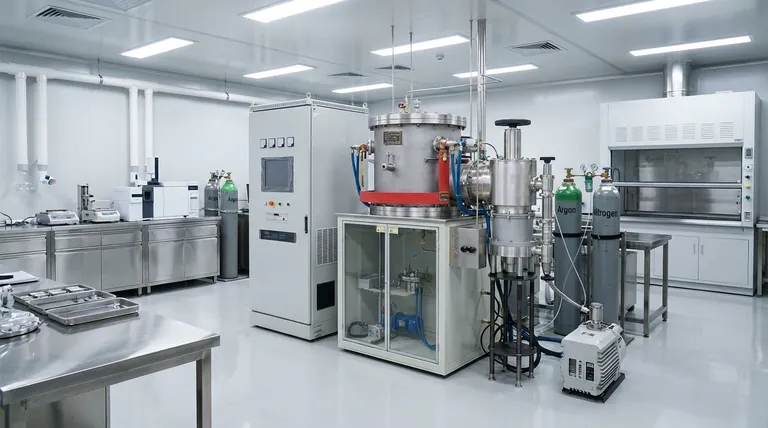
A high-vacuum or atmosphere-protected furnace is strictly required to facilitate the precise thermal decomposition of organic precursor polymers into inorganic ceramic phases without contamination. By utilizing an inert atmosphere (such as nitrogen or argon) or a vacuum, the furnace prevents unwanted oxidation while allowing for the exact regulation of temperature and heating rates essential for the material's transformation.
The furnace environment is not just about preventing burning; it is the decisive factor in engineering the material's final performance. The precision of this atmosphere directly dictates the carbon content and microscopic defects necessary for achieving optimal electromagnetic wave absorption.
The Transformation Mechanism
Converting Polymers to Ceramics
The core objective of the pyrolysis process is to strip away specific organic components from the precursor polymer. This leaves behind a stable, inorganic ceramic structure.
The Role of Controlled Atmospheres
To achieve this conversion, the process must occur in isolation from standard atmospheric oxygen. Tube furnaces or vacuum furnaces are employed to envelop the material in inert gases like nitrogen or argon.
Preventing Unwanted Reactions
Without this protective barrier, the polymer would simply oxidize or burn rather than decompose into the desired ceramic phases. The vacuum or inert gas ensures that the chemical changes are driven solely by heat, not by reaction with the outside air.
Engineering Material Properties
Regulating Carbon Content
The specific atmosphere and pressure settings within the furnace influence the residual carbon content in the final ceramic. This carbon content is a critical variable that defines the physical and electrical characteristics of the Precursor Derived Ceramic (PDC).
Creating Microscopic Defects
The pyrolysis process is used to intentionally engineer microscopic defects within the material. These defects are not errors; they are structural features necessary for the material's function.
Determining Dielectric Loss
The combination of carbon content and microscopic defects determines the material's dielectric loss capabilities. This property is the measure of how well the ceramic can dissipate electromagnetic energy.
The Critical Role of Precision
Precision Temperature Control
The furnace must possess a sophisticated temperature control system. It is not enough to simply reach a high temperature; the heating rate must be regulated with extreme accuracy.
The Impact of Thermal Fluctuations
Any deviation in temperature or heating speed alters the decomposition pathway. This results in inconsistent defect structures, which compromises the final quality of the ceramic.
The Link to Wave Absorption
Ultimately, the furnace's ability to maintain these precise conditions is the deciding factor in the product's application. The resulting microscopic structure is what enables the ceramic to effectively absorb electromagnetic waves.
Making the Right Choice for Your Goal
To maximize the performance of your Precursor Derived Ceramics, consider the following regarding your furnace selection:
- If your primary focus is material purity: Prioritize a furnace with high-integrity seals and vacuum capabilities to eliminate all traces of oxygen during the organic-to-inorganic transition.
- If your primary focus is electromagnetic performance: Ensure your furnace offers programmable heating rates to finely tune the microscopic defects and carbon content responsible for wave absorption.
The quality of your furnace atmosphere is the ceiling for the quality of your ceramic's performance.
Summary Table:
| Feature | Importance in PDC Pyrolysis | Impact on Final Ceramic |
|---|---|---|
| Inert Atmosphere | Prevents polymer oxidation/burning during decomposition | Ensures pure inorganic phase transition |
| Vacuum Capability | Removes residual oxygen and volatile components | Enhances material purity and structural integrity |
| Precise Heating Rate | Controls the rate of organic stripping | Determines microscopic defect density |
| Carbon Regulation | Manages residual carbon content via pressure/gas | Tunes electrical and dielectric loss properties |
Elevate Your PDC Performance with KINTEK Precision
Precision is the decisive factor in engineering the electromagnetic properties of Precursor Derived Ceramics. KINTEK provides high-performance lab solutions tailored for advanced material science. Backed by expert R&D and manufacturing, we offer Muffle, Tube, Rotary, Vacuum, and CVD systems—all fully customizable to meet your specific temperature and atmosphere requirements.
Don't let atmospheric contamination compromise your research. Contact KINTEK today to discover how our high-temperature furnace systems can help you achieve the exact carbon content and microscopic structures your materials demand.
Visual Guide

References
- Wenqing Wang, Rujie He. Advanced 3D printing accelerates electromagnetic wave absorption from ceramic materials to structures. DOI: 10.1038/s44334-024-00013-w
This article is also based on technical information from Kintek Furnace Knowledge Base .
Related Products
- Mesh Belt Controlled Atmosphere Furnace Inert Nitrogen Atmosphere Furnace
- 1400℃ Controlled Inert Nitrogen Atmosphere Furnace
- Controlled Inert Nitrogen Hydrogen Atmosphere Furnace
- 1200℃ Controlled Inert Nitrogen Atmosphere Furnace
- 1700℃ Controlled Inert Nitrogen Atmosphere Furnace
People Also Ask
- How is a controlled atmosphere furnace used in material research? Achieve Precise Material Synthesis and Heat Treatment
- What are the two main purposes of controlled atmosphere conditions in furnaces? Protect or Transform Materials for Peak Performance
- What types of furnaces have controlled atmosphere furnaces largely replaced? Boost Metallurgical Precision & Safety
- How does a controlled atmosphere furnace improve product quality and consistency? Master Precise Heat Treatment for Superior Results
- What types of gases can a controlled atmosphere furnace handle? Master Inert and Reactive Gases for Your Lab











