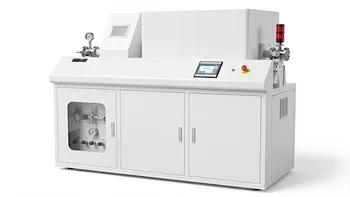
The success of synthesizing complex ceramic systems depends entirely on the precision of the thermal environment. For the final 1200°C annealing of Ca–Tb–Co–O samples, a high-temperature tube furnace provides superior temperature field uniformity and long-term thermal stability that standard equipment cannot match. These features are essential for achieving the 8-hour equilibrium required to stabilize the material's phase relationships and ensure high structural reproducibility.
A high-temperature tube furnace is the definitive tool for complex oxide synthesis because it bridges the gap between simple heating and precise material engineering. By providing a stable, uniform, and isolated environment, it ensures that chemical reactions reach a true state of equilibrium rather than a localized or incomplete phase.
The Critical Role of Thermal Uniformity and Stability
Ensuring a Consistent Temperature Field
At 1200°C, even minor fluctuations in temperature can lead to localized phase variations within a single sample. The high-temperature tube furnace utilizes a specialized heating zone that ensures the samples are heated consistently throughout their entire volume.
Long-Term Stability for 8-Hour Annealing
The 8-hour equilibrium process for Ca–Tb–Co–O requires the equipment to maintain a precise setpoint without drifting. Standard laboratory furnaces often struggle with thermal "creep," whereas tube furnaces are designed for long-term thermal stability during extended soaking periods.
Accurate Determination of Phase Equilibrium
To map the phase relationships of the Ca–Tb–Co–O system, researchers must know exactly what temperature the sample experienced. The precision of a tube furnace allows for the accurate determination of phase equilibrium relationships, which is the foundation of reliable material science data.
Achieving Structural Integrity and Reproducibility
Facilitating Full Atomic Diffusion
High-temperature treatment for 8 hours allows for the full diffusion and crystallization of different oxide components. The tube furnace provides the sustained energy and stable environment necessary for these solid-state reactions to complete, resulting in the desired polycrystalline phases.
Ensuring High Structural Reproducibility
Consistency is the hallmark of professional research. By eliminating the variables of uneven heating, the tube furnace ensures that every synthesized batch of Ca–Tb–Co–O possesses the same crystal structure and properties, making results verifiable and reproducible.
Stress Relief and Grain Boundary Optimization
The controlled cooling and stable soaking phases of a tube furnace help in eliminating residual thermal stresses. This process optimizes the distribution of grain boundary phases, which improves the mechanical reliability and thermal shock stability of the final ceramic product.
The Impact of Atmosphere Control on Sample Integrity
Isolation from Atmospheric Contaminants
Standard muffle furnaces are often open to the ambient air, which can introduce nitrogen or moisture that interferes with the Ca–Tb–Co–O system. A tube furnace provides a well-sealed environment, effectively eliminating interference from external gases that could alter the sample's chemistry.
Precision Gas Management
Many high-temperature tube furnaces are equipped with precision flow meters and sealed delivery systems. This allows researchers to control the exact mixture of gases, such as Oxygen or Argon, which is vital for studying phase transformations under specific partial pressures.
Prevention of Impurity Phases
Precise atmosphere and temperature control prevent the formation of unwanted secondary phases. For example, maintaining a constant air atmosphere ensures the samples undergo solid-state reactions without the loss of volatile components or the introduction of impurities.
Understanding the Trade-offs
Equipment Complexity and Setup Time
While a tube furnace offers superior control, it is more complex to set up than a standard box furnace. Loading samples into the center of the tube and ensuring proper seals for the end caps requires additional time and technical expertise.
Constraints on Sample Volume
The cylindrical geometry of the work tube limits the size and shape of samples that can be processed at once. For researchers needing to anneal very large batches or bulky components, the narrow diameter of a tube furnace can be a significant bottleneck.
Maintenance and Fragility
The ceramic or quartz tubes used in these furnaces are susceptible to thermal shock if heated or cooled too rapidly. Replacing these tubes is expensive and requires careful adherence to specific heating rates, such as 3°C per minute, to prevent cracking.
Making the Right Choice for Your Goal
How to Apply This to Your Project
The decision to use a high-temperature tube furnace should be driven by your specific requirements for material purity and phase accuracy.
- If your primary focus is phase equilibrium studies: Use a high-temperature tube furnace to ensure the 1200°C environment is uniform enough to produce a single, verifiable phase.
- If your primary focus is preventing contamination: Utilize the sealed environment of the tube furnace to isolate your Ca–Tb–Co–O samples from atmospheric nitrogen and moisture.
- If your primary focus is structural reproducibility: Rely on the precise temperature curves of the tube furnace to ensure that every batch of samples undergoes identical thermal history.
By prioritizing environmental control and thermal precision, you ensure that the resulting Ca–Tb–Co–O samples are of the highest possible scientific quality.
Summary Table:
| Feature | Tube Furnace Advantage | Impact on Ca–Tb–Co–O Samples |
|---|---|---|
| Temperature Uniformity | High precision specialized heating zones | Prevents localized phase variations |
| Thermal Stability | Maintains setpoint during 8-hour soak | Ensures accurate phase equilibrium |
| Atmosphere Control | Sealed environment with gas flow options | Eliminates nitrogen/moisture interference |
| Structural Integrity | Controlled cooling & stable energy | Facilitates full atomic diffusion & crystallization |
| Reproducibility | High batch-to-batch consistency | Guarantees verifiable and reliable research data |
Elevate Your Material Synthesis with KINTEK Precision
Achieving the perfect 1200°C equilibrium for complex oxide systems requires more than just heat—it requires total environmental control. KINTEK specializes in high-performance laboratory equipment, providing a comprehensive range of customizable high-temperature furnaces, including tube, muffle, rotary, vacuum, CVD, and atmosphere furnaces tailored for your unique research needs.
Whether you are mapping phase relationships or scaling up polycrystalline production, our furnaces deliver the thermal stability and atmospheric purity essential for scientific excellence.
Ready to optimize your annealing process? Contact our technical experts today to find the ideal furnace solution for your laboratory!
References
- O. Zaremba, R. Gladyshevskii. The Ca–Tb–Co–O system: phase diagram and crystal structures. DOI: 10.30970/cma17.0442
This article is also based on technical information from Kintek Furnace Knowledge Base .
Related Products
- 1200℃ Split Tube Furnace Laboratory Quartz Tube Furnace with Quartz Tube
- 1200℃ Controlled Inert Nitrogen Atmosphere Furnace
- 1200℃ Muffle Oven Furnace for Laboratory
- 1400℃ High Temperature Laboratory Tube Furnace with Alumina Tube
- Vertical Laboratory Quartz Tube Furnace Tubular Furnace
People Also Ask
- What is a split tube furnace? Unlock Easy Access for Complex Lab Experiments
- What are the components of a basic tube furnace design capable of withstanding 1200°C? Essential Parts for High-Temp Labs
- What safety measures should be followed when operating a split tube furnace? Ensure Safe and Efficient Lab Operations
- How does gas flow impact the performance of a split tube furnace? Optimize Your Process with Precision Control
- What are the key factors affecting temperature control in split tube furnaces? Ensure Precision and Uniformity