
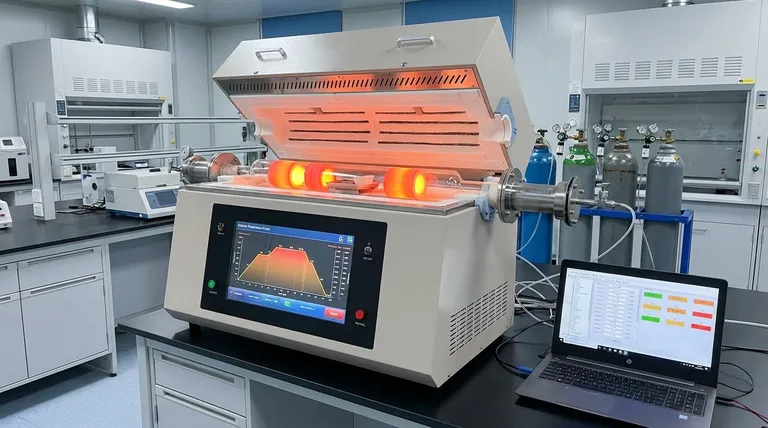
More elaborate tube furnaces incorporate advanced features primarily focused on enhanced temperature control, greater process versatility, and improved operational safety. These capabilities enable researchers and engineers to perform more complex thermal processes with high precision and reproducibility, moving beyond basic heating applications.
Elaborate tube furnaces distinguish themselves through multi-zone heating for superior temperature uniformity, sophisticated programmable digital controllers for precise process execution, and integrated safety and user-friendly design elements. These advancements cater to demanding applications requiring stringent control over heating profiles and atmospheric conditions.
Sophisticated Heating Zone Architectures
Advanced tube furnaces move beyond single heating elements to offer highly refined temperature management. This is critical for achieving specific thermal profiles and conditions.
Multi-Zone Heating Systems
Many advanced furnaces feature two or more heating zones, with some offering three zones or more. Each zone can be controlled independently or in a master/slave configuration.
Enhanced Temperature Uniformity
The primary benefit of multiple heating zones is the ability to achieve excellent temperature uniformity across the heated length of the tube. This is crucial for applications sensitive to temperature gradients.
Specialized Thermal Profiles
Multi-zone designs enable the creation of complex thermal profiles, such as steep temperature gradients for transport experiments or extended uniform zones for larger samples.
Independent Over-Temperature Protection
Each heating zone often includes independent over-temperature control, acting as a safety interlock to prevent runaway heating and protect both samples and equipment.
Advanced Programmable Control Systems
Modern elaborate tube furnaces integrate sophisticated digital controllers that significantly enhance process capabilities and user experience.
Segmented Program Control
Controllers offer 30-segment programmable automatic control or similar capabilities, allowing users to define intricate heating, soaking (holding), and cooling ramps. This is essential for processes like sintering, annealing, and crystal growth.
Intuitive User Interfaces
Features such as an intelligent 7-inch color touch screen provide a more intuitive and user-friendly interface for setting up and monitoring experiments.
Pre-set Sintering Curves
Some systems allow for presetting up to 15 sintering curves or other common process profiles. This simplifies repetitive experimental processes and ensures consistency.
Automated Parameter Management
Advanced systems can automatically control key parameters including temperature, atmosphere, heating rate, and holding time, adapting to various experimental needs.
Remote Interface Capabilities
An RS232 interface or similar connectivity allows operators to program segments and monitor the furnace remotely, facilitating more sophisticated and integrated laboratory setups.
High-Temperature and Atmosphere Control Capabilities
Beyond basic heating, elaborate furnaces offer the ability to reach extreme temperatures and precisely control the internal environment.
High Temperature Ranges
Many advanced high-temperature tube furnaces can reach up to 1800°C or more, suitable for demanding materials science applications.
Precise Temperature Regulation
Advanced controllers ensure precise temperature control, often down to a single degree, critical for processes requiring exact thermal conditions.
Controlled Atmosphere Options
Many models offer atmosphere control options, allowing for processing under vacuum or the introduction of specific gases like nitrogen, argon, or reactive gases. This is vital for applications like CVD or annealing in inert environments.
Enhanced Design and Safety Features
Elaborate tube furnaces prioritize user safety, durability, and operational longevity through thoughtful design.
Robust Construction
Furnaces are characterized by durable construction, often featuring a double-layer steel shell. This ensures longevity and structural integrity under demanding conditions.
Insulated Cooling Systems
A double-layer steel shell with fan cooling is a common safety feature. This design keeps the furnace's exterior surface temperature below 50°C, protecting operators from burns.
User-Centric Design
A focus on humanized design aims to make operation more intuitive and less prone to error, improving the overall user experience.
Understanding the Trade-offs
While advanced features offer significant benefits, they also introduce considerations that must be weighed.
Increased Complexity
The addition of multiple zones, sophisticated controllers, and atmosphere management systems inherently makes the furnace more complex to operate and maintain. Initial setup and programming require a steeper learning curve.
Higher Initial Investment
Elaborate tube furnaces with advanced capabilities come at a significantly higher cost than basic models. This investment must be justified by the requirements of the research or production process.
Maintenance and Calibration Needs
More components and sophisticated electronics mean potentially more points of failure and a greater need for regular calibration and maintenance to ensure accuracy and performance.
Making the Right Choice for Your Goal
Selecting an elaborate tube furnace depends entirely on the specific requirements of your application.
- If your primary focus is achieving extremely uniform heat distribution over a longer sample: Look for multi-zone furnaces with master/slave control and excellent temperature uniformity specifications.
- If your primary focus is running complex, multi-step thermal processes with high repeatability: Prioritize furnaces with 30-segment or more programmable controllers, touch screens, and the ability to save multiple process curves.
- If your primary focus is high-temperature synthesis or processing under specific gas environments: Seek models with high-temperature capabilities (1800°C+), robust atmosphere control options (vacuum/gas inlets), and precise temperature regulation.
- If your primary focus is operator safety and ease of use in a busy lab environment: Consider furnaces with double-layer cooling shells, intuitive touch screen interfaces, and humanized design elements.
These advanced features collectively empower researchers and industry professionals to push the boundaries of materials science and chemical engineering, enabling precise control over critical thermal processes.
Summary Table:
| Advanced Feature | Key Benefit | Ideal For |
|---|---|---|
| Multi-Zone Heating | Superior temperature uniformity & gradients | Transport experiments, large samples |
| Programmable Controllers (e.g., 30-segment) | Precise, repeatable complex thermal cycles | Sintering, annealing, crystal growth |
| High-Temperature & Atmosphere Control | Processing up to 1800°C+ in specific environments | CVD, materials synthesis, inert annealing |
| Enhanced Safety & Design | Operator protection and intuitive operation | Busy laboratory environments |
Ready to Elevate Your Thermal Processes?
Leveraging exceptional R&D and in-house manufacturing, KINTEK provides diverse laboratories with advanced high-temperature furnace solutions. Our product line, including Muffle, Tube, Rotary Furnaces, Vacuum & Atmosphere Furnaces, and CVD/PECVD Systems, is complemented by our strong deep customization capability to precisely meet unique experimental requirements.
Whether your goal requires multi-zone uniformity, complex programmable cycles, or robust atmosphere control, our experts can help you select or customize the ideal tube furnace for your application.
Contact KINTEK today to discuss your specific needs and discover how our advanced tube furnaces can bring precision, versatility, and reliability to your research or production.
Visual Guide

Related Products
- Vacuum Sealed Continuous Working Rotary Tube Furnace Rotating Tube Furnace
- 1400℃ High Temperature Laboratory Tube Furnace with Alumina Tube
- 1700℃ High Temperature Laboratory Tube Furnace with Alumina Tube
- 1200℃ Split Tube Furnace Laboratory Quartz Tube Furnace with Quartz Tube
- Vertical Laboratory Quartz Tube Furnace Tubular Furnace
People Also Ask
- What is the purpose of rotary tube furnaces? Achieve Uniform Heat Treatment for Powders and Granules
- What are the key advantages of using a rotary tube furnace? Achieve Dynamic, Uniform Heating for Powders
- What are the advantages of rotary tube furnaces in fuel compatibility? Boost Efficiency and Cut Costs
- How does the amount of material processed vary between batch and continuous rotary tube furnaces? Scale Your Production Efficiently
- What is the temperature range of some rotary tube furnaces? Achieve Uniform Heating Up to 1200°C



















