The right heating element is not about finding the highest-rated material—it’s about matching thermal limits and chemical stability to your exact process. For laboratory furnaces, the selection hinges on two non‑negotiable variables: the peak operating temperature you need, and the chemical environment inside the chamber. In oxidizing atmospheres, metallic alloys and ceramics like Nichrome, Platinum, Silicon Carbide, and Molybdenum Disilicide serve different temperature windows up to 1750°C. For the most extreme heat in vacuum, inert, or reducing conditions, refractory metals and graphite extend the range to 2800°C.
The core rule is simple: define your worst‑case temperature and the most aggressive gas environment, then choose the material that remains chemically and mechanically stable at that intersection. Ignoring either factor leads to rapid degradation, contamination, or complete element failure.
The Two Pillars of Element Selection: Peak Temperature and Atmosphere
Selecting a heating element is a decision that marries thermodynamics with chemistry. Every material has a hard temperature ceiling, but that ceiling can drop dramatically—or vanish entirely—if the surrounding gas reacts with the element.
Breaking Down the Thermal Ceilings
Temperature rating is not a gentle suggestion; it’s a survival limit. Exceeding a material’s maximum operating temperature triggers softening, grain growth, or accelerated oxidation. This leads to resistance drift, hot spots, and eventual burnout.
Lower‑temperature metals like Nichrome hold their strength and surface oxide protection only up to about 1200°C. Push beyond that and the protective oxide becomes unstable, exposing the base metal to rapid attack.
Ceramic‑based elements (SiC, MoSi₂, LaCrO₃) die by a different mechanism. Their life shortens exponentially with every degree above the rated limit, because the protective silica glass film that makes them viable in air begins to vaporize or devitrify.
Refractory metals and graphite cannot form protective oxide films useful in air. They survive only where no oxygen is present, so their temperature ceiling is entirely a function of their melting point and sublimation rate in the chosen vacuum or inert gas.
The Chemistry of Atmosphere Compatibility
Atmosphere dictates the failure mode. In oxidizing environments, materials that form a dense, slow‑growing oxide scale—like Chromia on Nichrome, Alumina on some alloys, or Silica on SiC and MoSi₂—are viable. In reducing or inert environments, those same oxides can be destabilized, exposing the metal core.
Refractory metals (Mo, W, Ta) become catastrophic sinks for carbon and nitrogen above roughly 1500°C. Even trace levels of CO, methane, or nitrogen in an “inert” furnace form embrittling carbides and nitrides that can turn a ductile wire into a brittle, useless filament in a single cycle.
Graphite is the ultimate high‑temperature material in pure inert gas, but it is a hungry reducer. Above 2000°C, carbon evaporation increases sharply, and any trace oxygen in the gas forms CO, slowly eating the element. This is why high‑purity helium passed through an oxygen getter becomes mandatory for long lifetimes at those temperatures.
A Material‑by‑Material Selection Guide
You can map your process conditions directly onto a material family using the following framework, which prioritizes chemical compatibility first and temperature second.
Lower‑Temperature Oxidizing Elements: Nichrome and Platinum
- Nichrome (Ni‑Cr) is the workhorse for routine air and reducing atmospheres. It reliably serves up to 1200°C thanks to a tenacious chromia scale. It is tolerant of thermal cycling and relatively inexpensive.
- Platinum (Pt) extends air operation to 1400°C. Its nobility means it never oxidizes, but it is sensitive to contamination by silicon or phosphorus vapors and is obviously far more costly. It is reserved for applications where purity is paramount.
Ceramic Elements for High‑Temperature Air: SiC, MoSi₂, LaCrO₃
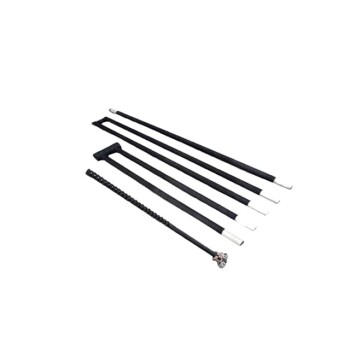
- Silicon Carbide (SiC) covers the 1450°C range in open air. Its silica protective layer is self‑healing, but SiC becomes vulnerable in reducing atmospheres above about 1250°C because the silica film is chemically reduced, leaving raw SiC to react with the process gas. This is a critical and often overlooked limitation.
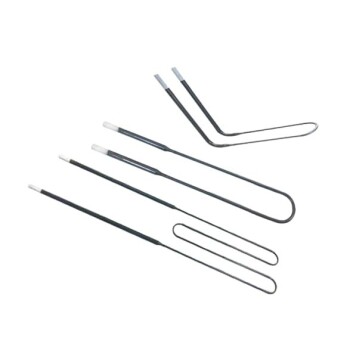
- Molybdenum Disilicide (MoSi₂) pushes oxidizing‑atmosphere capability to 1600°C (and some advanced grades to 1700°C). The element itself is a ceramic‑intermetallic composite that forms a perfect silica glass coat. However, it has low strength at temperature and is extremely brittle, requiring careful furnace design to support the elements.
- Lanthanum Chromite (LaCrO₃) serves niche applications up to 1750°C in air. Its conductivity and oxidation resistance make it ideal for very high‑temperature sintering, though it is rarely used in standard lab furnaces due to cost and lower mechanical robustness compared to MoSi₂.
Refractory Metals for Vacuum and Inert Environments
For processing that demands no oxygen, the refractory group delivers. Their limits vary with the metal, not just a generic “2000°C” cap.
- Molybdenum (Mo) operates comfortably up to 1700°C in vacuum, hydrogen, or argon. It oxidizes rapidly in air above 600°C, so it is strictly for controlled atmospheres. Even in good environments, residual carbon binder in furnace insulation can carbide the Mo at 1350°C, causing embrittlement.
- Tungsten (W) raises the ceiling to 2800°C in high vacuum or pure hydrogen/argon. It is the choice for the hottest metal‑lined furnaces, but CO and nitrogen are killers above 1400°C. CO forms tungsten carbide, while nitrogen forms tough, brittle tungsten nitrides.
- Tantalum (Ta) shines in ultra‑pure vacuum at up to 2500°C. However, it cannot tolerate hydrogen at all—absorbing it to form hydrides that lead to rapid failure—and it must avoid carbon‑containing gases above 1000°C.
Graphite for Extreme Temperatures
Graphite is the answer when you need to process at 2000°C and beyond without melting the element itself. In a true inert atmosphere (helium, argon) it can reach 2800°C, limited more by sublimation and reaction with trace impurities than by a defined melting point.
Vacuum operation is possible but constrains the maximum temperature. At around 1500–1600°C, carbon vapor pressure becomes significant enough to cause rapid mass loss. Above 2200°C in vacuum, degradation is simply too fast for practical use unless the cycle is very short.
Understanding the Trade‑offs
Objective selection means acknowledging that every choice involves compromises. The “best” material on paper often carries hidden operational burdens.
The Hidden Cost of Atmosphere Purity
Refractory metals and graphite are unforgiving of impurities. Selecting tungsten because it hits 2800°C is only valid if your furnace can maintain oxygen levels in the low parts‑per‑million, nitrogen is completely excluded, and your insulation does not outgas organics. The cost of that level of gas purity and system leak tightness can dwarf the element cost itself.
Lifetime vs. Maximum Rating
Operating continuously at the maximum rated temperature slashes lifetime. For SiC, running at 1450°C continuously might give 500 hours, while 1350°C could extend life fivefold. The same principle applies to MoSi₂ and graphite. Building a design margin—selecting an element rated 100–150°C above your target—often reduces total ownership cost far more than saving on the element.
Mechanical Vulnerability and Furnace Design
MoSi₂, SiC, and graphite elements are brittle. Thermal shock can crack a cold SiC rod on a rapid ramp‑up. MoSi₂ softens at temperature and can sag if not properly supported. Refractory metal wires sag as well and must be designed with adequate support geometry. Ignoring these mechanical realities leads to element failure that has nothing to do with temperature or atmosphere.
How to Apply This to Your Laboratory Process
Start by documenting your exact process requirements: the required dwell temperature, the ramp rate, the gases present at every stage (including during cooling), and any materials that might vaporize from your workpieces. Then compare against the material families using these goal‑oriented recommendations.
- If your primary focus is routine heat treating or sintering in ambient air below 1400°C: Choose Silicon Carbide elements. They offer an excellent balance of cost, robustness, and oxidation resistance in this range.
- If your primary focus is precise oxidation studies or clean high‑temperature air processing up to 1600°C: Use Molybdenum Disilicide elements. Their stable silica coating delivers long life and minimal contamination, provided you handle them with care.
- If your primary focus is ultra‑high temperature processing in inert gas or vacuum above 2000°C: Select Graphite elements in a carefully purified helium atmosphere. This combination gives you the highest practical ceiling with acceptable life, as long as carbon contamination is not a process concern.
- If your primary focus is achieving the cleanest possible high‑temperature vacuum environment for metal or ceramic processing: Choose Tungsten (up to 2800°C) or Molybdenum (up to 1700°C) elements. Invest heavily in gas purification and system integrity to protect your investment.
Match the element not to your aspirational temperature, but to the entire thermal‑chemical‑mechanical landscape of your process. That single discipline ensures you get performance, repeatability, and furnace longevity.
Summary Table:
| Material Family | Max Temp (°C) | Compatible Atmosphere | Key Considerations &
| Limitations |
|---|
| Nichrome (Ni-Cr) |
| Platinum (Pt) |
| Silicon Carbide (SiC) |
| Moly Disilicide (MoSi₂) |
| Molybdenum (Mo) |
| Tungsten (W) |
| Graphite |
Optimize Your High-Temperature Process with KINTEK Solution
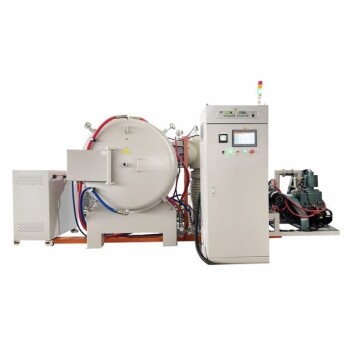
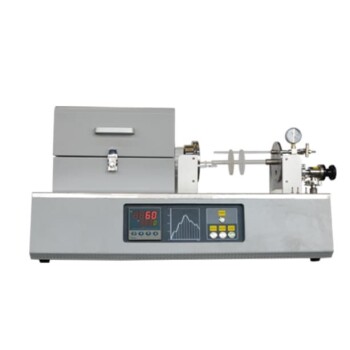
Choosing the wrong heating element can lead to rapid degradation, process contamination, and costly downtime. At KINTEK, we specialize in high-performance laboratory equipment and customizable high-temperature furnaces—including muffle, tube, rotary, vacuum, CVD, controlled atmosphere, dental, and induction melting furnaces tailored to your precise thermal and chemical requirements.
Whether you need custom element configurations or expert advice on atmosphere compatibility, our engineers are ready to deliver reliable, high-purity thermal processing solutions.
Contact KINTEK today to consult with our high-temp experts
Related Products
- 1400℃ Muffle Oven Furnace for Laboratory
- 1400℃ High Temperature Laboratory Tube Furnace with Alumina Tube
- 1700℃ High Temperature Laboratory Tube Furnace with Alumina Tube
- 1800℃ High Temperature Muffle Oven Furnace for Laboratory
- 1700℃ High Temperature Muffle Oven Furnace for Laboratory
People Also Ask
- What is the primary function of a high-temperature laboratory muffle furnace in chemical synthesis? Achieve Precision.
- How does a high-temperature laboratory muffle furnace affect material properties? Transform Anodic Oxide Films Fast
- What role does a laboratory high-temperature muffle furnace play in the proximate analysis of bamboo charcoal? Guide
- How is a laboratory high-temperature muffle furnace utilized to achieve the specific crystalline structure of LaFeO3 catalysts?
- What function does a muffle furnace perform in perovskite formation? Optimize Your Thermal Synthesis