
Utilizing industrial-grade ashing or box furnaces is the standard method for transforming green 3D-printed bioactive glass parts into dense, functional components. These furnaces employ precise, programmed temperature profiles to execute a sequential two-stage process: first removing polymer binders at lower temperatures, and then fusing the glass particles at high temperatures without altering their amorphous structure.
Core Insight: The success of this process relies entirely on the furnace's ability to facilitate viscous flow for densification while strictly preventing crystallization. This delicate balance requires a furnace capable of exact thermal ramp rates and stable temperature holding.
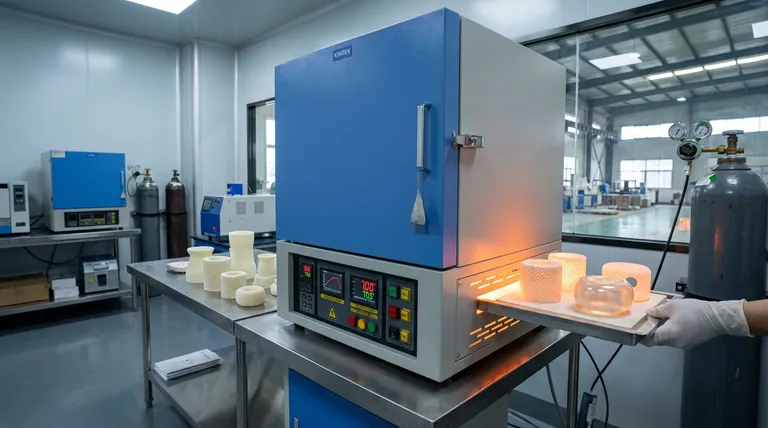
The Dual-Stage Thermal Process
To process bioactive glass, the furnace must run a continuous, multi-step program. The transition between these steps is critical for maintaining part geometry and material integrity.
Stage 1: Thermal Debinding
The first phase involves heating the part to a moderate temperature, typically 550°C.
During this stage, the furnace must maintain a controlled heating rate to ensure the complete removal of polymer binders used during printing.
If the heating rate is too aggressive, the rapid off-gassing of binders can crack or distort the delicate printed structure.
Stage 2: Sintering via Viscous Flow
Once debinding is complete, the furnace ramps up to the sintering temperature, approximately 700°C.
At this temperature, the bioactive glass particles undergo viscous flow. This mechanism allows the particles to soften and fuse together, eliminating voids left by the binder.
Achieving High Density
The goal of the sintering phase is to achieve a relative density of approximately 98%.
This high level of density ensures the mechanical strength requisite for medical or industrial applications, transforming the porous "green" part into a solid object.
Critical Processing Constraints
While the primary goal is densification, the furnace must operate within strict thermal boundaries to avoid ruining the material properties of the bioactive glass.
Preventing Unwanted Crystallization
The most critical function of the furnace during the 700°C hold is to prevent crystallization.
Bioactive glass relies on its amorphous (non-crystalline) structure for its biological reactivity. If the furnace temperature fluctuates too high or holds for too long, the glass may crystallize, reducing its bioactivity and altering its degradation rate.
Precision Control Requirements
To navigate the narrow window between sintering and crystallization, the furnace requires precise temperature control logic.
Industrial-grade units are preferred over standard kilns because they can strictly adhere to the programmed thermal profile, minimizing thermal overshoot or uneven heating zones.
Making the Right Choice for Your Goal
When selecting or programming a furnace for bioactive glass, your parameters must align with the specific material chemistry and desired outcome.
- If your primary focus is mechanical strength: Ensure the furnace can maintain the 700°C sintering temperature uniformly to achieve the target 98% relative density through viscous flow.
- If your primary focus is bioactivity: Prioritize furnace precision to strictly limit thermal exposure, ensuring the material remains amorphous and free of unwanted crystallization.
Success in sintering bioactive glass ultimately depends on a furnace that delivers heat with the precision of a laboratory instrument, not just the power of a kiln.
Summary Table:
| Process Stage | Typical Temperature | Primary Mechanism | Critical Objective |
|---|---|---|---|
| Thermal Debinding | ~550°C | Polymer Decomposition | Removal of binders without cracking structure |
| Sintering | ~700°C | Viscous Flow | Achieve ~98% relative density; fuse glass particles |
| Cooling/Hold | Controlled | Thermal Stability | Prevent crystallization to maintain bioactivity |
Elevate Your Advanced Material Processing with KINTEK
Precision is non-negotiable when working with sensitive materials like 3D-printed bioactive glass. KINTEK provides industrial-grade thermal solutions designed to meet the rigorous demands of medical and industrial R&D.
Backed by expert R&D and manufacturing, we offer a comprehensive range of Muffle, Tube, Rotary, Vacuum, and CVD systems. Whether you need exact thermal ramp rates for debinding or stable temperature holds to prevent unwanted crystallization, our high-temp lab furnaces are fully customizable to your unique specifications.
Ready to achieve superior density and bioactivity in your 3D-printed components?
Contact KINTEK Today for a Expert Consultation
Visual Guide

References
- High‐Resolution Stereolithography of Amorphous, Dense and Mechanically Stable Bioactive Glass. DOI: 10.1002/admt.202500925
This article is also based on technical information from Kintek Furnace Knowledge Base .
Related Products
- High Temperature Muffle Oven Furnace for Laboratory Debinding and Pre Sintering
- Vacuum Heat Treat Sintering Furnace with Pressure for Vacuum Sintering
- Vacuum Dental Porcelain Sintering Furnace for Dental Laboratories
- 2200 ℃ Graphite Vacuum Heat Treat Furnace
- Vacuum Heat Treat Sintering and Brazing Furnace
People Also Ask
- What thermal phenomena occur during polymer binder burnout in ceramic green bodies? Lab Furnace Guide
- What role does a high-temperature muffle furnace play in STFO synthesis? Achieve Pure Perovskite Results
- Why is controlled heat treatment in a muffle furnace necessary for calcined clay? Achieve Optimal Pozzolanic Activity
- How does a high-temperature muffle furnace facilitate the formation of LaNbxAl1−xO3+δ perovskite structures? Key Roles
- What role does a high-temperature muffle furnace play in the formation of biochar catalysts? Master Catalyst Synthesis



















