
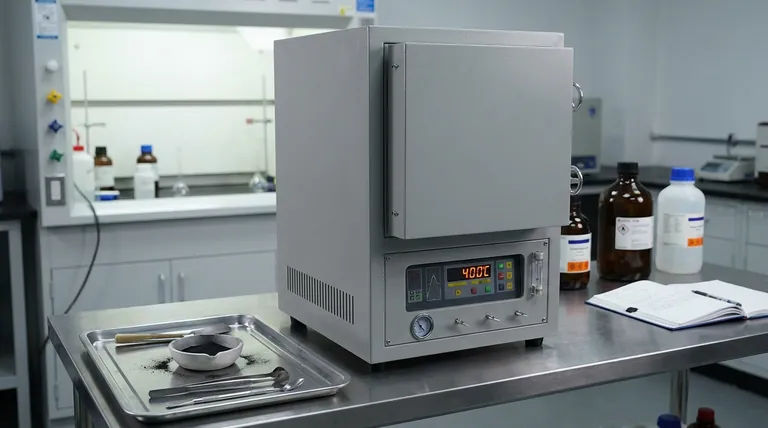
A muffle furnace acts as a precise thermal regulation tool used to introduce oxygen vacancy defects into the lattice of delta-manganese dioxide (delta-MnO2). By subjecting the material to controlled annealing, specifically at temperatures near 400°C, the furnace drives the loss of oxygen atoms to modify the crystal structure. This process is essential for enhancing electrochemical properties without destroying the material's fundamental layered architecture.
Core Takeaway The muffle furnace allows for the precise regulation of oxygen loss through stable environmental heating. While various temperatures influence the material, annealing at 400°C is the critical operational point for inducing optimal oxygen defects that boost conductivity and activity while preserving structural integrity.
The Mechanism of Defect Creation
Controlled Oxygen Loss
The primary function of the muffle furnace in this context is to create oxygen vacancies. By heating the delta-MnO2, oxygen atoms are released from the crystal lattice.
These vacancies are not errors; they are engineered features. The removal of oxygen changes the electronic environment of the manganese, which is the driver for improved performance.
Temperature Regulation
The degree of defect engineering is strictly dictated by the annealing temperature. The muffle furnace provides the stability required to hold specific set points, such as 300°C, 400°C, or 500°C.
The Optimal Window
Research indicates that 400°C is the most effective temperature for this specific material. At this setting, the furnace induces a level of oxygen defects that significantly enhances electrochemical activity.
Optimizing Physical Properties
Enhancing Surface Area
Beyond chemical changes, the furnace treatment alters the microphysical parameters of the material. Controlled annealing at 400°C can optimize the material to achieve a high specific surface area, reaching approximately 63 m²/g.
Improving Porosity and Wetting
The thermal treatment stabilizes the porous structure of the delta-MnO2. This structural evolution improves electrolyte wetting, ensuring that the liquid electrolyte can fully penetrate the material.
Accelerating Ion Migration
A well-annealed structure facilitates faster ion movement. By optimizing the pore size and surface area, the furnace treatment directly contributes to superior electrochemical performance.
Understanding the Trade-offs
Integrity vs. Activity
The critical challenge in defect engineering is balancing the number of defects with the stability of the crystal.
If the furnace temperature is too low, insufficient oxygen vacancies are created, resulting in lower electrochemical activity.
The Risk of Overheating
Conversely, excessive heat can compromise the material. The goal of using a muffle furnace is to introduce defects without compromising the integrity of the layered structure. Pushing temperatures beyond the optimal window (e.g., significantly above 400°C) risks collapsing the layers or altering the phase entirely, rendering the material less effective.
Making the Right Choice for Your Goal
To effectively utilize a muffle furnace for delta-MnO2 defect engineering, consider your specific performance targets:
- If your primary focus is maximizing electrochemical activity: Target an annealing temperature of 400°C to induce the optimal density of oxygen vacancies.
- If your primary focus is electrolyte interaction: Ensure the furnace program allows for stable heating to develop the necessary porosity and specific surface area (approx. 63 m²/g).
- If your primary focus is structural preservation: Avoid exceeding the optimal temperature range to prevent the collapse of the essential layered crystal structure.
Precision in thermal treatment is the difference between a degraded sample and a high-performance electrode material.
Summary Table:
| Annealing Parameter | Effect on delta-MnO2 Structure | Primary Benefit |
|---|---|---|
| Temperature (300°C) | Low oxygen vacancy density | Baseline structural stability |
| Optimal Temp (400°C) | Ideal oxygen defects & 63 m²/g surface area | Peak electrochemical activity |
| High Temp (>500°C) | Potential lattice collapse/phase change | Loss of layered integrity |
| Environment | Controlled thermal atmosphere | Uniform pore development |
Unlock High-Performance Material Synthesis with KINTEK
Precise defect engineering requires the uncompromising temperature stability found in KINTEK’s advanced laboratory furnaces. Whether you are optimizing delta-MnO2 for battery research or exploring novel crystal architectures, our equipment provides the thermal accuracy necessary to induce oxygen vacancies without compromising structural integrity.
Why partner with KINTEK?
- Expert R&D & Manufacturing: Our systems are built for the rigorous demands of material science.
- Diverse Product Range: Choose from Muffle, Tube, Rotary, Vacuum, and CVD systems tailored to your specific atmosphere and heat requirements.
- Fully Customizable: We design solutions for your unique laboratory or industrial scaling needs.
Take control of your material properties today. Contact our technical team for a custom solution and see how KINTEK can enhance your research outcomes.
References
- Shilong Li, Xiang Wu. Oxygen Vacancy-Rich δ-MnO2 Cathode Materials for Highly Stable Zinc-Ion Batteries. DOI: 10.3390/batteries10080294
This article is also based on technical information from Kintek Furnace Knowledge Base .
Related Products
- 1400℃ Muffle Oven Furnace for Laboratory
- 1700℃ High Temperature Muffle Oven Furnace for Laboratory
- 1800℃ High Temperature Muffle Oven Furnace for Laboratory
- 1200℃ Muffle Oven Furnace for Laboratory
- High Temperature Muffle Oven Furnace for Laboratory Debinding and Pre Sintering
People Also Ask
- What is the primary function of a high-temperature laboratory muffle furnace in chemical synthesis? Achieve Precision.
- How does a high-temperature laboratory muffle furnace affect material properties? Transform Anodic Oxide Films Fast
- How does a laboratory high-temperature muffle furnace contribute to the final formation of Bismuth Oxide nanosheets?
- How does a laboratory high-temperature muffle furnace facilitate the homogenization of borosilicate glass samples? Expert Insights
- What is the function of a muffle furnace in MOF-derived zirconia conversion? Optimize Phase & Pore Engineering



















