
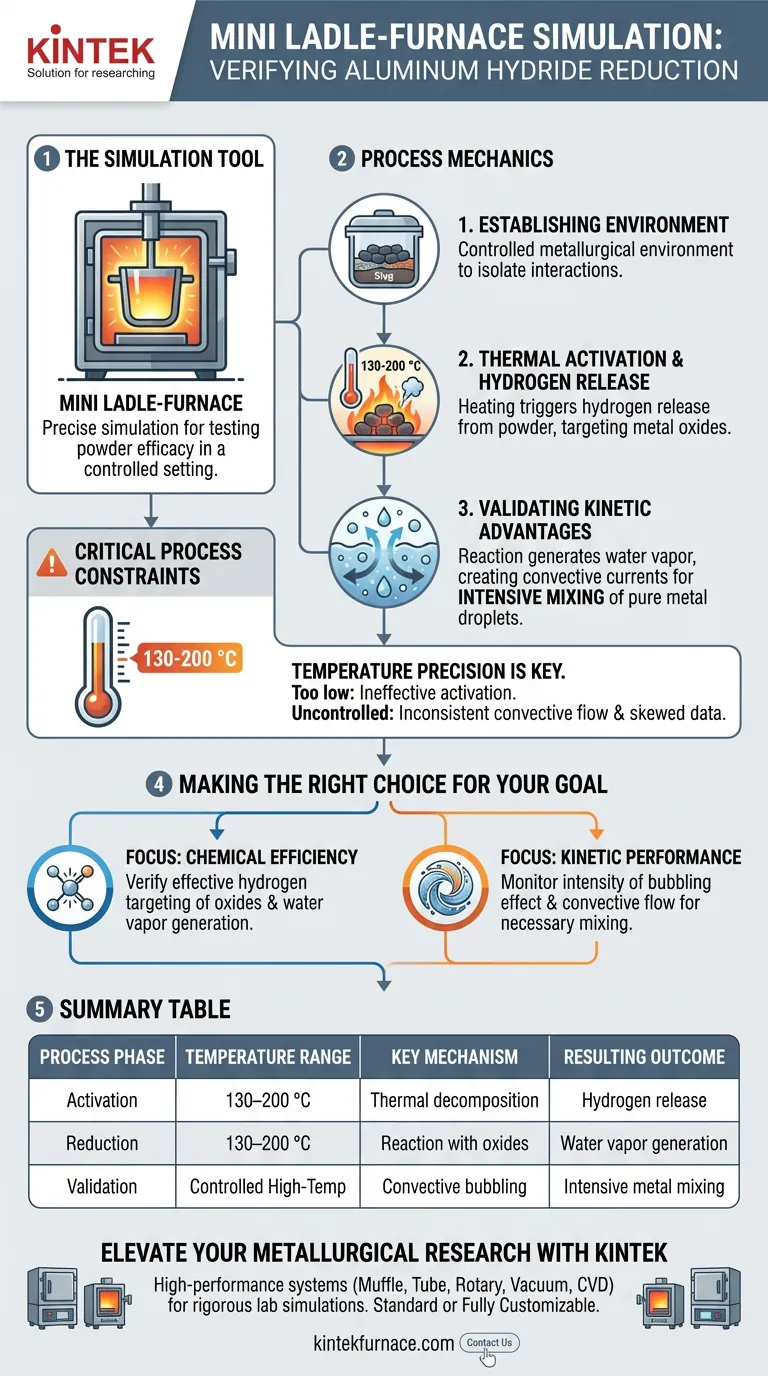
A mini ladle-furnace serves as a precise simulation tool for testing the efficacy of aluminum hydride powder in a controlled setting. It functions by heating briquettes containing the powder within a slag layer to a specific temperature range, triggering a chemical reaction that reduces metal oxides and validates the kinetic behavior of the materials.
The simulation validates the effectiveness of alumino-hydrogen reduction by inducing a dynamic interaction between released hydrogen and the molten environment. This process generates water vapor and convective currents, which are essential for the intensive mixing and separation of pure metal droplets.
The Mechanics of the Simulation
Establishing the Environment
The mini ladle-furnace is designed to create a controlled metallurgical environment. This isolation allows researchers to observe specific chemical interactions without the variables present in full-scale industrial operations.
Thermal Activation
The process begins when briquettes containing aluminum hydride powder are introduced to the slag layer. The system is heated to a critical range of 130 to 200 °C.
Hydrogen Release
Upon reaching this temperature window, the powder creates a reaction where hydrogen is released. This hydrogen targets and reduces the metal oxides present in the mixture.
Validating Kinetic Advantages
The Role of Water Vapor
The reduction reaction produces water vapor as a byproduct. In this simulation, the vapor acts as a loosening agent within the slag layer.
Creating Fluid Dynamics
The release of vapor creates a distinct bubbling effect. This bubbling drives convective fluid flow throughout the molten mixture.
Intensive Mixing
The convective flow promotes the intensive mixing of pure metal droplets within the molten steel. This physical agitation is the key indicator that validates the kinetic advantages of the alumino-hydrogen reduction process.
Critical Process Constraints
Temperature Precision
The success of this verification relies entirely on maintaining the specific 130-200 °C temperature window.
If the temperature is too low, the hydrogen release mechanism may not activate sufficiently to reduce the oxides. If the heating is uncontrolled, the rate of water vapor generation may differ, altering the convective flow and skewing the data regarding kinetic effectiveness.
Making the Right Choice for Your Goal
When analyzing results from a mini ladle-furnace simulation, focus on the specific physical indicators that align with your objectives.
- If your primary focus is Chemical Efficiency: Verify that the hydrogen release effectively targets metal oxides, resulting in the generation of water vapor.
- If your primary focus is Kinetic Performance: Monitor the intensity of the bubbling effect and convective flow to ensure it creates the necessary mixing of metal droplets.
This simulation method provides the definitive proof required to validate the alumino-hydrogen process before moving to larger applications.
Summary Table:
| Process Phase | Temperature Range | Key Mechanism | Resulting Outcome |
|---|---|---|---|
| Activation | 130–200 °C | Thermal decomposition of briquettes | Hydrogen release |
| Reduction | 130–200 °C | Reaction with metal oxides | Water vapor generation |
| Validation | Controlled High-Temp | Convective bubbling & fluid flow | Intensive metal mixing |
Elevate Your Metallurgical Research with KINTEK
Ready to validate your reduction processes with precision? Backed by expert R&D and manufacturing, KINTEK offers high-performance Muffle, Tube, Rotary, Vacuum, and CVD systems designed for rigorous laboratory simulations. Whether you need a standard setup or a fully customizable furnace tailored to your unique kinetic studies, our equipment ensures the temperature stability and control essential for your success.
Contact us today to find the perfect high-temp solution for your lab!
Visual Guide
References
- Gigo Jandieri, Giorgi Sakhvadze. Hydrated aluminum powder for direct alloying of steel and alloys - challenges of the future. DOI: 10.51582/interconf.19-20.03.2024.044
This article is also based on technical information from Kintek Furnace Knowledge Base .
Related Products
- 1700℃ High Temperature Laboratory Tube Furnace with Alumina Tube
- 1400℃ High Temperature Laboratory Tube Furnace with Alumina Tube
- Electric Rotary Kiln Small Rotary Furnace for Activated Carbon Regeneration
People Also Ask
- How does zone-melting in tube furnaces synthesize bismuth micro-wires? Master Single-Crystal Thermoelectric Growth
- How are high-temp tube furnaces used to measure diffusion coefficients per Fick's law? Master Precision Annealing
- How are high-temperature laboratory tube furnaces applied in long-term vacuum homogenization heat treatments for intermetallic samples?
- How do high-temperature laboratory tube furnaces ensure environmental stability? Precision Thermal Reduction Tips
- How are high-temperature tube furnaces applied in testing ceramic-supported alloy membranes? Insights


