
The two-stage heating program serves as a critical quality control mechanism that separates the release of volatile components from the final removal of carbon. By stabilizing the material at 270 °C before escalating to 700 °C, the muffle furnace prevents thermal shock and ensures the production of high-purity, amorphous silica.
The staged thermal approach eliminates the risks of local overheating, ensuring the final rice husk ash is white and free of residual carbon while retaining a reactive amorphous structure.
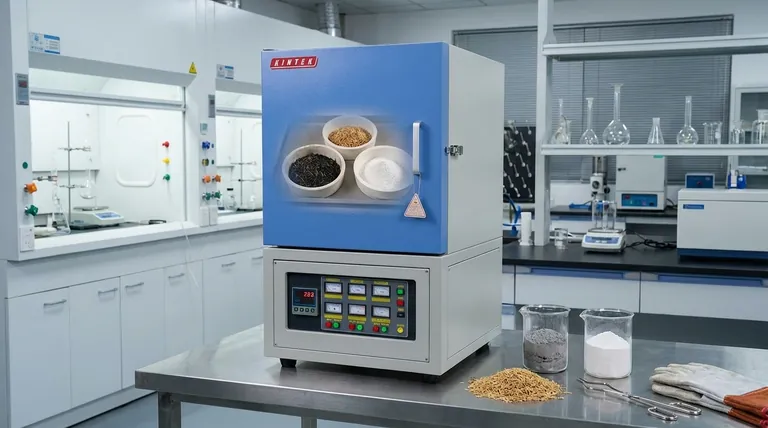
The Mechanics of the Two-Stage Process
To understand the quality of the final ash, one must look at what occurs during the distinct temperature plateaus. This separation of phases is the key to preventing structural defects.
Stage One: Controlled Carbonization (270 °C)
The first stage focuses on the steady decomposition of organic matter. By holding the temperature at 270 °C, the furnace allows for the controlled release of volatiles found within the rice husks.
This ensures that a significant portion of the organic load is removed gently. It prevents the violent off-gassing that can occur if the material is ramped directly to high temperatures.
Stage Two: Final Calcination (700 °C)
Once the volatiles are released, the furnace ramps to the second stage for complete decarbonization. At 700 °C, the remaining residual carbon is oxidized and removed.
This high-temperature phase is responsible for the physical appearance of the ash. It transforms the gray or black carbonized husk into a high-purity, white powder.
Impact on Material Structure
Beyond simple purity, the heating profile dictates the crystallographic nature of the silica.
Preventing Crystallization
Rapid heating often leads to uncontrolled temperature spikes. The two-stage program prevents this, ensuring the silica remains amorphous rather than transitioning into a crystalline phase.
Avoiding Local Overheating
When organic matter burns too quickly, it creates exothermic "hot spots" within the sample. By removing volatiles at a lower temperature first, the process minimizes the fuel available for these localized temperature spikes during the final calcination.
Understanding the Risks of Rapid Heating
While a single-stage, rapid heating program is faster, it introduces significant quality trade-offs that compromise the utility of the ash.
Loss of Reactivity
If the heating process causes the silica to crystallize (due to lack of control), the material becomes less reactive. Amorphous silica is generally preferred for industrial applications, such as in concrete or rubber reinforcement, due to its higher surface area and reactivity.
Incomplete Combustion
Rushing the process can trap carbon within the silica matrix. This results in gray ash with lower purity, which may be unsuitable for applications requiring high-grade white silica.
Making the Right Choice for Your Goal
The heating program you select should align with the specific properties you require from the rice husk ash.
- If your primary focus is High Reactivity: Adhere strictly to the two-stage process to prevent crystallization and maintain an amorphous structure.
- If your primary focus is Aesthetic Purity (Whiteness): Ensure the second stage at 700 °C is held long enough to fully oxidize all residual carbon.
By respecting the thermal limits of the material through a staged approach, you ensure a consistent, high-quality output that minimizes waste.
Summary Table:
| Heating Stage | Temperature | Primary Function | Impact on Ash Quality |
|---|---|---|---|
| Stage One | 270 °C | Controlled Carbonization | Releases volatiles gently; prevents violent off-gassing |
| Stage Two | 700 °C | Final Calcination | Removes residual carbon; produces high-purity white powder |
| Structural Goal | N/A | Amorphous Maintenance | Prevents crystallization; ensures high surface area & reactivity |
Elevate Your Material Purity with KINTEK
Precise thermal control is the difference between reactive amorphous silica and low-grade waste. KINTEK’s advanced muffle furnaces provide the programmable accuracy required for complex two-stage calcination processes, ensuring uniform heating and preventing local overheating for researchers and industrial manufacturers alike.
Backed by expert R&D and world-class manufacturing, KINTEK offers a comprehensive range of Muffle, Tube, Rotary, Vacuum, and CVD systems. All our lab high-temperature furnaces are fully customizable to meet your unique material science needs.
Ready to optimize your calcination results? Contact our technical experts today to find the perfect furnace solution for your laboratory.
References
- Shengwang Yuan, Yunhai Ma. A Comparative Study on Rice Husk, as Agricultural Waste, in the Production of Silica Nanoparticles via Different Methods. DOI: 10.3390/ma17061271
This article is also based on technical information from Kintek Furnace Knowledge Base .
Related Products
- High Temperature Muffle Oven Furnace for Laboratory Debinding and Pre Sintering
- 1200℃ Muffle Oven Furnace for Laboratory
- 1400℃ Muffle Oven Furnace for Laboratory
- Laboratory Muffle Oven Furnace with Bottom Lifting
- 1700℃ High Temperature Muffle Oven Furnace for Laboratory
People Also Ask
- What thermal phenomena occur during polymer binder burnout in ceramic green bodies? Lab Furnace Guide
- Why is controlled heat treatment in a muffle furnace necessary for calcined clay? Achieve Optimal Pozzolanic Activity
- What role does a high-temperature muffle furnace play in STFO synthesis? Achieve Pure Perovskite Results
- How does a high-temperature muffle furnace facilitate the formation of LaNbxAl1−xO3+δ perovskite structures? Key Roles
- What role does a high-temperature muffle furnace play in the formation of biochar catalysts? Master Catalyst Synthesis







