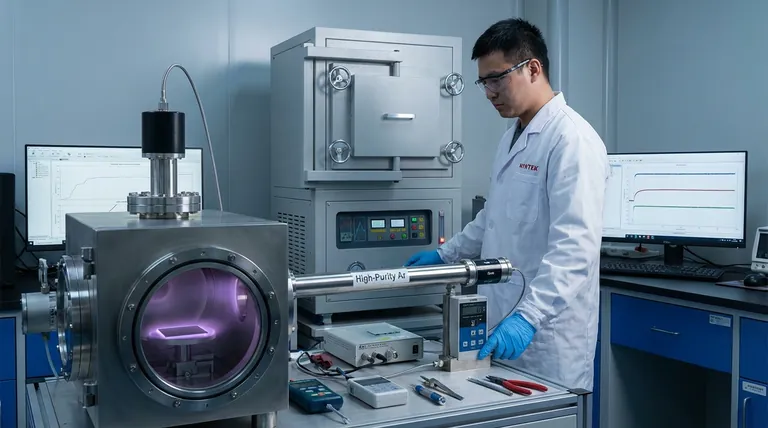
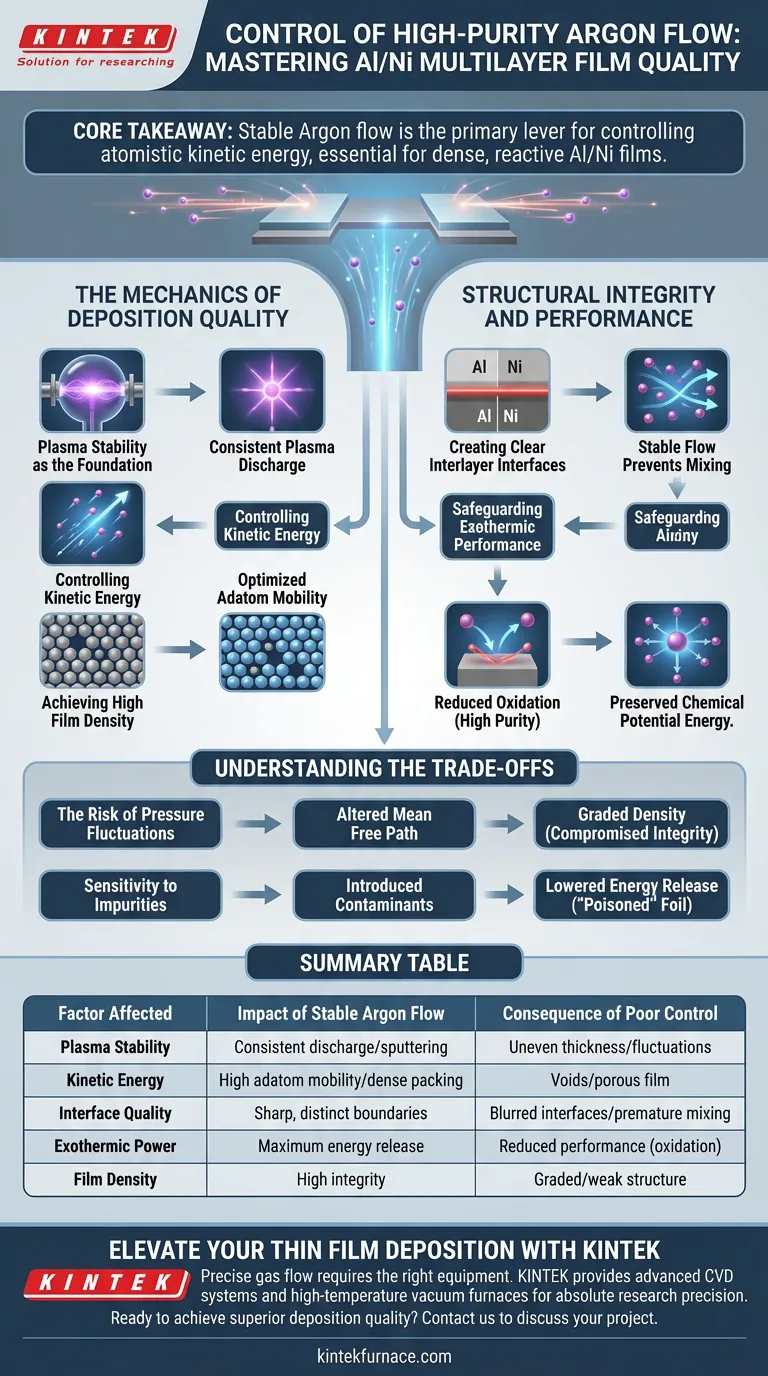
Precise control of high-purity Argon flow is the governing factor in stabilizing the sputtering plasma used for Al/Ni deposition. By regulating this flow, you effectively dictate the kinetic energy of the sputtered Aluminum and Nickel atoms as they travel to the substrate. This control is essential for creating high-density films with the sharp, clear interfaces necessary for the material's reactive performance.
Core Takeaway: Stability in Argon gas flow is not just about maintaining chamber pressure; it is the primary lever for controlling atomistic kinetic energy. This control minimizes oxidation and creates the distinct, dense layering required to preserve the maximum exothermic energy release of Al/Ni films.
The Mechanics of Deposition Quality
Plasma Stability as the Foundation
Argon acts as the discharge medium for the physical vapor deposition process.
Maintaining a stable flow ensures that the plasma discharge remains consistent throughout the coating run.
Without this consistency, the sputtering rate fluctuates, leading to uneven film thickness and unpredictable material properties.
Controlling Kinetic Energy
The flow of Argon directly influences the vacuum pressure and, consequently, the energy of the sputtered atoms.
By optimizing this flow, you control the kinetic energy with which Aluminum and Nickel atoms impact the substrate.
Higher kinetic energy (within optimal limits) facilitates better adatom mobility, allowing atoms to settle into a more compact structure.
Achieving High Film Density
The immediate result of controlled kinetic energy is high film density.
Dense films are less porous and mechanically more robust.
This density is achieved because the energetic impact packs the atoms tightly, eliminating voids that could weaken the structure.
Structural Integrity and Performance
Creating Clear Interlayer Interfaces
Al/Ni multilayer films function as reactive foils, releasing energy when the layers mix.
To maximize this reaction, the boundaries between the Aluminum and Nickel layers must be sharp and distinct.
Stable Argon flow prevents energetic variances that could cause premature intermixing or blurred interfaces during the deposition process.
Safeguarding Exothermic Performance
The ultimate goal of Al/Ni films is their exothermic (energy-releasing) capability.
High-purity Argon flow creates an environment that drastically reduces unintended oxidation.
By preventing oxygen and other impurities from contaminating the layers, you preserve the chemical potential energy stored within the film.
Understanding the Trade-offs
The Risk of Pressure Fluctuations
If Argon flow is not precisely controlled, chamber pressure will drift.
A drift in pressure alters the mean free path of the sputtered atoms.
This leads to a variance in impact energy, potentially resulting in a film with graded density rather than uniform density, compromising structural integrity.
Sensitivity to Impurities
Even with high-purity gas, flow interruptions can introduce contaminants.
Any introduction of impurities acts as a barrier to the Al/Ni reaction.
This effectively "poisons" the reactive foil, significantly lowering the total energy it can release upon activation.
Optimizing Your Deposition Process
To ensure the highest quality Al/Ni multilayer films, align your gas control strategy with your specific performance metrics:
- If your primary focus is Structural Density: Prioritize flow stabilization to maintain consistent kinetic energy, ensuring atoms pack tightly without voids.
- If your primary focus is Exothermic Power: Prioritize the use of high-purity Argon and strict leak control to eliminate oxidation and preserve sharp interlayer interfaces.
Mastery of Argon flow turns a standard coating process into a precision engineering tool, ensuring your reactive films deliver their maximum energy potential.
Summary Table:
| Factor Affected | Impact of Stable Argon Flow | Consequence of Poor Control |
|---|---|---|
| Plasma Stability | Consistent discharge and sputtering rates | Uneven film thickness and fluctuations |
| Kinetic Energy | High adatom mobility for dense packing | Voids and porous film structure |
| Interface Quality | Sharp, distinct layer boundaries | Blurred interfaces and premature mixing |
| Exothermic Power | Maximum energy release capability | Reduced performance due to oxidation |
| Film Density | High mechanical and structural integrity | Graded density and structural weakness |
Elevate Your Thin Film Deposition with KINTEK
Precise gas flow is critical for high-performance Al/Ni multilayer films, and having the right equipment is the foundation of that success. KINTEK provides industry-leading lab solutions, including advanced CVD systems and high-temperature vacuum furnaces, engineered for research that demands absolute precision.
Whether you are optimizing reactive foils or developing next-generation coatings, our expert R&D and manufacturing teams are here to deliver customizable systems tailored to your unique specifications.
Ready to achieve superior deposition quality? Contact us today to discuss your project and see how KINTEK’s expertise can empower your laboratory.
Visual Guide
References
- Konrad Jaekel, Heike Bartsch. Influence of Increasing Density of Microstructures on the Self‐Propagating Reaction of Al/Ni Reactive Nanoscale Multilayers. DOI: 10.1002/adem.202302225
This article is also based on technical information from Kintek Furnace Knowledge Base .
Related Products
- HFCVD Machine System Equipment for Drawing Die Nano Diamond Coating
- 915MHz MPCVD Diamond Machine Microwave Plasma Chemical Vapor Deposition System Reactor
- MPCVD Machine System Reactor Bell-jar Resonator for Lab and Diamond Growth
- RF PECVD System Radio Frequency Plasma Enhanced Chemical Vapor Deposition
- Cylindrical Resonator MPCVD Machine System for Lab Diamond Growth
People Also Ask
- What is Hot-filament Chemical Vapor Deposition (HFCVD)? Achieve High-Quality Thin Films with Precision Control
- What are the equipment for chemical vapor deposition? A Guide to the 5 Essential Components
- What is the significance of the vacuum pressure control system in the CVD coating process for powders?
- What is the function of high-purity Argon (Ar) gas during CVD? Optimize Your Thin Film Uniformity and Purity
- What are the advantages of using Chemical Vapor Deposition (CVD) for coating turbine blades? Enhance Life & Performance