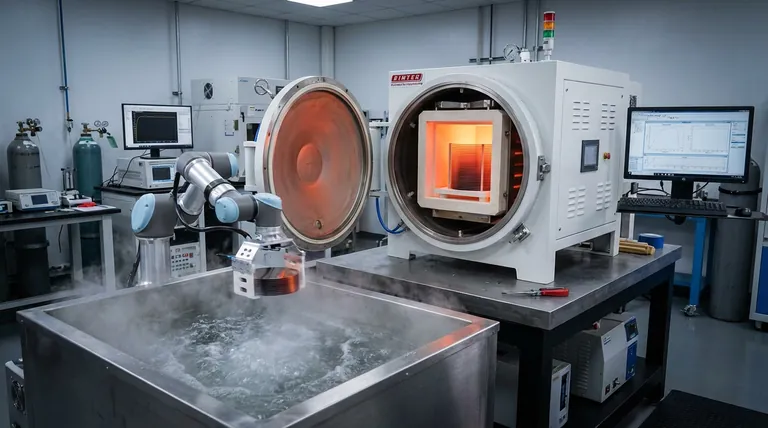
Rapid quenching after diffusion treatment fundamentally alters the material by locking in its high-temperature atomic configuration. By subjecting the silicon structure to cooling rates of 100-150 K/s, the process effectively "freezes" the distribution of impurities and phase structures that exist at elevated temperatures. This immediate thermal drop prevents the material from settling into a lower-energy equilibrium state that would otherwise degrade its performance.
Core Takeaway The primary function of rapid quenching is to prevent the precipitation of impurities like manganese and stop secondary phase changes. This preserves the specific deep-level structures that are essential for the material's photoelectric activity.
Preserving the High-Temperature State
The Mechanism of "Freezing"
At high diffusion temperatures, the silicon structure maintains a specific distribution of elements and phases. Rapid quenching utilizes cooling rates between 100 and 150 K/s to capture this state instantaneously.
Retaining Impurity Distribution
This process ensures that the impurity distribution present at high temperatures is maintained at room temperature. Without this rapid drop in temperature, atoms would have the thermal energy required to migrate and redistribute, altering the material's properties.
Preventing Structural Degradation
Avoiding Manganese Precipitation
A critical objective of this treatment is to stop the precipitation of manganese atoms. If the material is allowed to cool slowly, manganese atoms tend to cluster and precipitate out of the solution, rendering them ineffective for the intended application.
Halting Secondary Phase Changes
Slow cooling allows the material to undergo secondary phase changes. Rapid quenching interrupts these natural thermodynamic transitions, ensuring the material remains in the specific phase required for operation.
The Consequence of Slow Cooling (The Trade-off)
Loss of Photoelectric Activity
The "frozen" deep-level structures are explicitly required for photoelectric activity. If the cooling rate is insufficient (slow cooling), the material reverts to a more stable, inactive state, losing the specific electronic properties needed for the device to function.
Structural Inconsistency
Failing to achieve the 100-150 K/s threshold results in an uncontrolled structure. The "unnecessary precipitation" mentioned in the reference suggests that slow cooling produces a material with inconsistent phase compositions, compromising the integrity of the silicon structure.
Making the Right Choice for Your Goal
To optimize the material properties of the silicon structure effectively, you must strictly control the thermal profile.
- If your primary focus is photoelectric performance: You must maintain a cooling rate of at least 100-150 K/s to preserve the necessary deep-level structures.
- If your primary focus is material homogeneity: You must avoid slow cooling regimes to prevent manganese precipitation and unwanted secondary phases.
Success in this process relies entirely on the speed at which you can transition the material from diffusion temperatures to room temperature.
Summary Table:
| Feature | Rapid Quenching (100-150 K/s) | Slow Cooling (Equilibrium) |
|---|---|---|
| Impurity Distribution | "Frozen" in high-temp state | Atoms migrate and redistribute |
| Manganese Control | Prevents precipitation | Manganese clusters/precipitates |
| Structural Phase | Stops secondary phase changes | Undergoes thermodynamic transitions |
| Photoelectric Activity | Preserved (Deep-level structures) | Lost (Material becomes inactive) |
| Consistency | High structural integrity | Inconsistent phase compositions |
Achieve Precision Thermal Profiles with KINTEK
Maintaining a cooling rate of 100-150 K/s is critical for preserving the photoelectric activity and structural integrity of silicon materials. KINTEK provides the advanced technology needed to master these complex thermal cycles.
Backed by expert R&D and world-class manufacturing, we offer a comprehensive range of solutions including:
- Vacuum & CVD Systems for high-purity environments.
- Muffle, Tube, and Rotary Furnaces for precise diffusion control.
- Customizable Lab High-Temp Furnaces tailored to your specific quenching requirements.
Don't let slow cooling compromise your material performance. Contact our technical experts today to discover how our customizable furnace systems can enhance your research and production efficiency.
References
- A. T. Mamadalimov, Makhmudhodzha Isaev. Study of infrared quenching in silicide-silicon-silicide structures. DOI: 10.62476/apr61.55
This article is also based on technical information from Kintek Furnace Knowledge Base .
Related Products
- Stainless Steel Quick Release Vacuum Chain Three Section Clamp
- Laboratory Quartz Tube Furnace RTP Heating Tubular Furnace
- Custom Made Versatile CVD Tube Furnace Chemical Vapor Deposition CVD Equipment Machine
- Spark Plasma Sintering SPS Furnace
- Multi Heating Zones CVD Tube Furnace Machine for Chemical Vapor Deposition Equipment
People Also Ask
- What is the function of quartz vacuum encapsulation in RhSeCl CVT? Mastering Pure Crystal Growth
- What type of pump is used in water circulating vacuum pumps and how is it installed? Discover Robust Fluid-Based Vacuum Solutions
- What role do vacuum-sealed high-purity silica ampoules play in phase equilibrium experiments? Enhance Sample Integrity
- What is the operating principle of a vacuum freeze-dryer in the fabrication of carbon aerogels? Master Sublimation
- What role does a vacuum atmosphere play in Sn-Ag-Co TLP soldering? Optimize Bond Purity and Joint Strength