
Microwave sintering equipment achieves efficient heating by directly coupling a microwave electromagnetic field with the dielectric loss characteristics of the BCZY ceramic material. Instead of applying heat externally, this interaction causes the entire volume of the material to generate its own heat internally, resulting in a rapid and uniform temperature rise.
Core Insight: By leveraging volumetric self-heating, microwave sintering bypasses the slow thermal conduction of traditional methods. This enables rapid densification at lower temperatures, which is critical for preserving volatile elements like Barium and achieving a high-quality electrolyte microstructure.
The Mechanism of Volumetric Heating
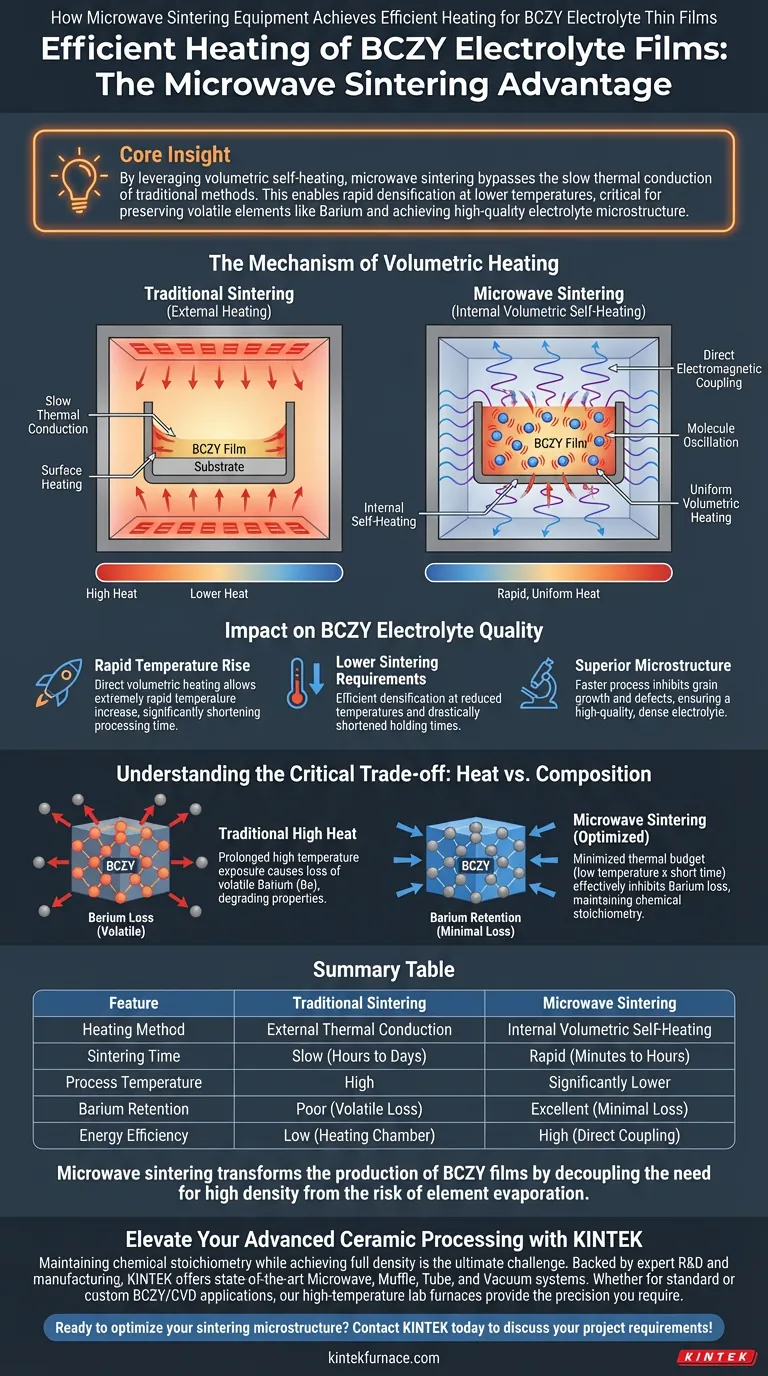
Direct Electromagnetic Coupling
Traditional ovens rely on heating elements to warm the air, which then warms the surface of the material. Microwave sintering operates differently by generating an electromagnetic field.
This field interacts directly with the dielectric loss mechanism within the ceramic material. The energy is transferred straight to the molecules, forcing them to align and oscillate, which generates thermal energy.
Internal Self-Heating
This process creates a self-heating mode where the material acts as the heat source.
Because the heat is generated internally rather than applied externally, the outcome is volumetric heating. The entire material warms up simultaneously, ensuring high energy efficiency and eliminating the lag time associated with thermal conduction.
Impact on BCZY Electrolyte Quality
Rapid Temperature Rise
The direct nature of volumetric heating allows for an extremely rapid temperature rise.
The equipment can bring the BCZY thin films to the necessary sintering state much faster than conventional furnaces. This significantly shortens the overall processing time.
Lower Sintering Requirements
Microwave sintering is highly efficient, allowing the material to densify at reduced sintering temperatures.
Additionally, the holding times—the duration the material must stay at peak heat—are drastically shortened. This combination of speed and lower heat input is a distinct advantage over resistive heating methods.
Understanding the Critical Trade-off: Heat vs. Composition
The Challenge of Volatility
In ceramic processing, there is often a trade-off between achieving high density (which requires heat) and maintaining chemical composition.
For BCZY electrolytes, prolonged exposure to high temperatures typically causes the loss of volatile elements, specifically Barium (Ba). Loss of Barium degrades the material's properties.
How Microwave Sintering Resolves This
Microwave equipment resolves this trade-off by minimizing the thermal "budget" (temperature x time).
Because the process requires lower temperatures and shorter holding times, it effectively inhibits the loss of Barium. This results in a superior microstructure and density without compromising the chemical stoichiometry of the membrane.
Making the Right Choice for Your Project
Microwave sintering is not just about speed; it is a quality control tool for volatile ceramics.
- If your primary focus is Compositional Integrity: Choose microwave sintering to minimize the evaporation of volatile elements like Barium, ensuring the electrolyte retains its intended chemical structure.
- If your primary focus is Microstructural Density: Utilize the volumetric heating capability to achieve a denser, more uniform membrane than is typically possible with surface-heating methods.
Microwave sintering transforms the production of BCZY films by decoupling the need for high density from the risk of element evaporation.
Summary Table:
| Feature | Traditional Sintering | Microwave Sintering |
|---|---|---|
| Heating Method | External Thermal Conduction | Internal Volumetric Self-Heating |
| Sintering Time | Slow (Hours to Days) | Rapid (Minutes to Hours) |
| Process Temperature | High | Significantly Lower |
| Barium Retention | Poor (Volatile Loss) | Excellent (Minimal Loss) |
| Energy Efficiency | Low (Heating Chamber) | High (Direct Coupling) |
Elevate Your Advanced Ceramic Processing with KINTEK
Maintaining chemical stoichiometry while achieving full density is the ultimate challenge in electrolyte fabrication. Backed by expert R&D and manufacturing, KINTEK offers state-of-the-art Microwave, Muffle, Tube, and Vacuum systems designed to solve your most complex thermal challenges. Whether you need a standard solution or a system fully customizable for unique BCZY or CVD applications, our high-temperature lab furnaces provide the precision you require.
Ready to optimize your sintering microstructure? Contact KINTEK today to discuss your project requirements!
Visual Guide
References
- Mengyang Yu, Shenglong Mu. Recent Novel Fabrication Techniques for Proton-Conducting Solid Oxide Fuel Cells. DOI: 10.3390/cryst14030225
This article is also based on technical information from Kintek Furnace Knowledge Base .
Related Products
- 915MHz MPCVD Diamond Machine Microwave Plasma Chemical Vapor Deposition System Reactor
- High Temperature Muffle Oven Furnace for Laboratory Debinding and Pre Sintering
- Spark Plasma Sintering SPS Furnace
- Small Vacuum Heat Treat and Tungsten Wire Sintering Furnace
- Vacuum Heat Treat Sintering Furnace Molybdenum Wire Vacuum Sintering Furnace
People Also Ask
- What is the MPCVD method and why is it considered effective for diamond deposition? Superior Purity & High Growth Rates
- What factors influence the quality of diamond deposition in the MPCVD method? Master the Critical Parameters for High-Quality Diamond Growth
- What are some key features and benefits of the microwave plasma chemical vapor deposition system? Achieve Unmatched Material Synthesis
- What is the purpose of a microwave plasma chemical vapor deposition system? Grow High-Purity Diamonds and Advanced Materials
- What is the basic principle of operation for the microwave plasma chemical vapor deposition system? Unlock High-Purity Material Growth



















