
Microstructural observation acts as the definitive diagnostic tool for correlating furnace settings with material outcomes. By visualizing internal features of Li1.3Al0.3Ti1.7(PO4)3 (LATP) samples, researchers bridge the gap between theoretical processing parameters and actual physical results. This visual data provides the scientific evidence needed to precisely adjust sintering temperatures and holding times.
The core utility of microstructural observation is turning visual defects into actionable process data. By identifying specific physical flaws like micro-cracks or residual pores, you can move from trial-and-error to targeted optimization of your heating profiles.
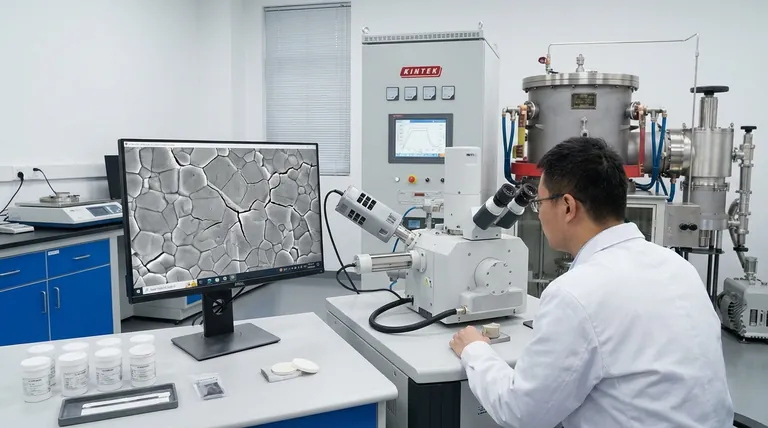
Diagnosing Material Quality Through Imaging
Assessing Densification Levels
The primary goal of sintering LATP is achieving high density. Microstructural observation allows you to visually confirm the densification levels of the ceramic.
If the imaging reveals a porous structure rather than a solid mass, it indicates that the sintering process was incomplete. This visual cue is the first step in diagnosing under-firing.
Analyzing Grain Architecture
Beyond density, the performance of LATP is heavily influenced by its crystalline structure. High-resolution imaging enables the detailed assessment of grain sizes and grain boundary distributions.
Understanding these boundaries is critical, as they often dictate the electrical and mechanical properties of the final material.
Identifying Critical Defects
Observation is the most effective method for detecting technical issues that are invisible to the naked eye.
Specifically, researchers look for micro-cracks or residual pores. The presence of these defects serves as an immediate red flag regarding the thermal history of the sample.
From Observation to Furnace Optimization
Creating a Feedback Loop
The data gathered from imaging is not just for characterization; it is scientific feedback for the manufacturing process.
You use these visual insights to validate the efficacy of your current temperature curves.
Adjusting Sintering Parameters
Once defects are identified, specific furnace parameters can be tuned.
If the observation reveals residual pores, researchers know to adjust the sintering temperature or extend the holding time to promote better fusion.
Conversely, if micro-cracks are prevalent, it suggests the need to refine heating or cooling rates to reduce thermal stress.
Understanding the Trade-offs
Visuals vs. Performance
While microstructural observation is essential, it assesses structure, not function.
A sample may look dense and crack-free but still exhibit poor ionic conductivity due to chemical composition changes that imaging alone might not capture.
The Scope of Observation
High-resolution imaging is typically localized.
You are observing a very small section of the LATP sample. There is always a risk that the observed area is not perfectly representative of the entire bulk material.
Optimizing Your Sintering Strategy
To effectively use microstructural observation for LATP development, align your visual findings with specific furnace adjustments:
- If your primary focus is eliminating porosity: Increase the sintering temperature or extend the holding time to allow for complete densification.
- If your primary focus is structural integrity: Look for micro-cracks and adjust the temperature curves to reduce thermal shock during heating or cooling phases.
Your goal is to use the microscope not just to see the material, but to calibrate the furnace that creates it.
Summary Table:
| Observation Finding | Indicated Material Issue | Required Furnace Adjustment |
|---|---|---|
| High Porosity | Incomplete densification | Increase sintering temperature or holding time |
| Micro-cracks | Thermal stress/shock | Refine heating/cooling rates for gradual transition |
| Coarse Grains | Excessive grain growth | Reduce peak temperature or shorten holding time |
| Residual Pores | Under-firing | Extend holding time to promote material fusion |
Maximize Your LATP Material Performance with KINTEK
Precise microstructural control begins with a high-performance furnace. At KINTEK, we empower researchers and manufacturers with advanced thermal solutions designed for the rigorous demands of solid-state electrolyte development.
Backed by expert R&D and manufacturing, KINTEK offers Muffle, Tube, Rotary, Vacuum, and CVD systems, along with other lab high-temperature furnaces—all fully customizable to meet your unique sintering profiles. Whether you are targeting zero-porosity or eliminating thermal stress micro-cracks, our equipment provides the stability and uniformity your materials require.
Ready to optimize your sintering process? Contact us today to discuss your custom furnace needs and see how our expertise can drive your innovation forward.
References
- Q.Z. Zeng, Zhongmin Wang. Influence of Zr Addition on the Microstructure and Hydrogenation Kinetics of Ti50−xV25Cr25Zrx (x = 0, 5, 7, and 9) Alloys. DOI: 10.3390/ma17061366
This article is also based on technical information from Kintek Furnace Knowledge Base .
Related Products
- High Temperature Muffle Oven Furnace for Laboratory Debinding and Pre Sintering
- 2200 ℃ Tungsten Vacuum Heat Treat and Sintering Furnace
- 2200 ℃ Graphite Vacuum Heat Treat Furnace
- Vacuum Heat Treat Sintering Furnace Molybdenum Wire Vacuum Sintering Furnace
- 1700℃ High Temperature Laboratory Tube Furnace with Alumina Tube
People Also Ask
- What thermal phenomena occur during polymer binder burnout in ceramic green bodies? Lab Furnace Guide
- Why is controlled heat treatment in a muffle furnace necessary for calcined clay? Achieve Optimal Pozzolanic Activity
- What role does a high-temperature muffle furnace play in STFO synthesis? Achieve Pure Perovskite Results
- How does a high-temperature muffle furnace facilitate the formation of LaNbxAl1−xO3+δ perovskite structures? Key Roles
- What role does a high-temperature muffle furnace play in the multi-stage synthesis of Li0.5MnFe1.5O4? Key to Pure Spinel



















