
Furnace calcination fundamentally alters the physical structure of kaolin, transitioning it from a relatively smooth state to a significantly rougher and more porous texture. Scanning Electron Microscopy (SEM) serves as the primary validation tool for this process, providing direct visual evidence that high-temperature treatment successfully optimizes particle distribution and pore structure for use as a catalyst support.
SEM imaging confirms that furnace calcination is not merely a thermal treatment but a structural activator, generating the necessary porosity and surface roughness that define high-performance catalyst supports.
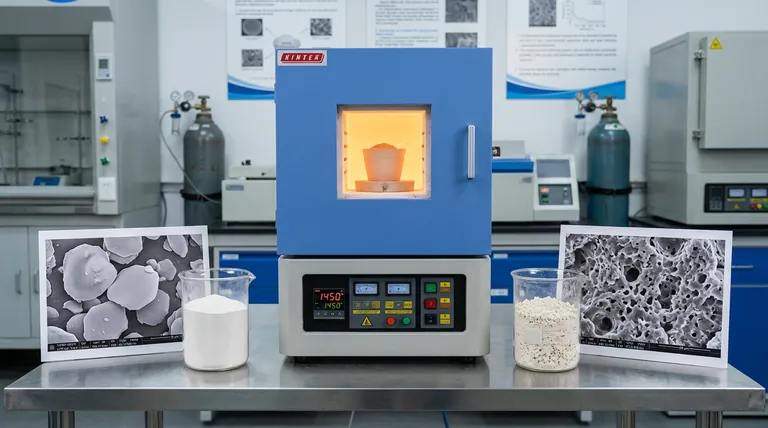
Analyzing the Morphological Transformation
From Smooth to Textured
Before treatment, raw kaolin typically exhibits a smoother surface profile. SEM analysis reveals that the intense heat of the furnace disrupts this smoothness.
This process introduces a high degree of surface roughness, which is the first physical indicator that the material is being activated for catalytic use.
The Emergence of Porosity
Beyond mere roughness, the SEM imagery highlights the creation of a distinct pore structure.
This is not a random degradation of the material; rather, it is an optimization of the microscopic architecture. The furnace treatment opens up the material, creating voids and channels that are invisible to the naked eye but clear under electron microscopy.
Optimization of Particle Distribution
The primary reference notes that this process also affects particle distribution.
SEM allows engineers to verify that the calcination has occurred uniformly, ensuring that the beneficial roughness and porosity are distributed evenly throughout the catalyst support rather than isolated in specific clusters.
Connecting Structure to Performance
The Link Between Roughness and Surface Area
While SEM shows the qualitative change (roughness), this directly correlates to quantitative improvements in performance.
The physical roughening observed in SEM images corresponds to a massive increase in specific surface area. Data indicates a jump from approximately 5.514 m²/g to 26.567 m²/g following calcination.
Facilitating Active Component Dispersion
The porous landscape revealed by SEM is critical for the catalyst's function.
A rougher, more porous surface allows for better dispersion of active components. Instead of sitting on a flat surface, chemical agents can penetrate the pores, leading to more effective interactions during chemical reactions.
Understanding the Trade-offs
Optimization vs. Degradation
It is crucial to interpret SEM images with a focus on controlled modification.
While increased porosity is desired, "optimizing" the structure implies a balance. If the furnace temperature is too high or the duration too long, the structure could degrade rather than improve. SEM helps confirm that the treatment has stopped at the point of maximum benefit without compromising physical integrity.
The Complexity of Verification
Relying solely on visual inspection via SEM can be subjective without accompanying data.
While SEM proves the existence of roughness and porosity, it must often be paired with other analytical methods (like BET analysis) to quantify the exact surface area gains. Visual roughness is a strong indicator of success, but it is part of a larger data picture.
Interpreting Microscopic Data for Project Success
To ensure your calcination process is yielding the right catalyst support, you must correlate visual data with your performance goals.
- If your primary focus is Reactivity: Look for SEM images that show maximum surface roughness and deep porosity, as this correlates to the 26.567 m²/g surface area target required for high catalytic efficiency.
- If your primary focus is Consistency: Use SEM to examine multiple sample points to ensure the particle distribution and pore formation are uniform across the entire batch.
Ultimately, a rough, porous microstructure observed under SEM is the definitive signature of a successfully activated kaolin catalyst.
Summary Table:
| Morphological Feature | Pre-Calcination State | Post-Calcination (SEM Observed) |
|---|---|---|
| Surface Texture | Smooth and uniform | Significantly rough and textured |
| Pore Structure | Minimal porosity | Distinct voids and open channels |
| Surface Area | ~5.514 m²/g | ~26.567 m²/g |
| Particle Distribution | Standard raw state | Optimized and uniform distribution |
| Catalytic Function | Low activity support | High-dispersion active support |
Unlock High-Performance Catalyst Activation with KINTEK
Precise morphology control is the key to transforming raw kaolin into high-performance catalyst supports. Backed by expert R&D and manufacturing, KINTEK offers high-precision Muffle, Tube, Rotary, Vacuum, and CVD systems, along with other lab high-temp furnaces—all fully customizable to meet your unique calcination requirements.
Our advanced thermal solutions ensure uniform heating and consistent structural activation, allowing you to achieve the exact porosity and surface roughness your research demands.
Ready to optimize your material transformation? Contact us today to discuss your project requirements!
References
- Luqman Buchori, Ndaru Okvitarini. Preparation of KI/KIO3/Methoxide Kaolin Catalyst and Performance Test of Catalysis in Biodiesel Production. DOI: 10.26554/sti.2024.9.2.359-370
This article is also based on technical information from Kintek Furnace Knowledge Base .
Related Products
- Electric Rotary Kiln Pyrolysis Furnace Plant Machine Small Rotary Kiln Calciner
- Dental Porcelain Zirconia Sintering Ceramic Vacuum Press Furnace
- Vacuum Dental Porcelain Sintering Furnace for Dental Laboratories
- Chairside Dental Porcelain Zirconia Sintering Furnace with Transformer for Ceramic Restorations
- High Temperature Muffle Oven Furnace for Laboratory Debinding and Pre Sintering
People Also Ask
- What are the advantages of electric rotary kilns compared to fuel-fired ones? Boost Precision and Efficiency in Your Process
- What advantages do electric rotary kilns offer over fuel-based kilns? Boost Efficiency and Purity in Your Process
- What materials can be processed in an electric rotary kiln? Versatile Solutions for Advanced Materials
- What are the key components of a rotary kiln electric furnace? Unlock Efficient Thermal Processing
- What is the significance of the refractory lining in a rotary kiln electric furnace? Unlock Efficiency and Longevity






