
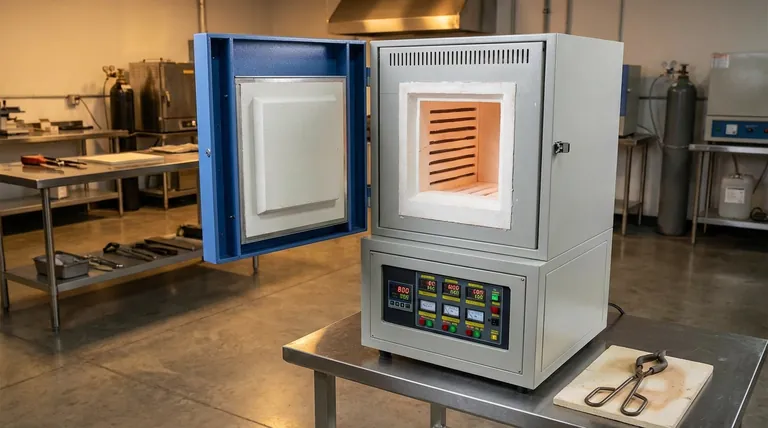
High-temperature quenching and tempering furnaces serve as the critical preparatory stage for advanced surface modification of AISI 304 stainless steel. Specifically, these furnaces subject the material to a precise thermal cycle, heating samples to 980°C for quenching followed by tempering at 650°C. This process is not intended to harden the steel in the traditional sense, but rather to condition the internal matrix structure for subsequent processing.
The primary function of this thermal pre-treatment is to optimize the steel's core toughness, creating a stable mechanical foundation capable of supporting a subsequent high-hardness nitrided layer without failure.
Optimizing the Matrix Structure
The Specific Thermal Cycle
For AISI 304 stainless steel, the process begins by heating the material to 980°C. This high-temperature excursion is immediately followed by a quenching phase.
Tempering for Stability
Following the quench, the material undergoes tempering at 650°C. This secondary heating step is essential for stabilizing the microstructure after the thermal shock of quenching.
Adjusting the Matrix
The combination of these temperatures is engineered to adjust the original matrix structure. This modification ensures the steel achieves the specific mechanical baseline required for surface engineering.
Enabling Surface Hardening
The Requirement for Core Toughness
The ultimate goal of this pre-treatment is to prepare the steel for surface nitriding. A high-hardness surface layer, such as the Fe3N strengthening phase, requires a robust substrate.
Preventing Surface Failure
If a hard nitrided layer is applied to an untreated, soft core, the surface is prone to cracking under load—similar to glass on a soft pillow. The quenching and tempering process provides the necessary core toughness to support this rigid outer shell.
Supporting High Loads
By optimizing the core mechanics first, the final component can withstand significant contact pressure. This ensures the hard surface layer remains intact and does not collapse into the core.
Understanding the Trade-offs
Process Complexity
Adding a quenching and tempering step before nitriding increases the total processing time and energy consumption. It transforms a single-step coating process into a multi-stage manufacturing cycle.
Thermal Stress Risks
Subjecting AISI 304 to temperatures as high as 980°C introduces significant thermal stress. Without precise control, this can lead to dimensional distortion or warping of the component before the surface treatment even begins.
Atmospheric Control
While the primary focus is temperature, these furnaces must often manage the atmosphere to prevent oxidation. Although high-vacuum sintering furnaces are used for other processes (like powder metallurgy), standard heat treatment furnaces must still mitigate surface degradation during these high-heat cycles.
Making the Right Choice for Your Goal
To determine if this pre-treatment cycle is necessary for your AISI 304 components, evaluate your performance requirements:
- If your primary focus is simple corrosion resistance: You may not need this high-temperature cycle, as standard annealing may suffice for basic applications.
- If your primary focus is wear resistance under load: You must implement this quenching (980°C) and tempering (650°C) cycle to ensure your nitrided surface layer does not fail prematurely due to a lack of core support.
By treating the core as the foundation, you ensure the longevity and reliability of the entire component.
Summary Table:
| Process Stage | Temperature | Primary Purpose |
|---|---|---|
| Quenching | 980°C | Adjusts original matrix structure and conditions the core |
| Tempering | 650°C | Stabilizes microstructure and relieves quenching thermal shock |
| Pre-treatment Goal | N/A | Provides core toughness to support high-hardness nitrided layers |
| Application | N/A | Essential for wear-resistant components under high contact pressure |
Elevate Your Material Performance with KINTEK
Don't let surface failure compromise your engineering goals. Whether you are prepping AISI 304 for nitriding or require specialized thermal cycles, KINTEK provides the precision tools you need. Backed by expert R&D and manufacturing, we offer high-performance Muffle, Tube, Rotary, Vacuum, and CVD systems—all customizable to your unique heat treatment specifications.
Maximize your core toughness and ensure surface reliability today.
Contact Our Thermal Experts Now
References
- G. Keerthi Reddy, Khristina Maksudovna Vafaeva. Influence of aisi 304 austenitic stainless steel by aqueous soluted nitriding and gas nitriding. DOI: 10.1051/matecconf/202439201019
This article is also based on technical information from Kintek Furnace Knowledge Base .
Related Products
- High Temperature Muffle Oven Furnace for Laboratory Debinding and Pre Sintering
- 1700℃ High Temperature Laboratory Tube Furnace with Alumina Tube
- 1800℃ High Temperature Muffle Oven Furnace for Laboratory
- 1700℃ High Temperature Muffle Oven Furnace for Laboratory
- 2200 ℃ Tungsten Vacuum Heat Treat and Sintering Furnace
People Also Ask
- What role does a high-temperature muffle furnace play in STFO synthesis? Achieve Pure Perovskite Results
- Why is controlled heat treatment in a muffle furnace necessary for calcined clay? Achieve Optimal Pozzolanic Activity
- What role does a high-temperature muffle furnace play in the multi-stage synthesis of Li0.5MnFe1.5O4? Key to Pure Spinel
- What role does a high-temperature muffle furnace play in the formation of biochar catalysts? Master Catalyst Synthesis
- What is the function of a laboratory high-temperature muffle furnace in niobate phosphor synthesis?



















