
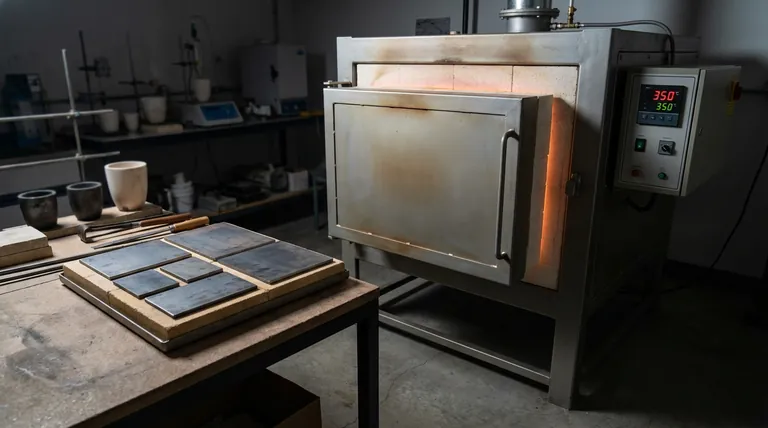
An industrial box resistance furnace facilitates sufficient bainite transformation by creating a highly stable, long-term isothermal environment. By maintaining a specific set temperature, such as 350°C, the furnace allows rapidly cooled steel plates to undergo a slow, complete transformation process.
The furnace serves as a surrogate for the thermal mass of industrial coils, holding steel at a constant temperature to replicate the "self-annealing" effect. This ensures the full conversion of austenite into the desired microstructure of carbide-free bainitic ferrite and retained austenite.
Replicating Industrial Conditions
Establishing the Isothermal Environment
The primary role of the box resistance furnace is to act as a thermal stabilizer.
After the steel plates undergo rapid cooling, they are transferred immediately to the furnace.
The furnace maintains a long-term, stable temperature (e.g., 350°C), ensuring the steel does not experience thermal fluctuations that would interrupt the phase transformation.
Simulating the Self-Annealing Effect
In actual industrial production, thick coils retain heat due to their large mass, creating a "self-annealing" effect.
Laboratory samples lack this physical mass and would cool too quickly in ambient air.
The box furnace compensates for this by providing an external heat source that mimics the slow cooling and heat retention inherent to industrial-scale thick coils.
Achieving the Target Microstructure
Promoting Full Transformation
Bainite transformation is not instantaneous; it requires time and thermal stability.
The furnace allows the austenite to transform slowly and fully.
Without this extended holding period, the transformation might remain incomplete, leading to an unstable microstructure.
Targeting Specific Phases
The ultimate goal of this simulation is to produce a specific set of microstructural components.
The controlled environment facilitates the formation of carbide-free bainitic ferrite.
It also preserves retained austenite, which is critical for the mechanical properties of the final steel product.
Understanding the Trade-offs
The Risk of Temperature Fluctuation
While the furnace aims for stability, any deviation in the isothermal environment can alter the outcome.
If the furnace temperature drifts, the steel may form unwanted phases (such as martensite or pearlite) rather than the targeted bainite.
The Necessity of Time
This process is time-intensive.
The simulation relies on a "long-term" hold to match the industrial self-annealing process.
Cutting the furnace time short will result in insufficient transformation, failing to accurately predict the material's industrial performance.
Making the Right Choice for Your Simulation
To ensure your laboratory results accurately reflect industrial reality, focus on the stability and duration of the heat treatment.
- If your primary focus is microstructural purity: Ensure the furnace maintains strict temperature uniformity to produce exclusively carbide-free bainitic ferrite and retained austenite.
- If your primary focus is process validation: Verify that the furnace holding time is long enough to fully simulate the self-annealing cycle of a thick industrial coil.
The success of the simulation hinges on the furnace's ability to turn a small laboratory sample into a thermal equivalent of a massive industrial coil.
Summary Table:
| Key Feature | Role in Bainite Transformation | Microstructural Impact |
|---|---|---|
| Isothermal Stability | Maintains constant set temperature (e.g., 350°C) | Prevents formation of unwanted martensite/pearlite |
| Simulated Mass | Replaces industrial 'self-annealing' effect | Compensates for small sample rapid heat loss |
| Extended Holding | Provides sufficient time for phase change | Ensures full conversion to carbide-free bainitic ferrite |
| Heat Retention | Mimics slow cooling of thick industrial coils | Stabilizes retained austenite for superior mechanics |
Elevate Your Metallurgical Research with KINTEK
Precision in phase transformation requires absolute thermal control. Backed by expert R&D and world-class manufacturing, KINTEK offers high-performance Muffle, Tube, Rotary, Vacuum, and CVD systems, along with highly customizable Box Resistance Furnaces designed to meet your unique laboratory needs.
Whether you are simulating industrial coiling or developing next-generation alloys, our furnaces provide the temperature uniformity and long-term stability essential for achieving carbide-free bainite and optimized retained austenite.
Ready to transform your simulation accuracy? Contact our technical experts today to find the perfect high-temp solution for your lab.
References
- Radhakanta Rana, Carlos García-Mateo. Design of carbide free bainitic steels for hot rolling practices. DOI: 10.1080/09500839.2024.2322552
This article is also based on technical information from Kintek Furnace Knowledge Base .
Related Products
- Mesh Belt Controlled Atmosphere Furnace Inert Nitrogen Atmosphere Furnace
- 1200℃ Controlled Inert Nitrogen Atmosphere Furnace
- High Pressure Laboratory Vacuum Tube Furnace
- Multi Zone Laboratory Quartz Tube Furnace Tubular Furnace
- 1700℃ Controlled Inert Nitrogen Atmosphere Furnace
People Also Ask
- What are the two main purposes of controlled atmosphere conditions in furnaces? Protect or Transform Materials for Peak Performance
- How is a controlled atmosphere furnace used in material research? Achieve Precise Material Synthesis and Heat Treatment
- How does a controlled atmosphere furnace improve product quality and consistency? Master Precise Heat Treatment for Superior Results
- What types of gases can a controlled atmosphere furnace handle? Master Inert and Reactive Gases for Your Lab
- What types of furnaces have controlled atmosphere furnaces largely replaced? Boost Metallurgical Precision & Safety











