
At its core, a Box Furnace is a versatile workhorse capable of performing a wide variety of common heat treatment processes. These include hardening, tempering, annealing, normalizing, stress relieving, preheating, calcining, and curing, making it a staple in many industrial facilities and laboratories.
A Box Furnace is best understood as a highly capable, general-purpose tool for thermal processing. Its primary strength lies in achieving precise temperatures in a standard air atmosphere, making it ideal for a broad range of applications where surface oxidation is not a critical concern.
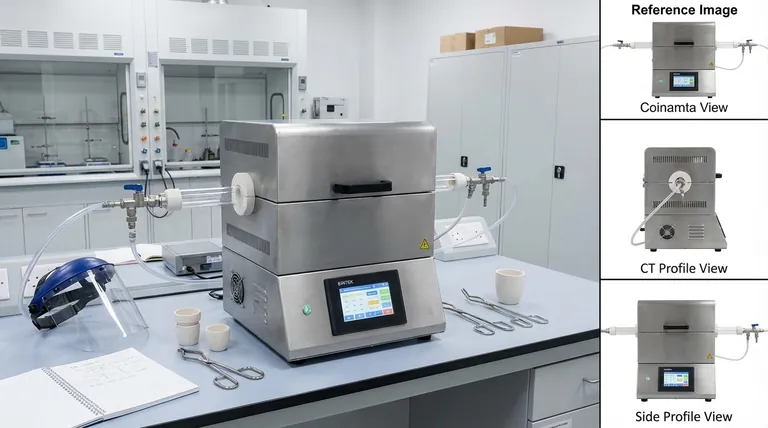
How a Box Furnace Enables Heat Treatment
A Box Furnace, also known as a batch furnace, is defined by its core design: a single chamber with a front-loading door, built for treating parts one batch at a time. This simple yet robust construction is what makes it so adaptable.
Robust Construction for Demanding Loads
Standard Box Furnaces are typically built with heavy plate steel and can accept very heavy loads. This makes them suitable for processing large individual parts or substantial batches of smaller components.
High-Temperature Capability
With ratings often reaching 2000°F and energy-efficient ceramic fiber insulation, these furnaces can easily achieve the temperatures required for most common heat treatments for steels and other alloys.
Precise Process Control
Modern furnaces come equipped with microprocessor-based temperature controllers and SCR power controls (for electric models). This ensures that the heating cycles are precise and repeatable, which is critical for achieving consistent metallurgical properties.
Core Processes Performed in a Box Furnace
The versatility of the Box Furnace allows it to handle the full spectrum of foundational heat treatment operations.
Hardening & Tempering
Hardening involves heating steel to a critical temperature and then rapidly cooling (quenching) it to create a very hard but brittle structure. The part is then tempered—reheated to a lower temperature—to reduce that brittleness and achieve the desired balance of hardness and toughness.
Annealing & Normalizing
Annealing is a process of heating and slow cooling to make a material softer and easier to machine or form. Normalizing involves air cooling after heating, which refines the grain structure and improves strength and uniformity in steel.
Stress Relieving & Preheating
Stress relieving uses lower temperatures to remove internal stresses caused by manufacturing processes like welding or machining, preventing distortion or cracking later on. Preheating is the process of heating a part before a subsequent operation like welding to prevent thermal shock.
Other High-Temperature Operations
Box Furnaces are also used for curing coatings or composite materials and calcining, a process that heats materials to drive off moisture and induce phase changes, often used in ceramics and catalyst production.
Understanding the Trade-offs: Atmosphere is Key
While incredibly versatile, the defining characteristic—and limitation—of a standard Box Furnace is its operating atmosphere.
The Standard Air Atmosphere
A typical Box Furnace operates in ambient air. For many materials and processes, this is perfectly acceptable. However, heating metals in the presence of oxygen will cause oxidation, or scale, to form on the surface.
The Role of Atmosphere Control
For materials where a clean, scale-free surface is critical (e.g., aerospace components, medical implants), a furnace with atmosphere control is required. Vacuum furnaces or inert atmosphere furnaces remove oxygen and other reactive gases to prevent surface reactions like oxidation and decarburization.
Optional Upgrades for Box Furnaces
It's possible to equip a Box Furnace with features like inert gas construction. This allows an inert gas like nitrogen or argon to be introduced, purging most of the oxygen. This provides a higher level of protection than air but typically does not achieve the purity of a dedicated vacuum furnace.
Making the Right Choice for Your Goal
To select the right thermal processing equipment, you must match the furnace's capabilities to your material and final part requirements.
- If your primary focus is general-purpose heat treatment: A standard Box Furnace is an excellent, cost-effective choice for processes like tempering, annealing, and stress relieving where minor surface oxidation is acceptable or can be cleaned off post-treatment.
- If your primary focus is a pristine, un-oxidized surface finish: You should investigate a vacuum furnace or a dedicated atmosphere furnace, as these are specifically designed to protect parts from surface contamination.
- If you need flexibility for both general and sensitive parts: Consider a Box Furnace with an optional inert gas package, which offers a compromise between the simplicity of a standard furnace and the protection of a controlled atmosphere.
Ultimately, choosing the right furnace depends on a clear understanding of your material's sensitivity to the processing atmosphere.
Summary Table:
| Process | Key Function | Typical Temperature Range |
|---|---|---|
| Hardening & Tempering | Increases hardness, then reduces brittleness | Up to 2000°F+ |
| Annealing & Normalizing | Softens material, refines grain structure | Varies by material |
| Stress Relieving & Preheating | Removes internal stresses, prevents thermal shock | Lower temperatures |
| Curing & Calcining | Sets coatings, drives off moisture/phase changes | Varies by application |
Need a furnace that fits your specific thermal processing needs? KINTEK's advanced high-temperature Box Furnaces are engineered for precision and durability. Leveraging our exceptional R&D and in-house manufacturing, we offer deep customization to perfectly match your unique requirements for hardening, annealing, or any other process. Our experts are ready to help you select or design the ideal solution. Contact our team today to discuss your application!
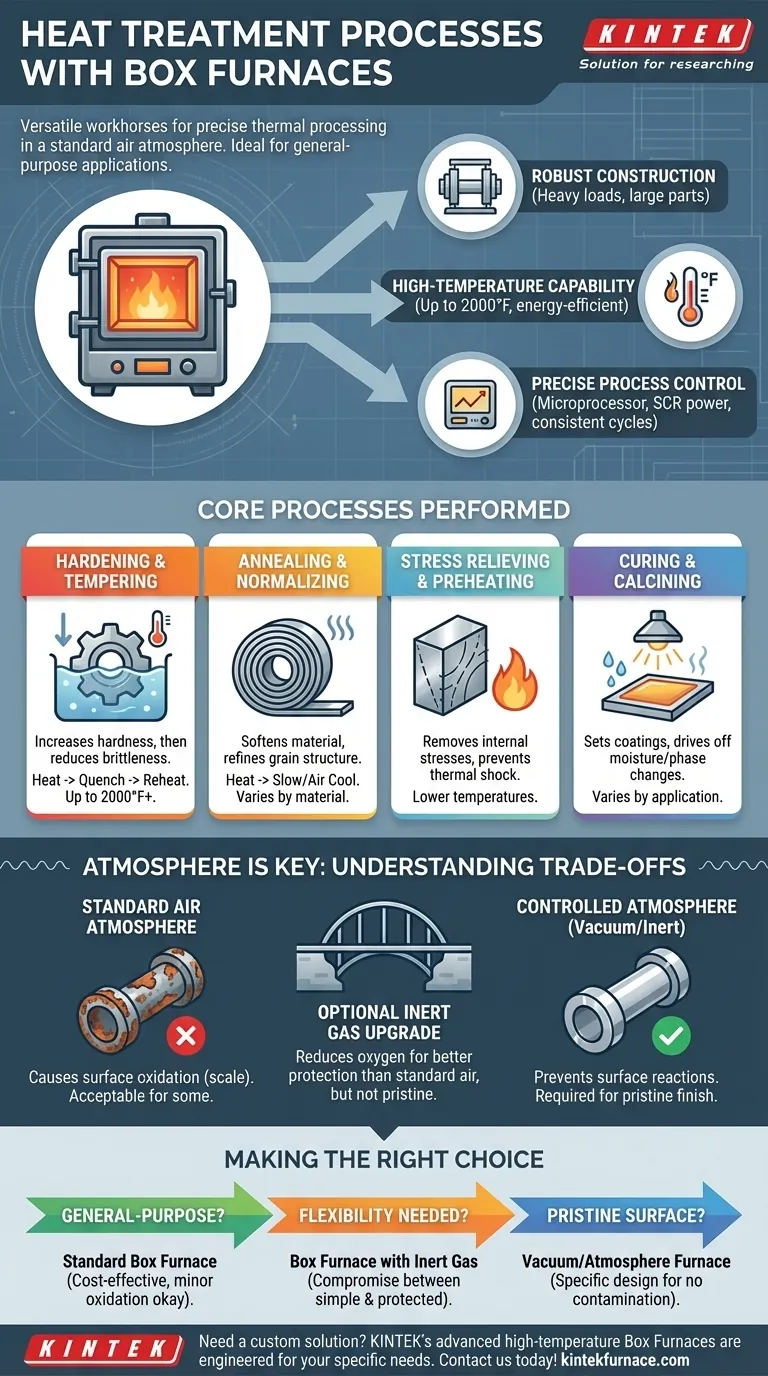
Visual Guide
Related Products
- Vacuum Hot Press Furnace Machine Heated Vacuum Press Tube Furnace
- Mesh Belt Controlled Atmosphere Furnace Inert Nitrogen Atmosphere Furnace
- Vacuum Heat Treat Sintering Furnace with Pressure for Vacuum Sintering
- 600T Vacuum Induction Hot Press Vacuum Heat Treat and Sintering Furnace
- High Temperature Muffle Oven Furnace for Laboratory Debinding and Pre Sintering
People Also Ask
- Why use Vacuum Hot Press (VHP) for ZnS Ceramics? Achieve Superior IR Transparency and Mechanical Strength
- What are the benefits of the vacuum environment system in a vacuum hot press furnace? Unlock High-Density Sintering
- What safety features are incorporated in vacuum hot press furnaces? Ensure Operator and Equipment Protection
- How does the uniaxial pressure applied by a vacuum hot press furnace affect the microstructure of ZrC-SiC materials?
- Why is a high vacuum environment crucial when preparing copper-carbon nanotube composites in a vacuum hot press furnace? Achieve Superior Composite Integrity



















