
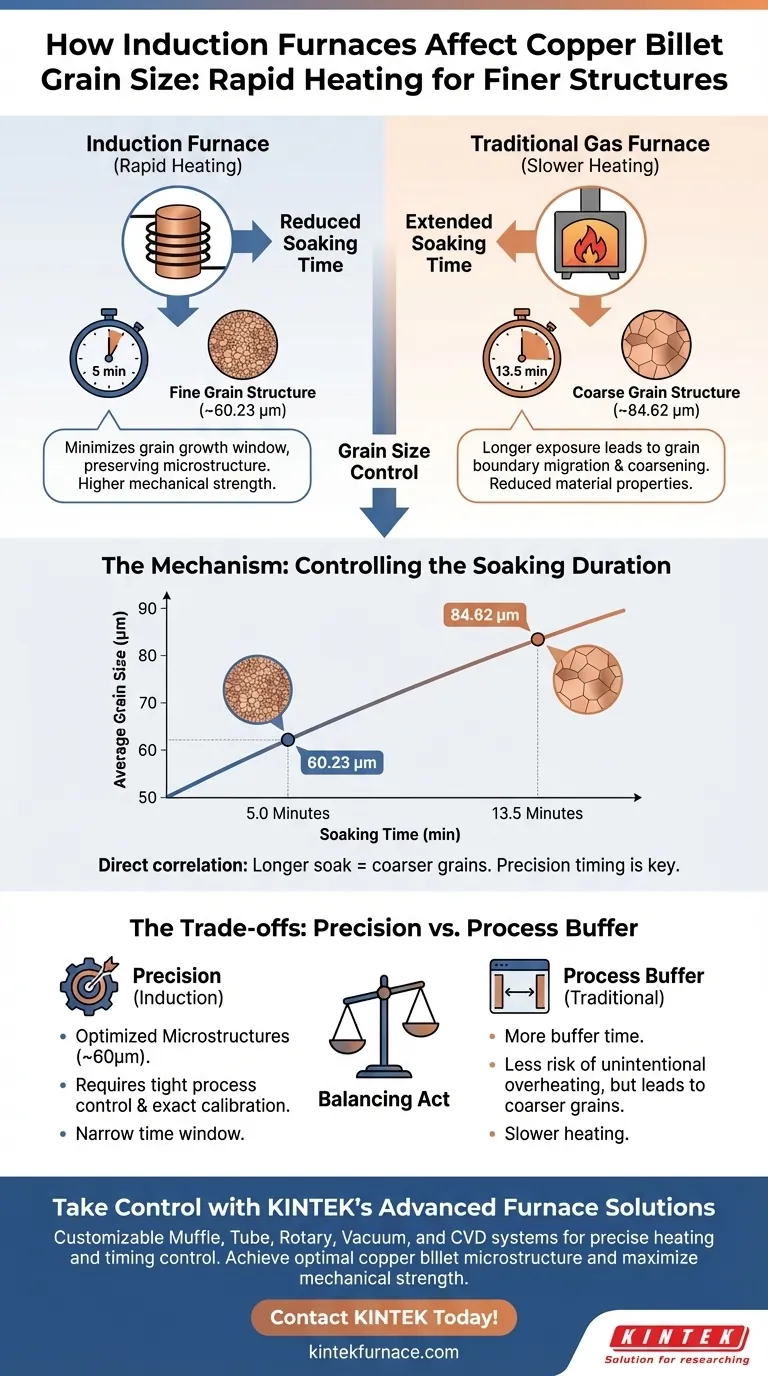
Induction furnaces significantly influence grain size through rapid heating and precise time control. By enabling shorter soaking times compared to traditional gas furnaces, induction heating minimizes the window for grain growth. Specifically, reducing the soaking duration allows the copper billet to retain a finer microstructure, whereas extended exposure to high temperatures invariably leads to grain coarsening.
The rapid heating capability of an induction furnace allows for reduced soaking times, which is the primary factor in preserving fine grain structures in copper billets. Controlling this duration is essential for determining the mechanical properties of the final extruded product.
The Mechanism of Grain Control
Rapid Heating vs. Traditional Methods
Induction furnaces offer a distinct advantage over traditional gas furnaces by generating heat directly within the metal. This allows for rapid heating and precise temperature regulation.
Because the target temperature is reached more quickly, the copper billet spends less total time in the critical grain-growth temperature range.
The Correlation Between Soaking Time and Grain Size
The duration a billet remains at temperature, known as the soaking time, is directly linked to the final grain size.
The relationship is linear: as soaking time increases, grain boundaries migrate and grains merge, resulting in a coarser structure. Controlling this variable is the most effective way to dictate the microstructure of the mother tube.
Data-Driven Evidence
Impact of Short Soaking Durations
Minimizing the soaking time is the key to achieving a fine grain structure.
According to specific processing data, reducing the soaking time in an induction furnace to 5 minutes results in a significantly finer grain size. Under these conditions, the grain size in the mother tube is measured at approximately 60.23 µm.
Consequences of Extended Soaking
When the process is prolonged, the microstructure degrades.
Extending the soaking time to 13.5 minutes allows for substantial grain growth. Data indicates that this longer duration results in grain coarsening up to 84.62 µm, altering the material properties of the alloy.
Understanding the Trade-offs
Precision vs. Process Buffer
While induction heating allows for optimized microstructures, it requires tighter process control than slower heating methods.
Because the window for achieving the optimal 5-minute soak is narrow, operators must ensure precise timing. There is less "buffer" time available compared to slower gas furnaces, meaning unintentional delays can quickly lead to unwanted grain coarsening.
Equipment Calibration
To achieve the specific grain sizes mentioned, the induction furnace requires exact calibration.
Inaccurate temperature sensors or inconsistent power delivery can alter the effective soaking time. This highlights the need for rigorous equipment maintenance to replicate the ~60 µm grain size consistently.
Making the Right Choice for Your Goal
To optimize your copper extrusion process, you must align your furnace settings with your desired material properties.
- If your primary focus is maximizing mechanical strength: Prioritize a short soaking time of approximately 5 minutes to maintain a fine grain size (~60.23 µm).
- If your primary focus is analyzing process defects: Investigate soaking times exceeding 10 minutes, as coarser grains (~84.62 µm) indicate an extended thermal cycle that may be unnecessary.
Mastering the precise timing of your induction furnace is the single most effective lever for controlling copper billet microstructure.
Summary Table:
| Soaking Duration | Average Grain Size (µm) | Microstructure Result | Impact on Material |
|---|---|---|---|
| 5.0 Minutes | ~60.23 µm | Fine Grain | Higher mechanical strength |
| 13.5 Minutes | ~84.62 µm | Coarse Grain | Reduced mechanical properties |
| Rapid Heating | Minimal Growth | Controlled | Optimized for extrusion |
| Extended Heating | Significant Growth | Degraded | Unnecessary thermal cycle |
Precision Heating for Superior Material Properties
Take control of your copper extrusion quality with KINTEK’s advanced induction and high-temperature furnace solutions. Backed by expert R&D and manufacturing, we offer customizable Muffle, Tube, Rotary, Vacuum, and CVD systems designed to provide the rapid heating and precise timing control necessary to prevent grain coarsening and ensure optimal microstructure.
Whether you need to maintain a strict 60µm grain size or require a bespoke system for unique metallurgical needs, KINTEK delivers the equipment and expertise to enhance your lab or production efficiency. Contact KINTEK today to discuss your customization needs!
Visual Guide
References
- Zeynep Sirel, Mehmet Ali Akoy. Influence of Phosphorus Content and Preheating Conditions on Grain Size of Cu-DHP Copper Tubes. DOI: 10.34088/kojose.1475031
This article is also based on technical information from Kintek Furnace Knowledge Base .
Related Products
- 600T Vacuum Induction Hot Press Vacuum Heat Treat and Sintering Furnace
- Vacuum Induction Melting Furnace
- 1200℃ Controlled Inert Nitrogen Atmosphere Furnace
- 1700℃ Controlled Inert Nitrogen Atmosphere Furnace
- Controlled Inert Nitrogen Hydrogen Atmosphere Furnace
People Also Ask
- Why use Vacuum Hot Press (VHP) for ZnS Ceramics? Achieve Superior IR Transparency and Mechanical Strength
- How does a vacuum hot press sintering furnace mitigate copper sintering swelling? Solve Fe-Cu Expansion Issues
- What are the benefits of using a vacuum hot press sintering furnace for the preparation of SiCw/2024 aluminum matrix composites? Achieve High-Performance Aerospace Materials
- How does the vacuum environment in a vacuum hot press sintering furnace protect chromium-containing ceramics? Find out.
- What are the key advantages of vacuum hot press sintering furnaces? Achieve Superior Density and Purity in Materials



















