
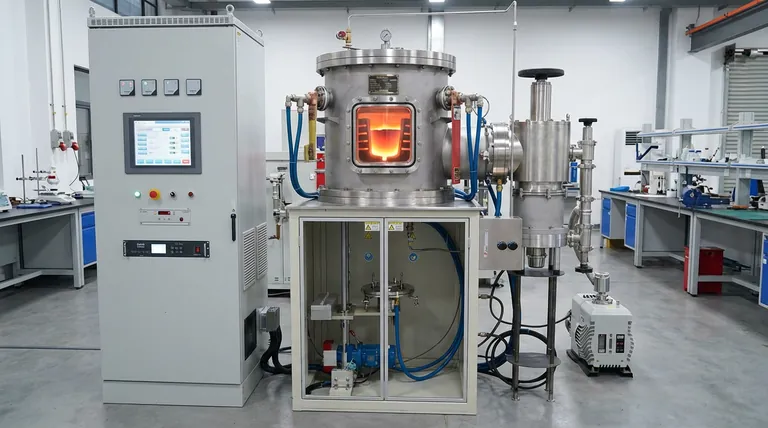
The primary function of this specialized furnace setup is to achieve high-purity melting and uniform alloying of reactive titanium without contamination. It combines electromagnetic induction to vigorously stir and react carbon with the metal matrix, while simultaneously utilizing a water-cooled copper crucible to prevent the molten titanium from touching and reacting with traditional container materials.
Core Takeaway This technology solves the fundamental conflict between the need for vigorous mixing and the high reactivity of molten titanium. It allows you to produce a homogeneous carbon-containing Ti-5Al-2.5Sn alloy by using the alloy’s own frozen outer layer—a "skull"—as a protective barrier, eliminating the impurities inherent in standard refractory melting.
The Critical Role of the Cold Copper Crucible
The "Skull" Melting Mechanism
The defining feature of this system is the cold copper crucible, which is actively water-cooled. Instead of the molten metal touching the crucible wall directly, the cooling effect causes the outer layer of the titanium alloy to freeze instantly upon contact.
Preventing Chemical Contamination
This frozen layer, known as a "skull," acts as a self-lining protective barrier. Because molten titanium is highly reactive, it would aggressively attack and dissolve standard refractory (ceramic) linings, introducing impurities.
Ensuring Exceptional Purity
By isolating the liquid melt within a shell of its own solid material, the process ensures zero cross-contamination from the crucible itself. This is the only reliable way to maintain the strict purity requirements necessary for aerospace-grade Ti-5Al-2.5Sn alloys.
Achieving Homogeneity Through Induction
Electromagnetic Stirring
The vacuum induction furnace (VIF) generates strong electromagnetic fields to heat the material. Beyond generating heat, these fields induce a vigorous stirring action within the molten pool.
Promoting Carbon-Metal Reactions
Carbon is often difficult to diffuse uniformly into a titanium matrix due to density differences and reactivity issues. The induction-driven stirring forces the carbon and metal elements to mix thoroughly, promoting a complete and uniform reaction.
Compositional Control
The vacuum environment inherent to VIF protects active elements from oxidation. This allows for precise control over the alloy's stoichiometry, ensuring the final chemical composition matches the intended design specifications.
Understanding the Trade-offs
Thermal Efficiency Challenges
Using a cold crucible is thermally inefficient compared to traditional ceramic crucibles. A significant amount of thermal energy is lost through the water-cooled walls to maintain the solid skull, requiring higher power inputs to keep the core molten.
Complexity of Operation
Balancing the cooling rate of the crucible with the heating power of the induction coil requires precise control. If the melt becomes too hot, it risks damaging the copper crucible; if it is too cool, the skull becomes too thick, reducing the volume of the usable melt.
Making the Right Choice for Your Goal
To maximize the quality of your carbon-containing Ti-5Al-2.5Sn alloy, consider how this technology aligns with your specific priorities:
- If your primary focus is material purity: Rely on the cold copper crucible's skull-melting capability to completely eliminate oxide or ceramic inclusions derived from containment vessels.
- If your primary focus is microstructural uniformity: Leverage the electromagnetic stirring of the induction furnace to ensure the carbon is evenly distributed and fully reacted throughout the titanium matrix.
Ultimate Success: The vacuum induction furnace with a cold copper crucible is the definitive tool for converting raw elements into a pristine, chemically homogeneous titanium alloy foundation.
Summary Table:
| Feature | Function in Ti-5Al-2.5Sn Preparation | Key Benefit |
|---|---|---|
| Cold Copper Crucible | Creates a solid 'skull' of the alloy to act as a barrier. | Eliminates contamination from refractory materials. |
| Vacuum Induction | Uses electromagnetic fields for heating and vigorous stirring. | Ensures uniform carbon diffusion and prevents oxidation. |
| Water-Cooling System | Maintains the temperature of the crucible walls. | Protects the equipment from reactive molten titanium. |
| Skull Melting | Utilizes the alloy's own frozen layer as a lining. | Guarantees aerospace-grade material purity. |
Elevate Your Material Purity with KINTEK
Precision in titanium alloying requires more than just heat—it requires a contamination-free environment. KINTEK provides industry-leading vacuum induction and high-temperature furnace systems tailored for reactive metal processing. Backed by expert R&D and manufacturing, we offer Muffle, Tube, Rotary, Vacuum, and CVD systems, all fully customizable to meet your unique metallurgical specifications.
Ready to optimize your Ti-5Al-2.5Sn production? Contact KINTEK today to discuss how our specialized furnace solutions can deliver the homogeneity and purity your aerospace projects demand.
References
- Agnieszka Szkliniarz, W. Szkliniarz. Microstructure and Properties of Ti-5Al-2.5Sn Alloy with Higher Carbon Content. DOI: 10.3390/coatings15020224
This article is also based on technical information from Kintek Furnace Knowledge Base .
Related Products
- 600T Vacuum Induction Hot Press Vacuum Heat Treat and Sintering Furnace
- Vacuum Induction Melting Furnace
- Vacuum Heat Treat Sintering Furnace with Pressure for Vacuum Sintering
- Small Vacuum Heat Treat and Tungsten Wire Sintering Furnace
- 2200 ℃ Tungsten Vacuum Heat Treat and Sintering Furnace
People Also Ask
- Why use Vacuum Hot Press (VHP) for ZnS Ceramics? Achieve Superior IR Transparency and Mechanical Strength
- How does a vacuum hot press sintering furnace mitigate copper sintering swelling? Solve Fe-Cu Expansion Issues
- What are the key advantages of vacuum hot press sintering furnaces? Achieve Superior Density and Purity in Materials
- What is the core function of a vacuum hot press sintering furnace in the preparation of high-density RuTi alloys? Achieve Maximum Density and Purity
- How does the vacuum environment in a vacuum hot press sintering furnace protect chromium-containing ceramics? Find out.



















