
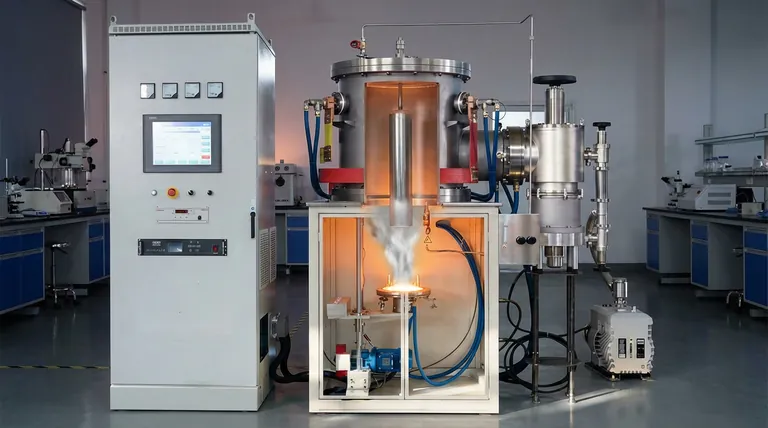
A vertical high-temperature vacuum furnace facilitates internal magnesium coating by creating a precisely controlled environment for evaporation and deposition. By maintaining a vacuum and heating magnesium powder to 600°C, the furnace vaporizes the material, allowing it to traverse the tube and condense uniformly onto the inner iron surface through carefully managed temperature differentials.
This process acts as a critical protective step, establishing a coating that prevents unwanted reactions between the iron sheath and boron to ensure a high-purity superconducting layer.
The Physics of the Coating Process
Eliminating Atmospheric Interference
The primary function of the vacuum system is to remove atmospheric gases that could interfere with the coating process.
By operating in a vacuum, the furnace ensures that the magnesium travels unimpeded and does not oxidize or react with air during the heating phase.
Controlled Evaporation
Inside the furnace, the temperature is raised to exactly 600°C.
At this specific thermal point, the magnesium powder placed inside the assembly evaporates, transitioning from solid to vapor.
Deposition via Temperature Differentials
The furnace does not simply heat the entire assembly uniformly; it leverages temperature differentials.
The magnesium vapor migrates from the hot evaporation source toward the inner surface of the iron tube.
Upon contact with the tube surface, the vapor condenses, solidifying into a consistent, uniform magnesium layer.
The Critical Role in MgB2 Wire Fabrication
Shielding the Iron Sheath
The iron tube serves as the sheath for the wire, but it poses a chemical risk to the superconducting materials.
Without a barrier, boron—a key component of Magnesium Diboride (MgB2)—is liable to react chemically with the iron sheath.
Increasing Superconductor Purity
The internal magnesium coating acts as a sacrificial barrier or buffer.
By minimizing the interaction between boron and the iron sheath, the process prevents contamination.
This results in a significantly higher purity for the final superconducting layer, which is essential for optimal electrical performance.
Critical Process Constraints
The Necessity of Strict Thermal Control
The primary reference highlights that the thermal environment must be "strictly controlled."
Fluctuations in temperature or inadequate vacuum pressure can lead to uneven coating thickness or incomplete vaporization.
Sensitivity to Temperature Differentials
The success of the condensation phase relies entirely on maintaining the correct temperature gradient.
If the differential between the vapor source and the tube wall is insufficient, the magnesium may not condense efficiently, compromising the coating's uniformity.
Ensuring Fabrication Success
To maximize the efficacy of this process for your specific requirements, consider the following:
- If your primary focus is material purity: Ensure the vacuum system is fully optimized to prevent oxidation and that the magnesium coating is thick enough to fully isolate the boron from the iron.
- If your primary focus is coating uniformity: Prioritize the calibration of temperature differentials within the vertical furnace to guarantee even condensation along the entire length of the tube.
Strict adherence to the 600°C evaporation point and vacuum integrity is the only way to reliably produce high-performance MgB2 wire.
Summary Table:
| Process Phase | Action | Purpose |
|---|---|---|
| Vacuum Activation | Removal of atmospheric gases | Prevents magnesium oxidation and interference |
| Thermal Evaporation | Heating powder to 600°C | Converts solid magnesium into vapor for transport |
| Controlled Deposition | Creating temperature differentials | Ensures uniform condensation on the iron tube inner surface |
| Barrier Formation | Internal Mg coating | Prevents reaction between iron sheath and boron powder |
Elevate Your Superconductor Fabrication with KINTEK
Precision is paramount when managing the delicate temperature differentials required for MgB2 wire coating. KINTEK provides industry-leading Vertical Vacuum and High-Temperature Furnaces designed to deliver the strict thermal control and vacuum integrity your research demands.
Backed by expert R&D and world-class manufacturing, we offer customizable Muffle, Tube, Rotary, Vacuum, and CVD systems tailored to your unique material science challenges. Whether you are optimizing material purity or coating uniformity, our systems ensure reliable, repeatable results for lab and industrial applications.
Ready to refine your high-temperature processes? Contact our technical experts today to discuss your custom furnace solution!
References
- Daniel Gajda, Tomasz Czujko. Investigation of Layered Structure Formation in MgB2 Wires Produced by the Internal Mg Coating Process under Low and High Isostatic Pressures. DOI: 10.3390/ma17061362
This article is also based on technical information from Kintek Furnace Knowledge Base .
Related Products
- Vertical Laboratory Quartz Tube Furnace Tubular Furnace
- 2200 ℃ Tungsten Vacuum Heat Treat and Sintering Furnace
- Molybdenum Vacuum Heat Treat Furnace
- 2200 ℃ Graphite Vacuum Heat Treat Furnace
- Vacuum Heat Treat Sintering Furnace Molybdenum Wire Vacuum Sintering Furnace
People Also Ask
- What are the key differences between single-zone and multi-zone vertical tube furnaces? Choose the Right Furnace for Your Lab
- What is the purpose of using an industrial-grade vertical tube furnace in phosphorus recovery? High-Fidelity Simulation
- How are wafers loaded and unloaded in a vertical tube furnace? Achieve Precision and Purity in Wafer Processing
- What is a vertical tube furnace and how does it function? Optimize Material Processing with Precision
- What are the main characteristics of vertical tube furnaces? Optimize Your Lab with Space-Saving, Uniform Heating



















