
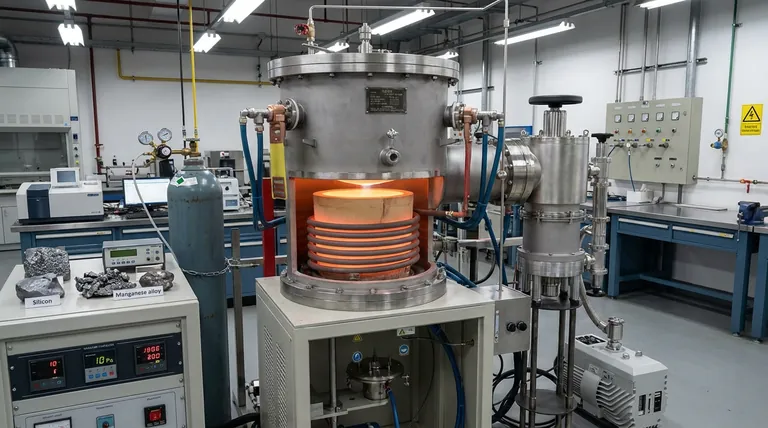
A Vacuum Induction Furnace functions by combining electromagnetic coil induction heating with a strictly controlled vacuum and argon atmosphere. It creates a high-temperature melting environment that isolates the molten metal from air interference, typically achieving a vacuum level of 10 Pa before heating to ensure experimental purity.
The core value of this furnace lies in its ability to eliminate variables; by preventing secondary oxidation and precisely controlling initial oxygen content, it ensures that any changes in the melt are solely the result of the Silicon-Manganese deoxidation process.
Generating Controlled Heat
Electromagnetic Induction
The furnace utilizes a water-cooled induction coil surrounding a refractory-lined crucible. When activated, this coil generates a magnetic field that induces eddy currents within the metal charge, rapidly generating heat to melt the steel.
Inherent Stirring Action
Beyond simple heating, the electromagnetic field creates a natural stirring effect within the molten pool. This ensures the Silicon and Manganese deoxidizers are homogeneously distributed throughout the melt, which is critical for consistent reaction rates.
Isolating the Experimental Environment
Achieving High Vacuum
Before the heating process begins, the system is evacuated to a high vacuum level, specifically 10 Pa. This step effectively degasses the chamber, removing ambient oxygen and nitrogen that would otherwise contaminate the experiment.
Argon Gas Protection
Once the vacuum is established, the chamber is often filled with argon gas. This inert atmosphere acts as a shield, preventing air from re-entering the environment and interacting with the molten steel during the high-temperature phase.
Why This Configuration Matters for Deoxidation
Preventing Secondary Oxidation
The primary function of the vacuum-argon system is to prevent secondary oxidation. In an open furnace, atmospheric oxygen would continuously react with the melt, making it impossible to distinguish between the oxygen removed by the deoxidizer and the oxygen absorbed from the air.
Protecting Reactive Elements
Manganese is highly susceptible to oxidative loss at high temperatures. The controlled low-pressure environment prevents the oxidative loss of manganese, ensuring the alloy composition remains stable throughout the simulation.
Accurate Thermodynamic Data
By strictly controlling the initial oxygen content and isolating the system, researchers can obtain precise thermodynamic data. This ensures the results reflect the true efficiency of the Silicon-Manganese deoxidation, rather than environmental anomalies.
Understanding the Constraints
Operational Complexity
Achieving and maintaining a 10 Pa vacuum adds significant complexity compared to standard atmospheric furnaces. Any breach in the vacuum seal or impurities in the argon supply can immediately invalidate the thermodynamic data.
Volatility Management
While the vacuum removes reactive gases, high vacuum conditions can theoretically encourage the evaporation of volatile elements like manganese. This is why the argon backfill is not optional—it provides the necessary partial pressure to suppress evaporation while maintaining chemical inertness.
Making the Right Choice for Your Research
To ensure your experimental simulation yields valid results, consider these operational priorities:
- If your primary focus is Thermodynamic Accuracy: Prioritize the integrity of the vacuum seal and argon purity to absolutely prevent secondary oxidation interactions.
- If your primary focus is Alloy Homogeneity: Rely on the induction stirring mechanism to ensure the deoxidizing agents are uniformly dispersed for consistent reaction kinetics.
The Vacuum Induction Furnace is not merely a melting tool; it is a precision instrument designed to isolate chemical reactions from the variables of the outside world.
Summary Table:
| Feature | Function in Deoxidation Simulation | Benefit to Research |
|---|---|---|
| Vacuum System (10 Pa) | Removes ambient oxygen and nitrogen | Prevents secondary oxidation & contamination |
| Induction Coil | Generates eddy currents for heating | Rapid melting & precise temp control |
| Stirring Action | Homogenizes molten pool via magnetic field | Ensures uniform deoxidizer distribution |
| Argon Backfill | Maintains inert partial pressure | Prevents volatile manganese evaporation |
| Sealed Environment | Isolates chemical reactions | Provides accurate thermodynamic data |
Elevate Your Metallurgical Research with KINTEK
Precise deoxidation studies require an environment free from atmospheric interference. KINTEK provides industry-leading Vacuum Induction Furnaces, Muffle, Tube, and CVD systems designed to meet the rigorous demands of modern laboratories.
Backed by expert R&D and world-class manufacturing, our systems are fully customizable to your specific simulation needs—ensuring you achieve the 10 Pa vacuum integrity and thermal stability your research deserves.
Ready to eliminate experimental variables? Contact our technical experts today to discuss your custom high-temperature furnace solution.
References
- Tian-le Song, Zefeng Zhang. Effect of Silicon–Manganese Deoxidation on Oxygen Content and Inclusions in Molten Steel. DOI: 10.3390/pr12040767
This article is also based on technical information from Kintek Furnace Knowledge Base .
Related Products
- 600T Vacuum Induction Hot Press Vacuum Heat Treat and Sintering Furnace
- Vacuum Induction Melting Furnace
- High Pressure Laboratory Vacuum Tube Furnace
- Small Vacuum Heat Treat and Tungsten Wire Sintering Furnace
- Vacuum Hot Press Furnace Machine Heated Vacuum Press Tube Furnace
People Also Ask
- Why use Vacuum Hot Press (VHP) for ZnS Ceramics? Achieve Superior IR Transparency and Mechanical Strength
- How does a vacuum hot press sintering furnace mitigate copper sintering swelling? Solve Fe-Cu Expansion Issues
- What is the core function of a vacuum hot press sintering furnace in the preparation of high-density RuTi alloys? Achieve Maximum Density and Purity
- How does the vacuum environment in a vacuum hot press sintering furnace protect chromium-containing ceramics? Find out.
- What are the benefits of using a vacuum hot press sintering furnace for the preparation of SiCw/2024 aluminum matrix composites? Achieve High-Performance Aerospace Materials



















