
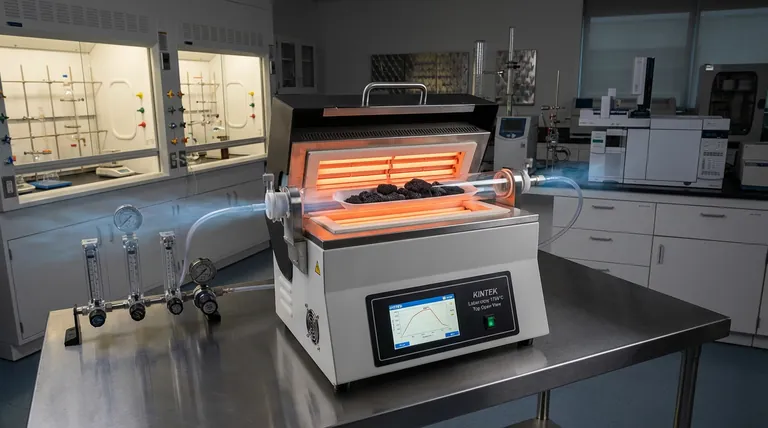
A tube furnace serves as the foundational reactor for activating autohydrolysis residues, providing the strictly controlled environment necessary to transform waste biomass into high-value porous carbon. By maintaining a target temperature of 800 °C under a continuous flow of high-purity nitrogen, the furnace prevents the material from burning to ash and instead forces the potassium oxalate (K2C2O4) to chemically etch the carbon framework.
Core Takeaway The tube furnace is not merely a heat source; it is an isolation chamber that eliminates oxygen to prevent combustion. This allows the activator to consume specific carbon atoms, creating a highly developed microporous structure with a vast specific surface area.
Creating the Conditions for Chemical Activation
Eliminating Oxygen Interference
The primary contribution of the tube furnace is the creation of a strictly managed inert atmosphere.
By pumping high-purity nitrogen into the sealed tube, the furnace purges all oxygen from the reaction zone.
Without this protection, the high temperatures would cause oxidative combustion, turning the carbon material into carbon dioxide and ash rather than activated carbon.
Facilitating the High-Temperature Reaction
The furnace sustains a precise temperature of 800 °C, which is the thermal threshold required for this specific activation process.
At this temperature, the potassium oxalate activator decomposes and reacts aggressively with the carbon framework.
This thermal stability ensures the reaction occurs uniformly throughout the residue, rather than only on the surface.
Why Precision Matters for Porosity
Constructing the Microporous Structure
The ultimate goal of using a tube furnace is to control the physical architecture of the carbon.
The environment allows the potassium oxalate to "dig" into the carbon skeleton, creating a network of microscopic holes known as micropores.
This precise etching process results in a material with a high specific surface area, which is critical for adsorption applications.
Uniform Heating and Decomposition
Unlike standard ovens, a tube furnace provides exceptional uniformity in heating across the sample.
This consistency ensures that the thermochemical decomposition of the hydrochar/residue mixture happens evenly.
Variations in temperature could lead to inconsistent pore development or incomplete activation.
Operational Trade-offs and Considerations
Volume vs. Control
While tube furnaces offer superior atmospheric control, they often suffer from limited workspace size compared to industrial kilns.
You are trading massive throughput for the ability to strictly manipulate the material's microstructure and composition.
Gas Flow Management
The effectiveness of the activation is entirely dependent on the atmosphere flow rate.
If the nitrogen flow is too low, evolved gases from the reaction may not be cleared effectively; if too high, it may cool the sample surface.
Maintaining the "purity" of the inert gas is a non-negotiable operational cost and complexity.
Optimizing the Activation Process
To achieve the best results with potassium oxalate activation, align your furnace settings with your specific objectives:
- If your primary focus is Maximum Surface Area: Prioritize high-purity nitrogen flow to ensure zero oxidation occurs while the micropores are being formed at 800 °C.
- If your primary focus is Material Consistency: Ensure the "dwell time" (the duration the material remains at peak temperature) is sufficient for the heat to penetrate the center of the powder bed.
The tube furnace converts a chaotic combustion risk into a controlled chemical manufacturing process.
Summary Table:
| Parameter | Role in Activation Process | Impact on Material |
|---|---|---|
| Inert Atmosphere | Purges oxygen using high-purity nitrogen | Prevents combustion and ash formation |
| Temperature (800°C) | Facilitates K2C2O4 decomposition | Triggers chemical etching of carbon framework |
| Thermal Uniformity | Ensures consistent heat distribution | Promotes uniform pore size and structure |
| Flow Control | Manages gas exchange rates | Removes reaction by-products for purity |
Elevate Your Materials Research with KINTEK Precision
Unlock the full potential of your carbon activation and biomass research with industry-leading thermal technology. Backed by expert R&D and manufacturing, KINTEK offers high-performance Tube, Muffle, Rotary, Vacuum, and CVD systems—all fully customizable to meet your specific laboratory requirements.
Whether you are scaling up production or refining microporous architectures, our furnaces provide the atmospheric control and thermal stability your breakthrough deserves. Contact KINTEK today to consult with our experts and find the perfect high-temperature solution for your needs.
References
- Dang Duc Viet, Toshiki Tsubota. Autohydrolysis treatment of bamboo and potassium oxalate (K2C2O4) activation of bamboo product for CO2 capture utilization. DOI: 10.1007/s11705-024-2402-8
This article is also based on technical information from Kintek Furnace Knowledge Base .
Related Products
- Vacuum Sealed Continuous Working Rotary Tube Furnace Rotating Tube Furnace
- 1400℃ High Temperature Laboratory Tube Furnace with Alumina Tube
- 1700℃ High Temperature Laboratory Tube Furnace with Alumina Tube
- High Pressure Laboratory Vacuum Tube Furnace
- Magnesium Extraction and Purification Condensing Tube Furnace
People Also Ask
- What is the purpose of rotary tube furnaces? Achieve Uniform Heat Treatment for Powders and Granules
- What are the key advantages of using a rotary tube furnace? Achieve Dynamic, Uniform Heating for Powders
- How does the amount of material processed vary between batch and continuous rotary tube furnaces? Scale Your Production Efficiently
- What are the advantages of rotary tube furnaces in fuel compatibility? Boost Efficiency and Cut Costs
- What is the temperature range of some rotary tube furnaces? Achieve Uniform Heating Up to 1200°C



















