
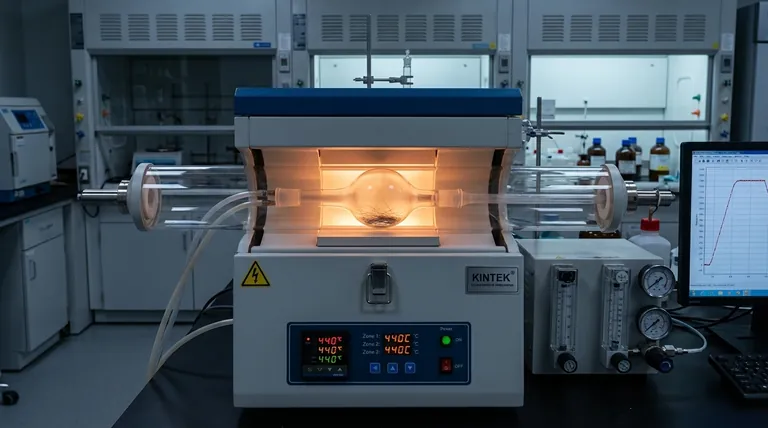
A three-zone tube furnace facilitates germanium nanowire synthesis by creating a precise thermal environment essential for the solvent-vapor growth (SVG) process. Through the establishment of specific temperature gradients, the furnace maintains a stable reaction temperature of 440°C within the vessel, enabling the controlled decomposition of the precursor.
The core advantage of the three-zone configuration is its ability to maintain the reaction vessel at an exact 440°C while managing thermal gradients. This stability is the critical factor in ensuring the complete decomposition of diphenylgermane (DPG) to produce high-quality nanowires.
The Role of Thermal Precision in SVG
Establishing Temperature Gradients
The defining feature of a three-zone tube furnace is its ability to create distinct thermal zones along the length of the heating element.
Unlike single-zone heaters, this configuration allows researchers to establish specific temperature gradients. This control is necessary to direct heat precisely where it is needed relative to the reaction vessel.
Maintaining Reaction Stability
For the solvent-vapor growth of germanium nanowires, the furnace is tasked with maintaining a stable high temperature of 440°C.
This temperature must be held constant within the specific reaction vessel, typically a long-neck round-bottom flask. Fluctuations at this stage can disrupt the growth mechanism.
Mechanism of Nanowire Formation
Precursor Decomposition
The primary chemical objective of the furnace's thermal environment is the decomposition of the precursor, diphenylgermane (DPG).
The precise 440°C heat ensures that this decomposition is complete. Incomplete decomposition often leads to lower quality materials or failed synthesis.
Catalyst Interaction and Growth
The decomposition of DPG occurs under the influence of catalysts within the heated zone.
The thermal stability provided by the three-zone furnace facilitates the correct interaction between the precursor vapor and the catalyst. This results in the formation of germanium nanowires with high aspect ratios, a key indicator of structural quality.
Understanding the Operational Trade-offs
Sensitivity to Calibration
While a three-zone furnace offers superior control, it introduces complexity in calibration.
The user must ensure that the interplay between the three zones actually results in 440°C at the specific location of the flask. Miscalibration of the gradients can lead to cold spots where decomposition fails.
Dependency on Vessel Placement
The effectiveness of the thermal gradient is highly dependent on the physical positioning of the long-neck round-bottom flask.
Because the furnace relies on spatial gradients, slight misalignments of the vessel relative to the heating zones can alter the effective reaction temperature, negatively impacting the aspect ratio of the nanowires.
Optimizing Your Synthesis Setup
To achieve the best results in germanium nanowire growth, focus on the precision of your thermal profile.
- If your primary focus is maximizing aspect ratios: Prioritize the stability of the central heating zone to ensure the reaction vessel never deviates from the 440°C target.
- If your primary focus is precursor efficiency: strict calibration of the thermal gradients is required to ensure complete decomposition of the diphenylgermane (DPG), preventing wasted material.
Success in solvent-vapor growth relies not just on reaching high temperatures, but on the unwavering stability of the thermal environment.
Summary Table:
| Parameter | Role in Ge NW Synthesis | Importance |
|---|---|---|
| Temperature Target | Constant 440°C in reaction vessel | Ensures complete DPG decomposition |
| Zone Configuration | Three-zone independent control | Manages precise thermal gradients |
| Precursor | Diphenylgermane (DPG) | Source material for nanowire growth |
| Key Outcome | High Aspect Ratio | Indicator of superior structural quality |
Elevate Your Nanomaterial Synthesis with KINTEK
Precision thermal environments are the backbone of successful solvent-vapor growth. KINTEK provides industry-leading R&D and manufacturing expertise to deliver high-performance Tube, Muffle, Rotary, and Vacuum furnace systems tailored for advanced material science. Whether you are synthesizing germanium nanowires or developing next-generation CVD processes, our customizable three-zone furnaces ensure the unwavering temperature stability your research demands.
Ready to optimize your lab’s thermal precision?
Contact KINTEK Today for a Custom Solution
References
- Syed Abdul Ahad, Hugh Geaney. Lithiophilic interlayer driven ‘bottom-up’ metal infilling in high current density Li-metal anodes. DOI: 10.1039/d4ta01072h
This article is also based on technical information from Kintek Furnace Knowledge Base .
Related Products
- Split Multi Heating Zone Rotary Tube Furnace Rotating Tube Furnace
- Multi Zone Laboratory Quartz Tube Furnace Tubular Furnace
- Multi Heating Zones CVD Tube Furnace Machine for Chemical Vapor Deposition Equipment
- Magnesium Extraction and Purification Condensing Tube Furnace
- Vertical Laboratory Quartz Tube Furnace Tubular Furnace
People Also Ask
- What are the main applications of multi zone tube furnaces in university laboratories? Unlock Precision in Material Science and Energy Research
- How are multi zone tube furnaces used in ceramics, metallurgy and glass research? Unlock Precise Thermal Control for Advanced Materials
- What environmental protection applications utilize multi zone tube furnaces? Unlock Precision in Waste Treatment and Green Tech
- What temperature-related capabilities make multi zone tube furnaces valuable for research? Unlock Precision Thermal Control
- Why are multi zone tube furnaces particularly useful for nanomaterial research? Unlock Precise Thermal Control for Advanced Synthesis



















