
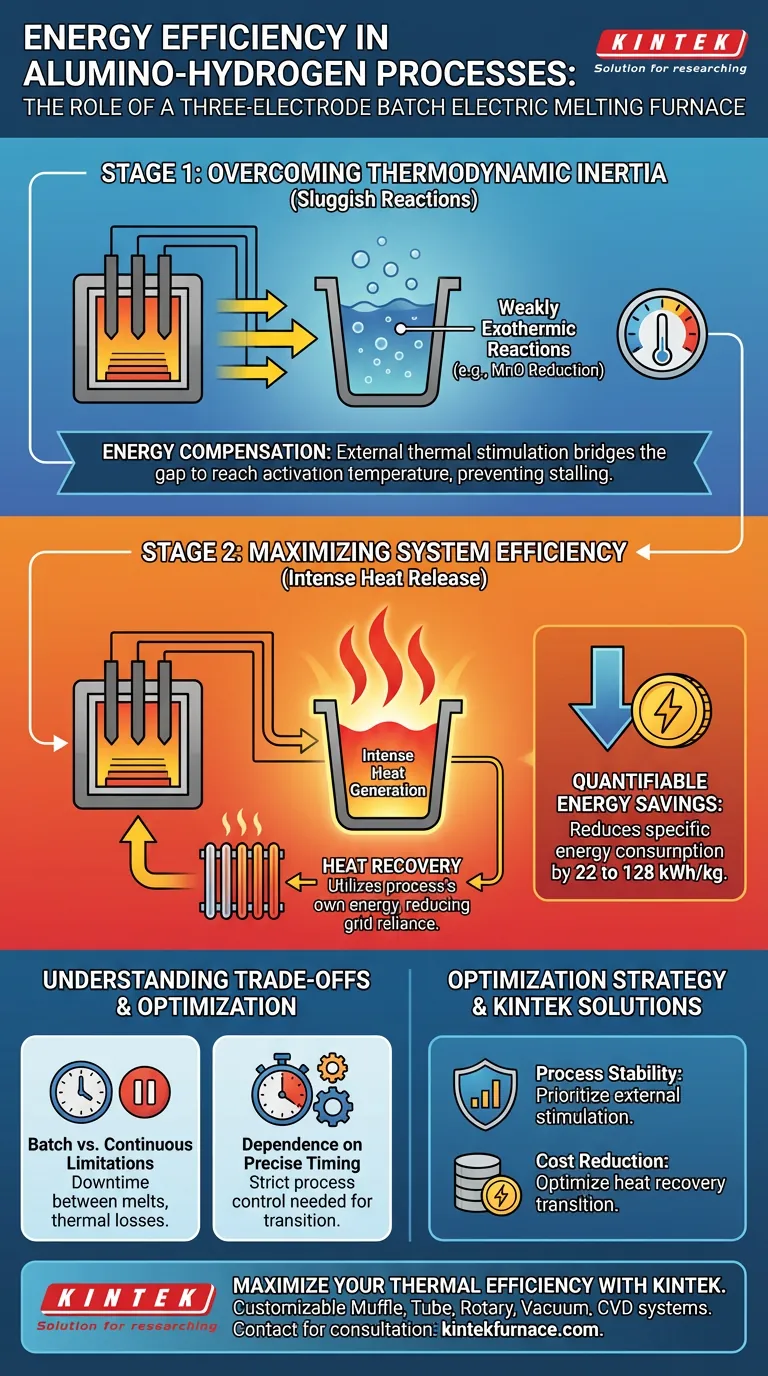
A three-electrode batch electric melting furnace acts as a critical thermal bridge, supplying external energy when chemical reactions are insufficient to sustain themselves. Specifically, it compensates for the low heat output during the initial reduction of oxides, ultimately reducing specific energy consumption by 22 to 128 kWh per kilogram of product.
Core Takeaway: The furnace does not merely melt material; it actively balances the thermodynamic inefficiencies of the alumino-hydrogen process by jumpstarting weakly exothermic reactions and enabling the recovery of heat generated in later stages.
Overcoming Thermodynamic Inertia
Stimulating Weak Reactions
The primary challenge in combined alumino-hydrogen thermal reduction is that early reaction stages are often chemically sluggish.
The reduction of specific components, such as manganese oxides to MnO, is weakly exothermic.
Without external intervention, these reactions lack the naturally occurring thermal energy required to propagate effectively.
The Role of the Three-Electrode System
The electric furnace provides the necessary energy compensation to bridge this thermodynamic gap.
By applying external thermal stimulation, the furnace ensures the process reaches the necessary activation temperatures during the aluminothermic stage.
This prevents the reaction from stalling due to insufficient heat generation.
Maximizing System Efficiency
Facilitating Heat Recovery
Once the reaction moves past the initial sluggish stage, subsequent chemical interactions release intense heat.
The furnace infrastructure is not just an input device; it is designed to coordinate with this thermal shift.
This coordination allows the system to utilize the process's own generated energy rather than relying solely on the electrical grid for the duration of the cycle.
Quantifiable Energy Savings
The impact of this thermal management is measurable and significant.
By optimizing the heating cycle to match the reaction's needs, specific energy consumption drops by 22 to 128 kWh per kilogram.
This represents a massive improvement in overall energy utilization for the production line.
Understanding the Trade-offs
Batch vs. Continuous Limitations
While efficient per cycle, this is specifically a batch electric melting furnace.
This implies inherent downtime between melts for loading and discharging, which can impact overall throughput compared to fully continuous systems.
The energy savings during the melt must be weighed against the thermal losses that occur while the furnace is idle between batches.
Dependence on Precise Timing
The efficiency of this system relies heavily on "equipment coordination."
If the external heat is applied too long, electricity is wasted; if applied too briefly, the reaction stalls.
Operators must maintain strict process control to ensure the transition from external heating to internal heat recovery happens at the exact thermodynamic tipping point.
Optimizing Production Strategy
To maximize the benefits of this furnace setup, align your operational goals with the equipment's strengths.
- If your primary focus is process stability: Prioritize the furnace's ability to provide external stimulation during the volatile early reduction stages to prevent reaction failure.
- If your primary focus is cost reduction: Focus on optimizing the transition point to the heat recovery phase to hit the upper range of the 128 kWh/kg savings potential.
The three-electrode furnace transforms the alumino-hydrogen process from a thermally disjointed reaction into a cohesive, energy-efficient cycle.
Summary Table:
| Feature | Impact on Efficiency | Benefit |
|---|---|---|
| Energy Compensation | Stimulates weakly exothermic reactions | Prevents process stalling in early stages |
| Heat Recovery | Captures heat from intense later stages | Reduces reliance on external electrical grid |
| Thermal Management | Cuts 22–128 kWh/kg of specific energy | Significant reduction in production costs |
| Process Control | Balances thermodynamic inertia | Ensures stable, cohesive reaction cycles |
Maximize Your Thermal Efficiency with KINTEK
Are you looking to optimize your reduction processes and slash specific energy consumption? KINTEK provides the cutting-edge thermal technology your lab or production facility needs.
Backed by expert R&D and manufacturing, we offer Muffle, Tube, Rotary, Vacuum, and CVD systems, as well as specialized high-temperature furnaces—all fully customizable to meet your unique thermodynamic requirements. Whether you are balancing weak exothermic reactions or seeking advanced heat recovery, our solutions ensure precision and stability.
Take control of your production costs today. Contact KINTEK for a custom consultation and let our experts design the perfect furnace system for your unique application.
Visual Guide
References
- Gigo Jandieri, Giorgi Sakhvadze. Hydrated aluminum powder for direct alloying of steel and alloys - challenges of the future. DOI: 10.51582/interconf.19-20.03.2024.044
This article is also based on technical information from Kintek Furnace Knowledge Base .
Related Products
- Vacuum Induction Melting Furnace
- Electric Rotary Kiln Pyrolysis Furnace Plant Machine Small Rotary Kiln Calciner
- Electric Rotary Kiln Continuous Working Small Rotary Furnace Kiln for Pyrolysis Plant Heating
- Electric Rotary Kiln Small Rotary Furnace for Activated Carbon Regeneration
- Spark Plasma Sintering SPS Furnace
People Also Ask
- What are the core functions of the High Vacuum Induction Melting (VIM) furnace? Optimize DD5 Superalloy Purification
- What are the advantages of using a VIM furnace to control residual oxygen pressure? Achieve Superior Metal Uniformity
- What is the role of VIM and directional solidification in aero-engine blade substrates? Engineering Extreme Durability
- What are the technical advantages of using a Vacuum Induction Melting furnace in the development of advanced packaging steel?
- What role does a Vacuum Induction Melting furnace play in the production of high-aluminum nickel-based superalloys?

















