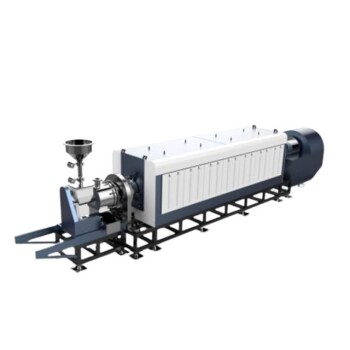
A phosphorus diffusion furnace contributes to defect engineering by performing a critical dual role: it simultaneously forms the solar cell emitter and executes phosphorus diffusion gettering (PDG). Through the creation of a phosphorosilicate glass (PSG) layer, the process draws mobile metallic impurities—specifically iron—out of the bulk silicon and immobilizes them at the surface, significantly improving the material's carrier lifetime.
While mechanical and chemical separation occurs in earlier processing stages, the phosphorus diffusion furnace serves as the final, high-precision purification step. It transforms Upgraded Metallurgical Grade Silicon (UMG-Si) into a viable solar substrate by chemically extracting residual deep-level impurities that earlier processes could not remove.
The Mechanics of Phosphorus Diffusion Gettering (PDG)
Formation of the "Getter" Layer
At specific high temperatures, the furnace facilitates the diffusion of phosphorus into the silicon wafer. This reaction creates a surface layer known as phosphorosilicate glass (PSG). This layer acts as a chemical sink, creating a thermodynamically favorable region for impurities to migrate towards.
Immobilization of Metallic Impurities
The primary defect engineering function here is the capture of transition metals. Impurities such as iron diffuse through the silicon lattice during the high-temperature cycle. Once they reach the highly doped n-type region and the PSG layer, they become trapped and immobilized, preventing them from acting as recombination centers in the active region of the cell.
Enhancement of Carrier Lifetime
By removing these recombination centers, the minority carrier lifetime of the silicon is drastically improved. For UMG-Si, which naturally contains higher baseline impurity levels, this step is vital to pushing carrier lifetimes to potentially hundreds of microseconds, a requirement for high-efficiency solar energy conversion.
The Role of PDG in the UMG-Si Purification Chain
Completing the Purification Process
The production of UMG-Si begins with an electric arc furnace for basic reduction, followed by a directional solidification furnace which utilizes segregation coefficients to push impurities to the top of the ingot. However, these physical separation methods often leave residual metallic contamination in the solidified crystal.
Addressing the Limits of Directional Solidification
While directional solidification handles bulk purification, it cannot remove every atom of dissolved metal. The phosphorus diffusion furnace addresses these remaining micro-defects at the wafer level. It acts as a final "polishing" step for the crystal's purity, ensuring that the cost-effective UMG-Si material can compete with higher-grade polysilicon in performance.
Understanding the Trade-offs
The "Dead Layer" Risk
While heavy phosphorus doping improves gettering (impurity removal), it can create a "dead layer" at the surface. This region is highly recombining for charge carriers generated by light, potentially reducing the short-circuit current of the solar cell if the diffusion is too deep.
Thermal Budget Management
The high temperatures required for effective gettering must be carefully managed. Excessive thermal exposure can degrade the bulk lifetime of the silicon or activate other structural defects, effectively undoing the benefits of the impurity removal.
Process Saturation
The PSG layer has a finite capacity for absorbing impurities. If the initial quality of the UMG-Si is too low (containing extremely high iron concentrations), the gettering process may saturate, leaving residual impurities in the bulk material that limit final cell efficiency.
Optimizing Defect Engineering for Solar Performance
To maximize the potential of UMG-Si, you must balance the intensity of the diffusion process with the quality of the incoming wafer.
- If your primary focus is Maximum Purity (Low-Grade Input): Prioritize a heavier diffusion profile to maximize the gettering effect and extract the highest volume of iron, accepting a potential trade-off in blue response.
- If your primary focus is Cell Efficiency (High-Grade Input): Optimize the thermal profile for a lighter emitter to minimize surface recombination, relying on the inherent purity of the material rather than aggressive gettering.
Success in UMG-Si applications relies not just on removing defects, but on precisely controlling the thermal dynamics that trap them.
Summary Table:
| Process Component | Role in Defect Engineering | Impact on UMG-Si Quality |
|---|---|---|
| PSG Layer Formation | Creates a chemical sink at the wafer surface | Draws out mobile metallic impurities like Iron |
| Phosphorus Diffusion | High-temperature impurity migration | Immobilizes defects, preventing recombination |
| Thermal Management | Controls the "Thermal Budget" | Balances purification with structural integrity |
| Carrier Lifetime | Result of recombination center removal | Increases lifetime to hundreds of microseconds |
Maximize Your UMG-Si Potential with KINTEK Precision
Transitioning from metallurgical grade silicon to high-efficiency solar substrates requires precise thermal control and expert engineering. Backed by industry-leading R&D and manufacturing, KINTEK offers specialized CVD systems, Tube furnaces, and customizable high-temperature lab furnaces designed to master the phosphorus diffusion process.
Whether you are optimizing Phosphorus Diffusion Gettering (PDG) or managing complex thermal budgets, our equipment provides the stability and uniformity your materials demand. Let KINTEK help you overcome the 'Dead Layer' risk and enhance your carrier lifetimes today.
Contact KINTEK to discuss your custom furnace needs
References
- Production of upgraded metallurgical-grade silicon for a low-cost, high-efficiency, and reliable PV technology. DOI: 10.3389/fphot.2024.1331030
This article is also based on technical information from Kintek Furnace Knowledge Base .
Related Products
- Spark Plasma Sintering SPS Furnace
- Slide PECVD Tube Furnace with Liquid Gasifier PECVD Machine
- 1700℃ Controlled Inert Nitrogen Atmosphere Furnace
- Custom Made Versatile CVD Tube Furnace Chemical Vapor Deposition CVD Equipment Machine
- Inclined Rotary Plasma Enhanced Chemical Deposition PECVD Tube Furnace Machine
People Also Ask
- How does the heating mechanism of Spark Plasma Sintering (SPS) function? Enhance TiC/SiC Composite Fabrication
- Why is it necessary to maintain a high vacuum environment during the SPS of SiC? Key to High-Density Ceramics
- What are the technical advantages of using an SPS sintering furnace? Elevate Al2O3-TiC Material Performance
- What are the steps in the discharge plasma sintering process? Master Fast, High-Density Material Consolidation
- What are the advantages of spark plasma sintering (SPS) over traditional forging? Precision Microstructural Control