Knowledge How does a needle valve control silver foil surface quality for graphene growth? Prevent defects with pressure control.
Author avatar

Tech Team · Kintek Furnace

Updated 3 hours ago

How does a needle valve control silver foil surface quality for graphene growth? Prevent defects with pressure control.


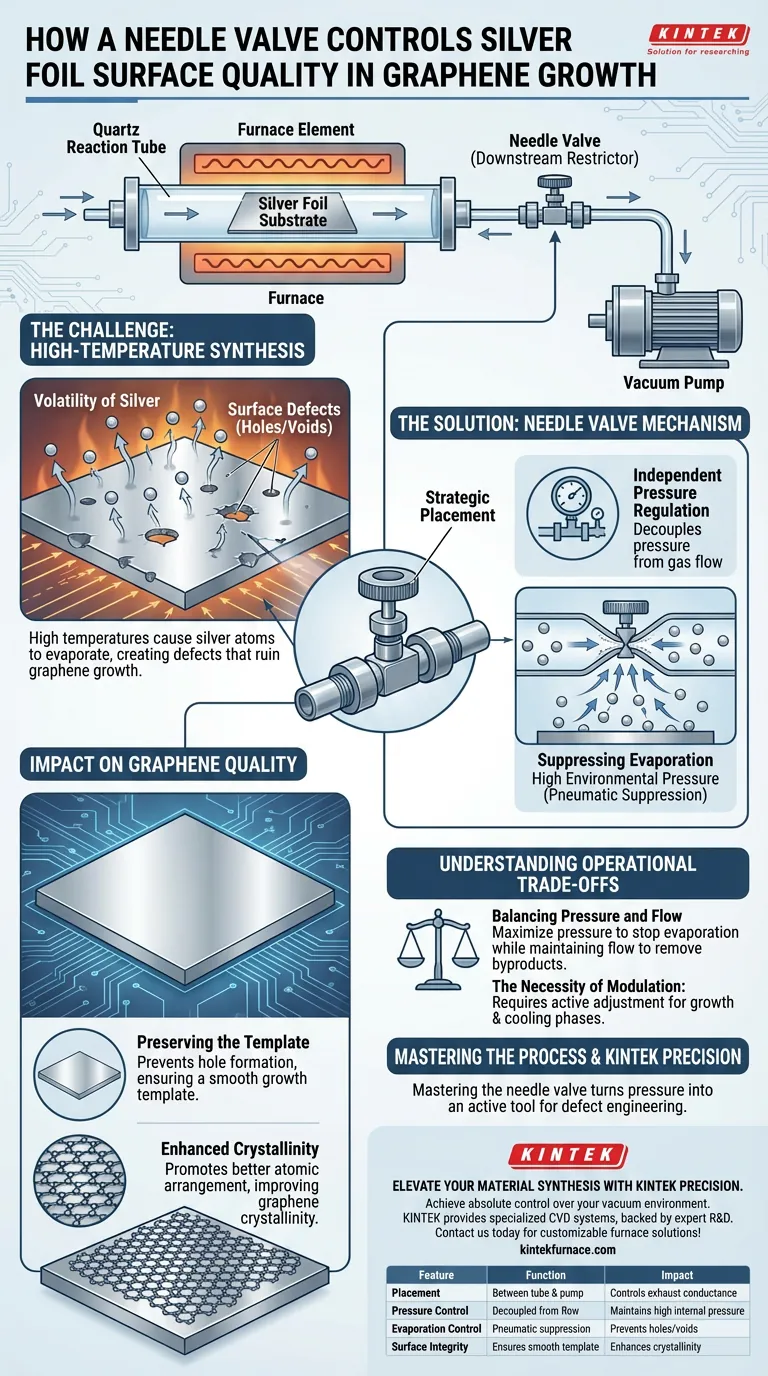
The needle valve serves as a precise regulator of environmental pressure independent of gas flow rates. Installed between the quartz reaction tube and the vacuum pump, it restricts the exhaust path to maintain higher internal pressures during the critical growth and cooling phases. This elevated pressure physically suppresses the evaporation of silver atoms at high temperatures, effectively preventing the formation of holes on the substrate and ensuring a pristine surface for high-quality graphene synthesis.

High-temperature synthesis often causes silver substrates to evaporate, creating surface defects that ruin graphene growth. The needle valve solves this by decoupling pressure control from gas flow, allowing you to maintain high environmental pressure that locks silver atoms in place to preserve the foil's integrity.
How does a needle valve control silver foil surface quality for graphene growth? Prevent defects with pressure control.

The Challenge of High-Temperature Synthesis

The Volatility of Silver

Graphene growth requires significant thermal energy to catalyze the reaction. However, at these elevated temperatures, silver atoms on the substrate surface become highly volatile.

Formation of Surface Defects

Without intervention, this volatility leads to the excessive evaporation of silver atoms. As atoms leave the lattice, they create voids and holes on the foil surface, degrading the template required for continuous graphene layers.

The Mechanism of the Needle Valve

Strategic Placement

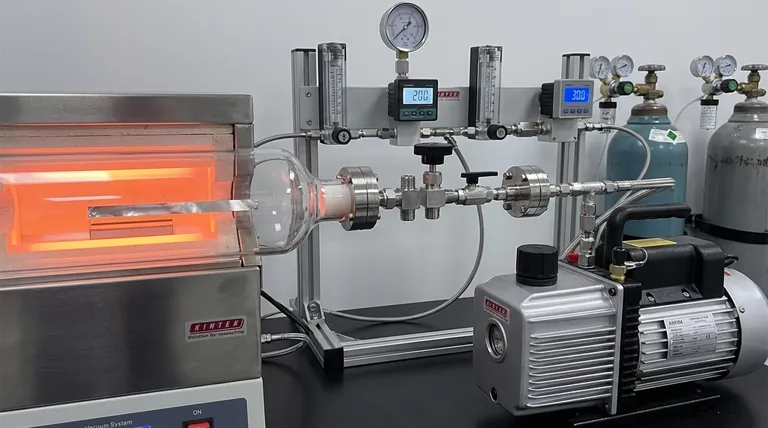
The needle valve is positioned specifically between the quartz tube (the reaction chamber) and the vacuum pump. This location is critical for its function as a downstream restrictor.

Independent Pressure Regulation

The primary function of this component is to modulate the vacuum pressure without altering the input gas flow rates. By adjusting the valve opening, you can decouple the exhaust rate from the intake rate.

Suppressing Evaporation

Constricting the valve increases the environmental pressure within the chamber. This high-pressure environment acts as a pneumatic suppression system, preventing the silver atoms from sublimating and forcing them to remain part of the solid substrate.

Impact on Graphene Quality

Preserving the Template

By preventing the formation of holes on the silver foil, the needle valve ensures the substrate remains smooth and continuous. This is the foundational requirement for epitaxial growth.

Enhanced Crystallinity

A stable, defect-free silver surface promotes better atomic arrangement of carbon atoms. Consequently, the graphene grown under these controlled pressure conditions exhibits significantly improved crystallinity.

Understanding Operational Trade-offs

The Necessity of Modulation

The needle valve is not a "set and forget" component; it requires active modulation. It must be adjusted to suit the specific requirements of both the growth and cooling stages.

Balancing Pressure and Flow

While the goal is high pressure, the system still requires flow to remove byproducts. The trade-off lies in finding the precise valve position that maximizes pressure to stop evaporation while maintaining just enough conductance for the system to function.

Making the Right Choice for Your Goal

To maximize the effectiveness of the needle valve in your setup, consider the following operational priorities:

  • If your primary focus is preventing substrate damage: Prioritize restricting the valve opening during peak temperatures to maximize suppression of silver evaporation.
  • If your primary focus is graphene crystallinity: Ensure the valve maintains consistent high pressure throughout the cooling stage to prevent late-stage surface degradation.

Mastering the needle valve transforms chamber pressure from a passive environmental variable into an active tool for defect engineering.

Summary Table:

Feature Function in Graphene Growth Impact on Silver Foil
Placement Between reaction tube and vacuum pump Controls exhaust conductance
Pressure Control Decoupled from gas flow rates Maintains high internal pressure
Evaporation Control Pneumatic suppression of atoms Prevents hole formation and voids
Surface Integrity Ensures a smooth growth template Enhances graphene crystallinity

Elevate Your Material Synthesis with KINTEK Precision

Achieving the perfect graphene layer requires more than just high temperatures—it demands absolute control over your vacuum environment. KINTEK provides the specialized equipment needed to master complex CVD processes.

Backed by expert R&D and world-class manufacturing, we offer a comprehensive range of Muffle, Tube, Rotary, Vacuum, and CVD systems, all of which are fully customizable to meet your unique research or production needs. Whether you are looking to suppress substrate evaporation or optimize crystalline growth, our engineering team is ready to support your lab's success.

Ready to refine your growth process? Contact us today to explore our customizable furnace solutions!

Visual Guide
How does a needle valve control silver foil surface quality for graphene growth? Prevent defects with pressure control. Visual Guide

References

  1. Hikaru Iwatani, Fumihiko Maeda. Graphene Synthesis on Silver Foil by Chemical Vapor Deposition Using Ethanol. DOI: 10.1380/ejssnt.2025-026

This article is also based on technical information from Kintek Furnace Knowledge Base .

Related Products

People Also Ask

Related Products

304 316 Stainless Steel High Vacuum Ball Stop Valve for Vacuum Systems

304 316 Stainless Steel High Vacuum Ball Stop Valve for Vacuum Systems

KINTEK's 304/316 stainless steel vacuum ball valves and stop valves ensure high-performance sealing for industrial and scientific applications. Explore durable, corrosion-resistant solutions.

Ultra High Vacuum Stainless Steel KF ISO CF Flange Pipe Straight Pipe Tee Cross Fitting

Ultra High Vacuum Stainless Steel KF ISO CF Flange Pipe Straight Pipe Tee Cross Fitting

KF/ISO/CF ultra-high vacuum stainless steel flange pipe systems for precision applications. Customizable, durable, and leak-tight. Get expert solutions now!

1200℃ Controlled Inert Nitrogen Atmosphere Furnace

1200℃ Controlled Inert Nitrogen Atmosphere Furnace

KINTEK 1200℃ Controlled Atmosphere Furnace: Precision heating with gas control for labs. Ideal for sintering, annealing, and material research. Customizable sizes available.

CF KF Flange Vacuum Electrode Feedthrough Lead Sealing Assembly for Vacuum Systems

CF KF Flange Vacuum Electrode Feedthrough Lead Sealing Assembly for Vacuum Systems

Reliable CF/KF flange vacuum electrode feedthrough for high-performance vacuum systems. Ensures superior sealing, conductivity & durability. Customizable options available.

Laboratory Vacuum Tilt Rotary Tube Furnace Rotating Tube Furnace

Laboratory Vacuum Tilt Rotary Tube Furnace Rotating Tube Furnace

KINTEK Laboratory Rotary Furnace: Precision heating for calcination, drying, sintering. Customizable solutions with vacuum & controlled atmosphere. Enhance research now!

Custom Made Versatile CVD Tube Furnace Chemical Vapor Deposition CVD Equipment Machine

Custom Made Versatile CVD Tube Furnace Chemical Vapor Deposition CVD Equipment Machine

KINTEK's CVD Tube Furnace offers precision temperature control up to 1600°C, ideal for thin film deposition. Customizable for research and industrial needs.

Ultra High Vacuum CF Observation Window Flange with High Borosilicate Glass Sight Glass

Ultra High Vacuum CF Observation Window Flange with High Borosilicate Glass Sight Glass

CF Ultra-High Vacuum Observation Window Flange with high borosilicate glass for precise UHV applications. Durable, clear, and customizable.

Multi Zone Laboratory Quartz Tube Furnace Tubular Furnace

Multi Zone Laboratory Quartz Tube Furnace Tubular Furnace

KINTEK Multi-Zone Tube Furnace: Precise 1700℃ heating with 1-10 zones for advanced material research. Customizable, vacuum-ready, and safety-certified.

Ultra High Vacuum Observation Window KF Flange 304 Stainless Steel High Borosilicate Glass Sight Glass

Ultra High Vacuum Observation Window KF Flange 304 Stainless Steel High Borosilicate Glass Sight Glass

KF Ultra-High Vacuum Observation Window with borosilicate glass for clear viewing in demanding vacuum environments. Durable 304 stainless steel flange ensures reliable sealing.

Multi Heating Zones CVD Tube Furnace Machine for Chemical Vapor Deposition Equipment

Multi Heating Zones CVD Tube Furnace Machine for Chemical Vapor Deposition Equipment

KINTEK's Multi-Zone CVD Tube Furnaces offer precision temperature control for advanced thin film deposition. Ideal for research and production, customizable for your lab needs.

Laboratory Muffle Oven Furnace with Bottom Lifting

Laboratory Muffle Oven Furnace with Bottom Lifting

Boost lab efficiency with KT-BL Bottom Lifting Furnace: precise 1600℃ control, superior uniformity, and enhanced productivity for material science and R&D.

Laboratory Quartz Tube Furnace RTP Heating Tubular Furnace

Laboratory Quartz Tube Furnace RTP Heating Tubular Furnace

KINTEK's RTP Rapid Heating Tube Furnace delivers precise temperature control, rapid heating up to 100°C/sec, and versatile atmosphere options for advanced lab applications.

Split Chamber CVD Tube Furnace with Vacuum Station CVD Machine

Split Chamber CVD Tube Furnace with Vacuum Station CVD Machine

Split Chamber CVD Tube Furnace with Vacuum Station - High precision 1200°C lab furnace for advanced materials research. Customizable solutions available.

Electric Rotary Kiln Continuous Working Small Rotary Furnace Kiln for Pyrolysis Plant Heating

Electric Rotary Kiln Continuous Working Small Rotary Furnace Kiln for Pyrolysis Plant Heating

KINTEK's electric rotary furnaces offer precision heating up to 1100°C for calcination, drying, and pyrolysis. Durable, efficient, and customizable for labs and production. Explore models now!

1700℃ Controlled Inert Nitrogen Atmosphere Furnace

1700℃ Controlled Inert Nitrogen Atmosphere Furnace

KT-17A Controlled Atmosphere Furnace: Precise 1700°C heating with vacuum & gas control. Ideal for sintering, research & material processing. Explore now!

1700℃ High Temperature Laboratory Tube Furnace with Quartz or Alumina Tube

1700℃ High Temperature Laboratory Tube Furnace with Quartz or Alumina Tube

KINTEK's Tube Furnace with Alumina Tube: Precision heating up to 1700°C for material synthesis, CVD, and sintering. Compact, customizable, and vacuum-ready. Explore now!

Vacuum Sealed Continuous Working Rotary Tube Furnace Rotating Tube Furnace

Vacuum Sealed Continuous Working Rotary Tube Furnace Rotating Tube Furnace

Precision rotary tube furnace for continuous vacuum processing. Ideal for calcination, sintering, and heat treatment. Customizable up to 1600℃.

1200℃ Split Tube Furnace Laboratory Quartz Tube Furnace with Quartz Tube

1200℃ Split Tube Furnace Laboratory Quartz Tube Furnace with Quartz Tube

Discover KINTEK's 1200℃ Split Tube Furnace with quartz tube for precise high-temperature lab applications. Customizable, durable, and efficient. Get yours now!

High Pressure Laboratory Vacuum Tube Furnace Quartz Tubular Furnace

High Pressure Laboratory Vacuum Tube Furnace Quartz Tubular Furnace

KINTEK High Pressure Tube Furnace: Precision heating up to 1100°C with 15Mpa pressure control. Ideal for sintering, crystal growth, and lab research. Customizable solutions available.

1400℃ Controlled Inert Nitrogen Atmosphere Furnace

1400℃ Controlled Inert Nitrogen Atmosphere Furnace

KT-14A Controlled Atmosphere Furnace for labs & industry. 1400°C max temp, vacuum sealing, inert gas control. Customizable solutions available.


Leave Your Message