
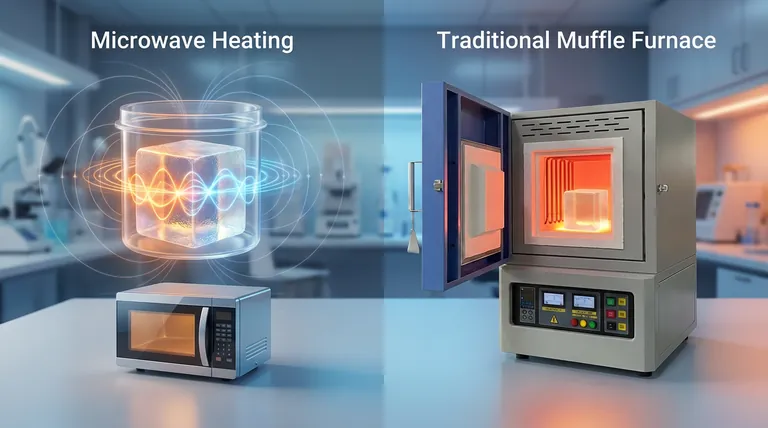
Microwave heating systems operate on a fundamentally different mechanism than traditional muffle furnaces. While traditional furnaces rely on passive, slow heat conduction to raise the temperature of a material, microwave systems utilize electromagnetic radiation. This radiation directly targets polar molecules within the solid electrolyte, such as adsorbed water and carbon residues, allowing for immediate and selective volume heating.
Microwave heating offers a mechanistic advantage by selectively targeting impurities for rapid removal, thereby avoiding the structural degradation caused by the prolonged thermal exposure inherent to traditional conduction-based methods.
The Mechanics of Heating
Direct Targeting vs. Passive Conduction
The primary differentiator is how energy is transferred to the material. Traditional muffle furnaces heat the environment around the sample, relying on thermal conduction to slowly penetrate the solid electrolyte.
In contrast, microwave systems use electromagnetic radiation. This radiation bypasses the need for external conduction, interacting directly with specific molecules inside the material structure.
Selective Volume Heating
Microwave energy provides "selective volume heating." This means the system can heat specific components within the bulk material rather than heating everything uniformly from the outside in.
This mechanism specifically targets polar molecules. In the context of damaged solid electrolytes, these targets are usually the contaminants you want to remove, such as moisture and carbon residues.
Efficiency in Regeneration
Rapid Removal of Impurities
Because microwave radiation directly couples with polar molecules, it is highly effective at removing surface hydration layers.
It also targets carbonate impurities efficiently. The direct energy transfer allows these contaminants to be expelled much faster than they would be in a conventional thermal environment.
High Heating Rates
The process offers extremely high heating rates. By eliminating the lag time associated with thermal conduction, the regeneration process becomes significantly faster.
This speed is not just about saving time; it is a critical component of preserving the material's quality, as it reduces the total time the electrolyte spends under thermal stress.
Understanding the Trade-offs of Thermal Methods
The Risk of Prolonged Exposure
When using a traditional muffle furnace, the material must undergo prolonged exposure to heat to ensure the center of the sample reaches the required temperature.
This duration creates a significant trade-off. The longer the solid electrolyte is exposed to high heat, the greater the risk of structural damage.
Organic Carbonization and Structural Integrity
A common pitfall of the slower conduction method is "organic carbonization." The extended heating times required by muffle furnaces can cause organic residues to carbonize rather than being cleanly removed.
Microwave heating avoids this by heating the residues directly and rapidly. This localized targeting preserves the structural integrity of the electrolyte, regenerating it without the collateral damage caused by bulk heating methods.
Making the Right Choice for Your Goal
To ensure optimal recovery of your solid electrolytes, select your heating method based on your specific purity and structural requirements.
- If your primary focus is maximizing processing speed: Utilize microwave heating to leverage high heating rates and the immediate interaction with polar contaminants.
- If your primary focus is preserving structural integrity: Choose microwave systems to avoid the risks of organic carbonization and structural breakdown caused by the prolonged heat of muffle furnaces.
By switching to microwave heating, you move from a passive heating process to an active, targeted regeneration strategy.
Summary Table:
| Feature | Microwave Heating System | Traditional Muffle Furnace |
|---|---|---|
| Heating Mechanism | Active electromagnetic radiation (volumetric) | Passive thermal conduction (surface-in) |
| Targeting | Selective (targets polar molecules/impurities) | Non-selective (heats entire environment) |
| Heating Rate | Extremely high and rapid | Slow and gradual |
| Contaminant Removal | Efficient removal of moisture & carbon residues | Risk of organic carbonization |
| Structural Integrity | High (minimizes thermal stress duration) | Lower (risk from prolonged heat exposure) |
| Best For | Rapid, high-purity regeneration | General bulk heat treatment |
Revolutionize Your Material Regeneration with KINTEK
Don't let traditional heating methods compromise the integrity of your solid electrolytes. Backed by expert R&D and manufacturing, KINTEK offers cutting-edge laboratory solutions, including high-precision Muffle, Tube, Rotary, Vacuum, and CVD systems. Whether you need standard equipment or a fully customizable system for unique research needs, our technology ensures faster processing and superior structural preservation.
Ready to upgrade your lab's performance? Contact our technical experts today to find the perfect heating solution for your specific application!
References
- Boyeong Jang, Yoon Seok Jung. Revitalizing Sulfide Solid Electrolytes for All‐Solid‐State Batteries: Dry‐Air Exposure and Microwave‐Driven Regeneration. DOI: 10.1002/aenm.202502981
This article is also based on technical information from Kintek Furnace Knowledge Base .
Related Products
- Molybdenum Disilicide MoSi2 Thermal Heating Elements for Electric Furnace
- Multi Heating Zones CVD Tube Furnace Machine for Chemical Vapor Deposition Equipment
- Electric Rotary Kiln Continuous Working Small Rotary Furnace Kiln for Pyrolysis Plant Heating
People Also Ask
- What are the typical application temperatures for molybdenum disilicide (MoSi2) heating elements? Master High-Temp Performance
- What is the primary use of molybdenum disilicide? Ideal for High-Temp Heating Elements
- What are the characteristics of molybdenum disilicide heating elements? Unlock High-Temp Performance
- What are the properties of molybdenum disilicide (MoSi2) that make it suitable for high-temperature applications? Discover Its High-Temp Resilience
- What are the applications of molybdenum disilicide heating elements? Achieve Extreme Heat Stability for Industrial Processes


