
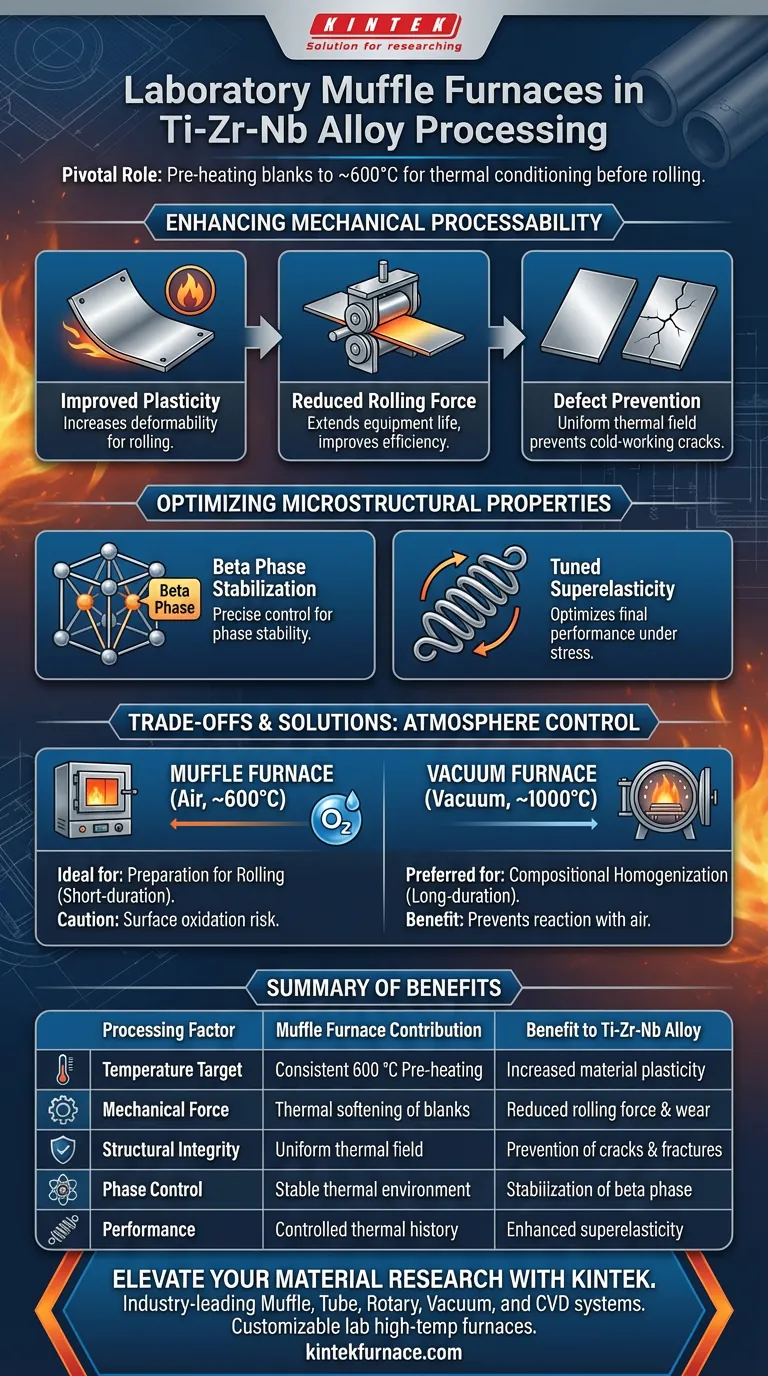
A laboratory muffle furnace plays a pivotal role in the pre-rolling stage of processing Ti-Zr-Nb alloy sheets by providing a stable, high-temperature environment. Specifically, it is utilized to pre-heat alloy blanks to approximately 600 °C, ensuring the material is thermally conditioned for subsequent mechanical deformation.
By establishing a precise thermal field, the muffle furnace optimizes the alloy's plasticity and stabilizes its internal phase structure. This not only prevents structural failures during rolling but also defines the material's final superelastic capabilities.
Enhancing Mechanical Processability
Improving Material Plasticity
The primary function of the muffle furnace in this context is to prepare the alloy for physical deformation.
By pre-heating the Ti-Zr-Nb blanks to 600 °C, the furnace significantly increases the material's plasticity. This thermal softening is a prerequisite for successful rolling operations.
Reduction of Rolling Force
Proper thermal conditioning directly impacts the efficiency of the rolling machinery.
When the alloy maintains optimal plasticity, the force required to deform the sheet is substantially reduced. This extends the lifespan of rolling equipment and improves energy efficiency during processing.
Prevention of Structural Defects
Temperature stability is the main defense against material failure.
Without the precise pre-heating provided by the muffle furnace, the alloy is susceptible to cold-working cracks. The furnace ensures a uniform thermal field that mitigates these stress-induced fractures.
Optimizing Microstructural Properties
Stabilization of the Beta Phase
Beyond simple heating, the muffle furnace acts as a tool for phase control.
Precise temperature regulation is critical for stabilizing the metastable beta phase within the Ti-Zr-Nb alloy. This phase stability is the microstructural foundation for the alloy's advanced performance characteristics.
Tuning Superelastic Performance
The ultimate goal of this thermal processing is functional performance.
By controlling the thermal history of the blank, the muffle furnace helps optimize the superelasticity of the final sheet. This ensures the material behaves predictably under stress in its end-use application.
Understanding the Trade-offs
Atmosphere Control Limitations
While effective for pre-heating, standard muffle furnaces typically operate with an air atmosphere.
Ti-Zr-Nb alloys are highly reactive to oxygen at elevated temperatures. Extended exposure in a standard muffle furnace can lead to surface oxidation or embrittlement.
Suitability for Process Stages
It is crucial to distinguish between pre-heating and long-term homogenization.
For short-duration rolling preparation, the muffle furnace is ideal. However, for long-duration treatments like homogenization annealing (often at 1000 °C), a vacuum resistance furnace is preferred to prevent reaction with air and ensure chemical consistency.
Making the Right Choice for Your Goal
To maximize the quality of your Ti-Zr-Nb alloy sheets, align your furnace selection with your specific processing stage:
- If your primary focus is Preparation for Rolling: Utilize a muffle furnace at ~600 °C to maximize plasticity and minimize rolling force.
- If your primary focus is Compositional Homogenization: Choose a vacuum resistance furnace to eliminate dendritic segregation without risking oxidation.
Precise thermal management is the critical link between a raw alloy blank and a high-performance, crack-free superelastic component.
Summary Table:
| Processing Factor | Muffle Furnace Contribution | Benefit to Ti-Zr-Nb Alloy |
|---|---|---|
| Temperature Target | Consistent 600 °C Pre-heating | Increased material plasticity for rolling |
| Mechanical Force | Thermal softening of blanks | Reduced rolling force and equipment wear |
| Structural Integrity | Uniform thermal field | Prevention of cold-working cracks and fractures |
| Phase Control | Stable thermal environment | Stabilization of the metastable beta phase |
| Performance | Controlled thermal history | Enhanced superelasticity in the final sheet |
Elevate Your Material Research with KINTEK
Precise thermal management is the difference between material failure and high-performance innovation. KINTEK provides industry-leading Muffle, Tube, Rotary, Vacuum, and CVD systems, all engineered to meet the rigorous demands of advanced metallurgy.
Whether you are processing reactive Ti-Zr-Nb alloys or developing new superelastic components, our expert R&D and manufacturing team can deliver customizable lab high-temp furnaces tailored to your exact specifications.
Ready to optimize your thermal processing? Contact KINTEK today to discuss your project requirements with our technical specialists.
Visual Guide
References
- K. V. Sergienko, A. G. Kolmakov. Physical and Mechanical Properties of Ti-Zr-Nb Alloys for Medical Use. DOI: 10.3390/met14111311
This article is also based on technical information from Kintek Furnace Knowledge Base .
Related Products
- Laboratory Muffle Oven Furnace with Bottom Lifting
- 1200℃ Muffle Oven Furnace for Laboratory
- 1400℃ Muffle Oven Furnace for Laboratory
- 1800℃ High Temperature Muffle Oven Furnace for Laboratory
- High Temperature Muffle Oven Furnace for Laboratory Debinding and Pre Sintering
People Also Ask
- What is the importance of the calcination process? Master High-Purity Calcium Phosphate Nanopowder Production
- What function does a muffle furnace perform in Ba0.75Ca0.25TiO3 calcination? Ensure Phase Purity & Synthesis
- Why is a high-temperature muffle furnace required for FeOx-MOx/TiO2? Engineering High-Performance Nanocomposites
- Why is a high-temperature laboratory muffle furnace essential for the alkali fusion process in zeolite synthesis?
- What are the primary functions of a high-temperature laboratory muffle furnace in the preparation of biosorbent materials?



















