
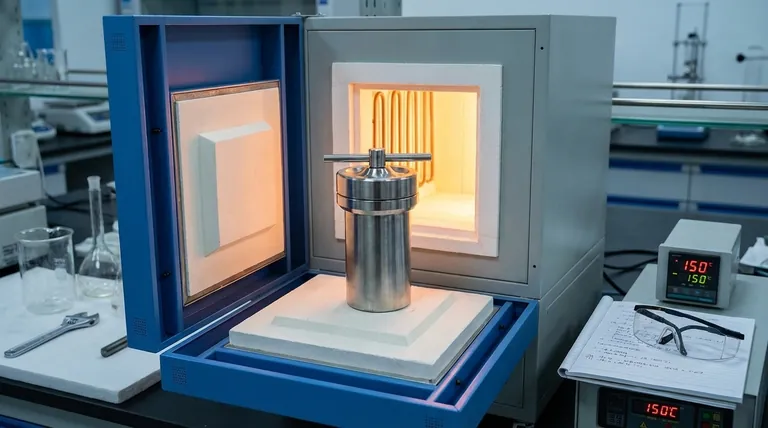
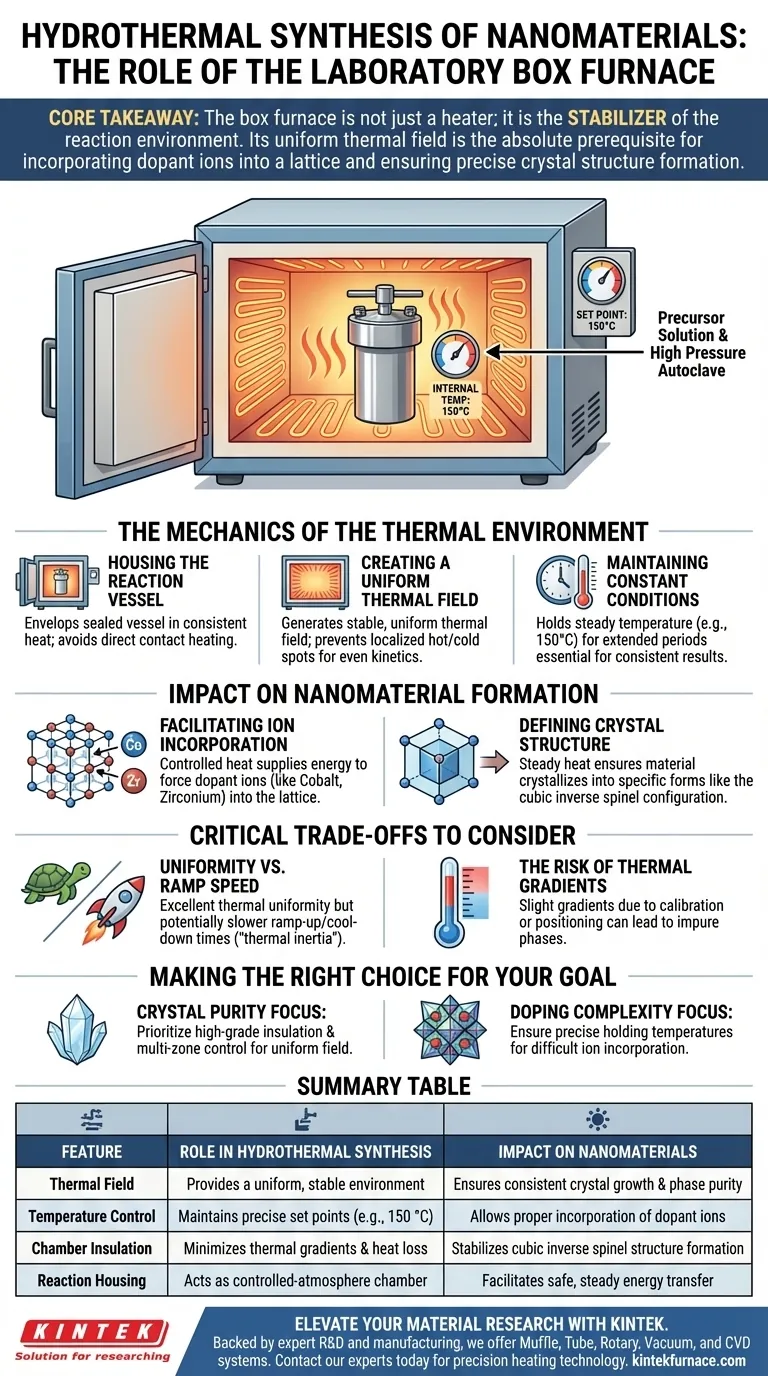
In hydrothermal synthesis, the laboratory box furnace functions as the critical external heating environment for the high-pressure autoclave containing your precursor solution. It envelops the sealed vessel in a consistent heat source, raising the internal temperature to specific set points (such as 150 °C) and maintaining that thermal energy for the duration of the reaction.
Core Takeaway The box furnace is not merely a heater; it is the stabilizer of the reaction environment. Its ability to provide a uniform thermal field is the absolute prerequisite for incorporating dopant ions into a lattice, ensuring the successful formation of precise crystal structures like the cubic inverse spinel configuration.
The Mechanics of the Thermal Environment
Housing the Reaction Vessel
The box furnace acts as a chamber to house the autoclave. Unlike direct heating methods (like a hot plate), the box furnace surrounds the entire vessel with heated air.
Creating a Uniform Thermal Field
The primary function of the furnace is to generate a stable and uniform thermal field. This ensures that heat is distributed evenly across the surface of the autoclave, preventing localized hot or cold spots that could skew the reaction kinetics.
Maintaining Constant Conditions
For synthesis to occur, the system must hold a steady temperature, specifically 150 °C in common ferrite synthesis protocols. The furnace's insulation and control systems maintain this plateau, which is essential for consistent chemical results.
Impact on Nanomaterial Formation
Facilitating Ion Incorporation
The controlled heat provided by the furnace supplies the energy required to force dopant ions into the material's structure. For example, this thermal environment allows Cobalt (Co) and Zirconium (Zr) ions to successfully integrate into an Iron Oxide lattice.
Defining Crystal Structure
The stability of the heating process dictates the final morphology of the nanomaterial. A fluctuating temperature would yield inconsistent results, but the steady heat of the box furnace ensures the material crystallizes into a specific cubic structure with an inverse spinel configuration.
Critical Trade-offs to Consider
Uniformity vs. Ramp Speed
While box furnaces offer excellent thermal uniformity, they may have slower ramp-up and cool-down times compared to other heating methods. This "thermal inertia" is beneficial for stability but requires patience during the production cycle.
The Risk of Thermal Gradients
If the box furnace is not calibrated or if the autoclave is positioned poorly, slight thermal gradients can occur. Even minor deviations can prevent the proper incorporation of ions, leading to impure phases rather than the desired inverse spinel structure.
Making the Right Choice for Your Goal
To maximize the effectiveness of a box furnace in hydrothermal synthesis, consider your specific objective:
- If your primary focus is Crystal Purity: Prioritize a furnace with high-grade insulation and multi-zone control to ensure the thermal field remains absolutely uniform for ion incorporation.
- If your primary focus is Doping Complexity: Ensure your furnace can maintain precise holding temperatures (e.g., exactly 150 °C) for extended periods to force difficult ions like Cobalt or Zirconium into the lattice.
The quality of your external thermal field directly dictates the internal structural integrity of your nanomaterial.
Summary Table:
| Feature | Role in Hydrothermal Synthesis | Impact on Nanomaterials |
|---|---|---|
| Thermal Field | Provides a uniform, stable environment around the autoclave | Ensures consistent crystal growth and phase purity |
| Temperature Control | Maintains precise set points (e.g., 150 °C) | Allows proper incorporation of dopant ions (Co, Zr) |
| Chamber Insulation | Minimizes thermal gradients and heat loss | Stabilizes cubic inverse spinel structure formation |
| Reaction Housing | Acts as a controlled-atmosphere heating chamber | Facilitates safe and steady energy transfer to vessels |
Elevate Your Material Research with KINTEK
Precise crystal engineering requires an unwavering thermal environment. KINTEK provides high-performance laboratory solutions specifically designed for the rigorous demands of nanomaterial production. Backed by expert R&D and manufacturing, we offer a comprehensive range of Muffle, Tube, Rotary, Vacuum, and CVD systems, all fully customizable to meet your unique hydrothermal synthesis needs.
Whether you are doping complex ions or targeting specific cubic morphologies, our high-temperature furnaces ensure the thermal stability your lab requires. Contact our technical experts today to discover how KINTEK’s precision heating technology can improve your research outcomes.
Visual Guide
References
- Saba Yaqoob, Alberto D’Amore. Magnetic and Dielectric Properties of Cobalt and Zirconium Co-Doped Iron Oxide Nanoparticles via the Hydrothermal Synthesis Approach. DOI: 10.3390/jcs9010032
This article is also based on technical information from Kintek Furnace Knowledge Base .
Related Products
- Laboratory Quartz Tube Furnace RTP Heating Tubular Furnace
- 1700℃ High Temperature Laboratory Tube Furnace with Alumina Tube
- 1400℃ High Temperature Laboratory Tube Furnace with Alumina Tube
- Laboratory Muffle Oven Furnace with Bottom Lifting
- Laboratory Vacuum Tilt Rotary Tube Furnace Rotating Tube Furnace
People Also Ask
- What physical conditions does a laboratory Tube Furnace provide for SOEC? Precision Heat for Solid Oxide Characterization
- What are the main features and functions of a laboratory tube furnace? Unlock Precise High-Temp Control for Your Lab
- What role does a laboratory tube furnace play in geological and mineralogical research? Unlock Earth's Secrets with Precision
- What conditions do tube furnaces provide for Au-Seeded TiO2 nanowires? Master Precision Thermal Synthesis
- What parameters must be controlled when calcining freeze-dried oxide precursors in a laboratory tube furnace? A Guide



















