
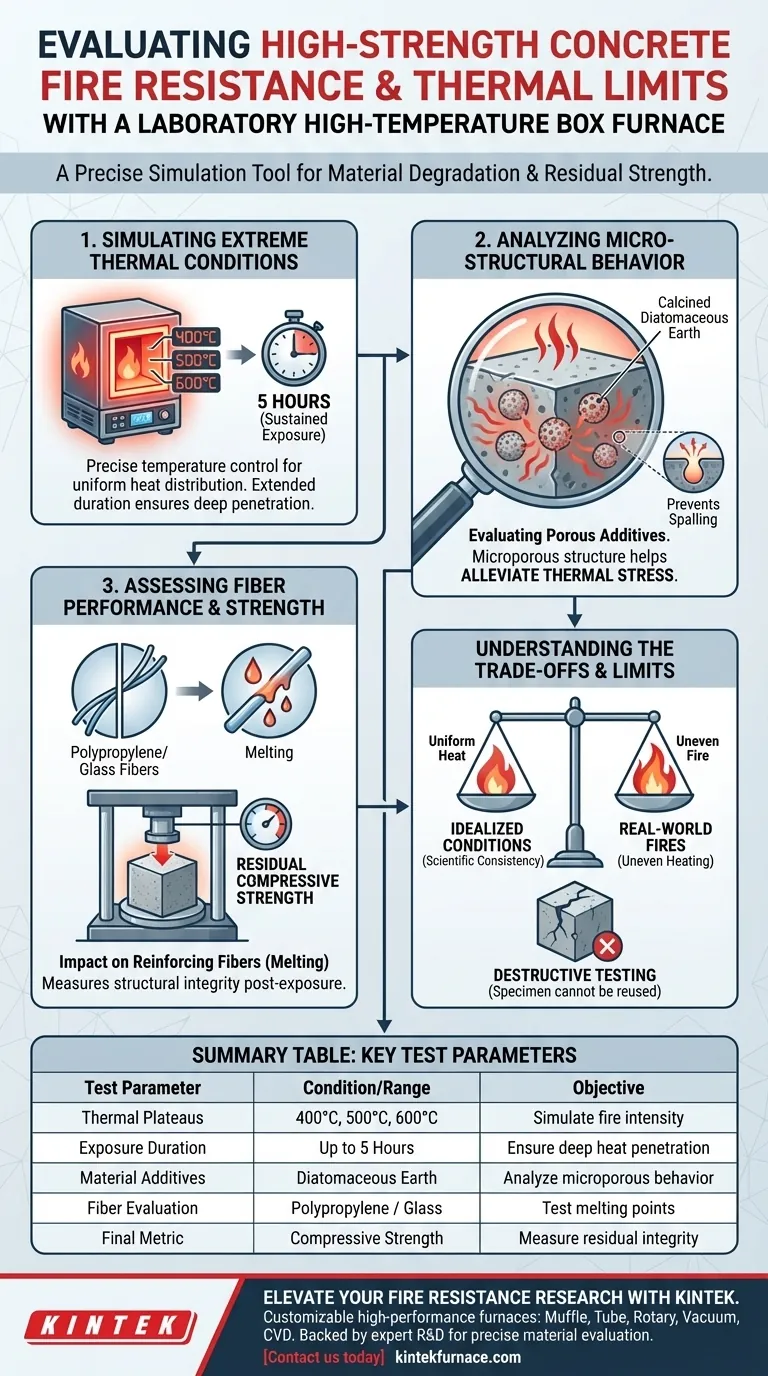
A laboratory high-temperature box furnace serves as a precise simulation tool for evaluating how high-strength concrete withstands extreme heat. By exposing specimens to specific thermal plateaus of 400°C, 500°C, and 600°C for durations of up to five hours, researchers can isolate and measure the material's degradation and residual strength.
By maintaining a controlled environment, this equipment allows for the critical analysis of internal micro-structures and fiber behavior, quantifying exactly how additives alleviate thermal stress before structural failure occurs.
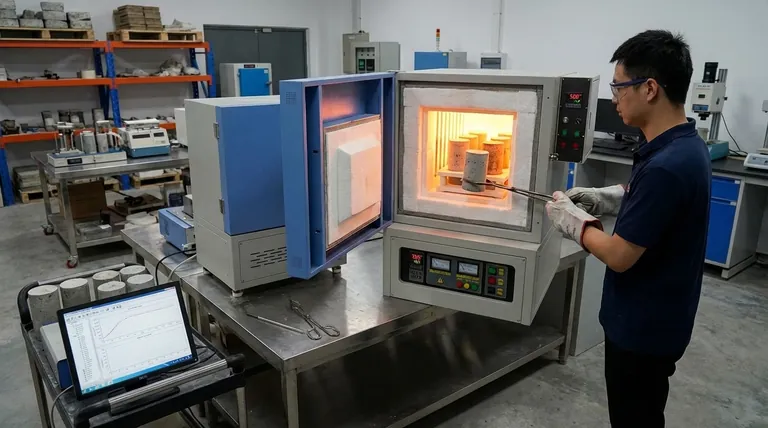
Simulating Extreme Thermal Conditions
Precise Temperature Control
The box furnace allows researchers to target specific high-temperature levels crucial for fire safety testing.
According to standard protocols, the equipment creates a stable environment at 400°C, 500°C, and 600°C.
Sustained Heat Exposure
Reaching high temperatures is not enough; the duration of exposure determines the depth of heat penetration.
The furnace maintains these target temperatures for 5 hours.
This extended duration ensures that the thermal stress affects the entire concrete specimen, not just the outer surface layer.
Analyzing Micro-Structural Behavior
Evaluating Porous Additives
The furnace is instrumental in testing the efficacy of additives like Calcined Diatomaceous Earth.
Researchers use the data from these tests to examine the additive's microporous structure.
Alleviating Thermal Stress
The primary goal of this analysis is to understand how the microporous structure functions under heat.
Specifically, the test reveals how these pores help alleviate thermal stress within the concrete matrix, potentially preventing explosive spalling or cracking.
Assessing Fiber Performance and Strength
Impact on Reinforcing Fibers
High-strength concrete often contains fibers that react differently to heat than the cement paste.
The furnace creates conditions that melt materials like polypropylene or glass fibers.
Measuring Residual Compressive Strength
Once the fibers have melted or degraded, the core structural question remains.
The test allows engineers to measure the residual compressive strength of the concrete.
This data point confirms whether the concrete retains structural integrity after the internal reinforcement has been compromised by heat.
Understanding the Trade-offs
Idealized vs. Real-World Conditions
A box furnace provides a uniform heat distribution, which is necessary for scientific consistency.
However, this differs from real-world fires, which often subject structures to uneven heating and rapid thermal gradients.
The Limits of Destructive Testing
The process described is inherently destructive.
Once the concrete is exposed to these temperatures for 5 hours to measure residual strength, the specimen cannot be re-tested or used for other analyses.
Making the Right Choice for Your Goal
To utilize a high-temperature box furnace effectively for concrete evaluation, consider your specific testing objectives:
- If your primary focus is material formulation: Use the furnace to determine if the microporous structure of Calcined Diatomaceous Earth is effectively reducing thermal stress at the 500-600°C range.
- If your primary focus is structural safety: Concentrate on the residual compressive strength data to understand how the melting of polypropylene or glass fibers affects the load-bearing capacity after a 5-hour exposure.
Reliable fire resistance data depends on rigorous, sustained thermal simulation to reveal the true limits of your material.
Summary Table:
| Test Parameter | Condition/Range | Objective |
|---|---|---|
| Thermal Plateaus | 400°C, 500°C, 600°C | Simulate specific fire intensity levels |
| Exposure Duration | Up to 5 Hours | Ensure deep heat penetration into the specimen |
| Material Additives | Diatomaceous Earth | Analyze microporous behavior under thermal stress |
| Fiber Evaluation | Polypropylene / Glass | Test melting points and impact on reinforcement |
| Final Metric | Compressive Strength | Measure residual structural integrity post-exposure |
Elevate Your Fire Resistance Research with KINTEK
Precise material evaluation requires high-performance heating solutions that you can trust. Backed by expert R&D and manufacturing, KINTEK offers a wide range of laboratory high-temperature furnaces, including Muffle, Tube, Rotary, Vacuum, and CVD systems—all fully customizable to meet your unique testing protocols.
Whether you are analyzing micro-structural behavior or measuring residual compressive strength, our furnaces provide the stability and control your lab needs. Contact us today to discover how KINTEK’s advanced thermal technology can empower your next breakthrough in high-strength concrete and material science.
Visual Guide
References
- Muttaqin Hasan, Taufiq Saidi. Properties of High-Strength Concrete Incorporating Calcined Diatomaceous Earth, Polypropylene, and Glass Fibers. DOI: 10.3390/buildings15020225
This article is also based on technical information from Kintek Furnace Knowledge Base .
Related Products
- 1700℃ High Temperature Laboratory Tube Furnace with Alumina Tube
- 1400℃ High Temperature Laboratory Tube Furnace with Alumina Tube
- 1700℃ High Temperature Muffle Oven Furnace for Laboratory
- 1800℃ High Temperature Muffle Oven Furnace for Laboratory
- High Temperature Muffle Oven Furnace for Laboratory Debinding and Pre Sintering
People Also Ask
- How does zone-melting in tube furnaces synthesize bismuth micro-wires? Master Single-Crystal Thermoelectric Growth
- How do high-temperature laboratory tube furnaces ensure environmental stability? Precision Thermal Reduction Tips
- How are high-temp tube furnaces used to measure diffusion coefficients per Fick's law? Master Precision Annealing
- How are high-temperature laboratory tube furnaces applied in long-term vacuum homogenization heat treatments for intermetallic samples?
- How are high-temperature tube furnaces applied in testing ceramic-supported alloy membranes? Insights



















