
A high-temperature box resistance furnace acts as a precision reactor that establishes the thermal and atmospheric conditions strictly required for synthesizing WC/C@N-S nanocatalysts. It heats the precursor materials to 900 °C while utilizing an integrated vacuum and nitrogen (N2) system to maintain a completely inert environment. This dual action facilitates the carbonization of biomass and the in-situ growth of tungsten carbide (WC) nanoparticles without the risk of oxidation.
The furnace is not merely a heat source; it is an atmospheric shield. Its ability to maintain a strictly oxygen-free environment at high temperatures is the deciding factor that allows for successful Nitrogen-Sulfur (N-S) doping and the preservation of active catalytic sites.
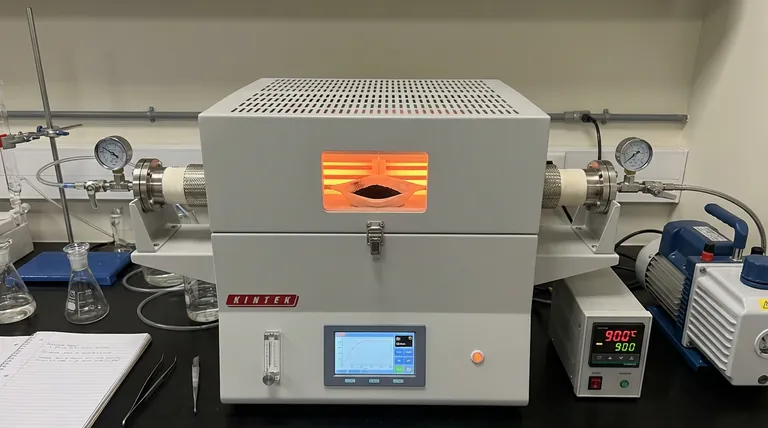
Establishing the Inert Reaction Environment
To synthesize WC/C@N-S, standard heating is insufficient; the atmosphere must be rigorously controlled to prevent the material from burning up.
Vacuum-Assisted Air Removal
Before heating begins, the furnace utilizes an integrated vacuum pump.
This step physically evacuates the chamber, stripping away ambient air and moisture that would otherwise react with the precursor materials.
Nitrogen Saturation
Once the air is removed, high-purity nitrogen (N2) is introduced into the chamber.
This creates a stable, inert blanket around the sample. The nitrogen ensures that the chemical reactions occur in isolation, preventing oxygen from degrading the carbon support or the tungsten components.
Thermal Transformation at 900 °C
The furnace provides the high-energy environment necessary to drive complex chemical transformations simultaneously.
Biomass Carbonization
At 900 °C, the furnace converts the biomass precursor into a carbonaceous support matrix.
Because this happens under nitrogen, the biomass carbonizes rather than combusts, forming a stable structure to host the metal nanoparticles.
In-Situ Growth of Nanoparticles
The high thermal energy drives the in-situ growth of tungsten carbide (WC) nanoparticles.
Simultaneously, it facilitates the doping of Nitrogen and Sulfur (N-S) atoms into the carbon lattice, a process that significantly enhances the material's catalytic properties.
Preventing Active Site Oxidation
The most critical function of this thermal profile is protection.
By coupling high heat with the inert N2 atmosphere, the furnace prevents the oxidation of the newly formed WC nanoparticles, ensuring the active sites remain metallic and chemically potent.
Enhancing Material Quality
Beyond the basic chemical synthesis, the furnace treatment serves as a refinement step for the physical structure of the catalyst.
Improving Crystallinity
The sustained high-temperature calcination improves the crystallinity of the nanoparticles.
High crystallinity is directly linked to the structural stability of the final photocatalyst, ensuring it can withstand operational stress.
Removal of Impurities
The furnace effectively burns off volatile organic impurities and synthesis byproducts.
This purification step ensures the chemical purity of the final WC/C@N-S catalyst, leaving behind only the robust, functional material.
Understanding the Operational Sensitivities
While the furnace enables synthesis, precise control is required to avoid common pitfalls that degrade catalyst performance.
The Risk of Oxidation
If the vacuum seal is compromised or the nitrogen flow is impure, oxygen will enter the system at 900 °C.
This causes the rapid oxidation of the tungsten and the combustion of the carbon support, effectively destroying the catalyst.
Thermal Precision vs. Degradation
The target temperature of 900 °C is a calculated balance.
Deviating significantly from this temperature can result in incomplete carbonization (too low) or the sintering of nanoparticles (too high), which reduces the available surface area for catalytic reactions.
Optimizing Your Synthesis Strategy
When utilizing a high-temperature box resistance furnace for WC/C@N-S synthesis, prioritize your parameters based on your specific material goals.
- If your primary focus is Chemical Purity: Ensure the initial vacuum cycle is thorough and the nitrogen source is high-purity to eliminate all traces of oxygen and moisture.
- If your primary focus is Structural Stability: Prioritize the duration of the hold time at 900 °C to maximize crystallinity and ensure complete removal of organic impurities.
The success of your synthesis relies on the furnace's ability to maintain a pristine, inert separation between the intense heat and the reactive atmosphere.
Summary Table:
| Feature | Function in WC/C@N-S Synthesis | Benefit to Catalyst Quality |
|---|---|---|
| Vacuum System | Removes ambient air/moisture | Prevents oxidation of precursors |
| Nitrogen (N2) Atmosphere | Creates an inert blanket | Enables carbonization without combustion |
| 900°C Thermal Range | Drives in-situ nanoparticle growth | Ensures high crystallinity and stability |
| Atmospheric Shielding | Protects active catalytic sites | Preserves chemical potency and purity |
Elevate Your Material Synthesis with KINTEK
Precision is the difference between a failed reaction and a breakthrough catalyst. Backed by expert R&D and manufacturing, KINTEK offers specialized Muffle, Tube, Rotary, Vacuum, and CVD systems designed to meet the rigorous demands of nanocatalyst synthesis. Whether you need strictly controlled inert environments or high-temperature stability, our lab furnaces are fully customizable for your unique research needs.
Ready to optimize your thermal processing?
Contact our specialists today to find the perfect furnace solution!
References
- Zunming Lu, Xiaofeng Wei. N-S Co-Doped WC Nanoparticles Show High Catalytic Activity in Hydrogen Evolution Reaction. DOI: 10.3390/coatings15060630
This article is also based on technical information from Kintek Furnace Knowledge Base .
Related Products
- 1700℃ High Temperature Laboratory Tube Furnace with Alumina Tube
- 1400℃ High Temperature Laboratory Tube Furnace with Alumina Tube
- 1700℃ Controlled Inert Nitrogen Atmosphere Furnace
- 1700℃ High Temperature Muffle Oven Furnace for Laboratory
- 1800℃ High Temperature Muffle Oven Furnace for Laboratory
People Also Ask
- How does zone-melting in tube furnaces synthesize bismuth micro-wires? Master Single-Crystal Thermoelectric Growth
- How are high-temperature laboratory tube furnaces applied in long-term vacuum homogenization heat treatments for intermetallic samples?
- How are high-temp tube furnaces used to measure diffusion coefficients per Fick's law? Master Precision Annealing
- How do high-temperature laboratory tube furnaces ensure environmental stability? Precision Thermal Reduction Tips
- How are high-temperature tube furnaces applied in testing ceramic-supported alloy membranes? Insights



















