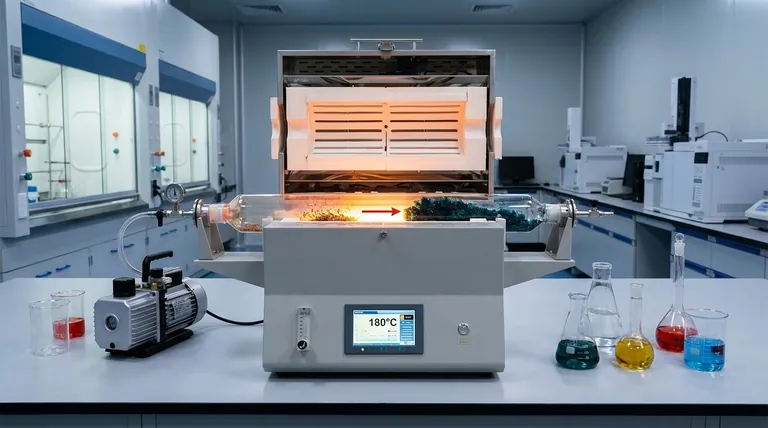
Heating equipment serves as the primary catalyst for the chemical fusion required to synthesize Palladium Phthalocyanine (PdPc). It is responsible for maintaining a strictly controlled reaction environment, specifically holding a temperature of 180 °C for a duration of 45 minutes. This thermal input is the mechanism that transforms raw chemical precursors into the stable complexes used in organic semiconductors.
By providing controlled thermal energy, heating equipment does not merely warm the components; it drives the specific molecular cyclization and metal coordination necessary to create the final compound.
The Mechanics of Synthesis
Driving the Fusion Process
The synthesis of PdPc begins with a complex mixture of precursors. You are not simply heating a single element, but fusing a specific blend of urea, ammonium chloride, ammonium molybdate, phthalic anhydride, and palladium chloride.
Inducing Molecular Change
The application of heat is what transitions these raw ingredients into a unified structure. The thermal energy induces molecular cyclization, a process where the molecular structure "rings up" to form the phthalocyanine macrocycle.
Facilitating Metal Coordination
Simultaneously, the heat facilitates metal coordination. This ensures the palladium atom is correctly integrated into the center of the phthalocyanine ring, stabilizing the final molecule.
Critical Process Parameters
Precise Temperature Maintenance
Success depends on thermal stability. The heating equipment must be capable of reaching and maintaining exactly 180 °C.
Controlled Duration
The reaction is time-dependent. The equipment must sustain this temperature for 45 minutes to ensure the reaction runs to completion without degrading the material.
Outcome: Semiconductor Stability
The result of this strictly heated process is a stable PdPc complex. This stability is a non-negotiable requirement for the material's end-use in organic semiconductor applications.
Understanding the Trade-offs
Stability vs. Fluctuation
The primary reference emphasizes the need for a stable reaction temperature. The trade-off here is between equipment cost and precision. Standard heating elements that fluctuate significantly around the set point (180 °C) may fail to induce uniform cyclization.
The Risk of Incomplete Fusion
If the heating equipment cannot maintain the temperature for the full 45 minutes, the fusion of the urea and palladium chloride mixture may be incomplete. This results in a low-quality product unsuitable for semiconductor use.
Making the Right Choice for Your Goal
To ensure high-quality synthesis of Palladium Phthalocyanine, focus on the capabilities of your thermal control system.
- If your primary focus is Chemical Yield: Ensure your equipment provides uniform heat distribution to fuse the urea, ammonium, and phthalic anhydride mixture completely.
- If your primary focus is Semiconductor Quality: Prioritize equipment with high thermal stability to maintain 180 °C without deviation, ensuring proper metal coordination.
Precise thermal regulation is the difference between a raw chemical mixture and a functional organic semiconductor.
Summary Table:
| Parameter | Specification | Purpose in PdPc Synthesis |
|---|---|---|
| Target Temperature | 180 °C | Induces molecular cyclization and fusion |
| Reaction Duration | 45 Minutes | Ensures complete metal coordination |
| Key Precursors | PdCl2, Phthalic Anhydride, Urea | Raw materials for semiconductor complex |
| Critical Outcome | Thermal Stability | Ensures high-quality organic semiconductor yield |
Elevate Your PdPc Synthesis with KINTEK’s Thermal Expertise
Achieving the precise 180 °C threshold for molecular cyclization requires more than just heat; it requires uncompromising stability. KINTEK provides high-performance lab high-temp furnaces, including Muffle, Tube, and Vacuum systems, specifically engineered to maintain the strict thermal environments necessary for organic semiconductor production.
Backed by expert R&D and precision manufacturing, our equipment is fully customizable to meet your unique chemical fusion needs. Ensure your materials achieve maximum stability and yield—Contact KINTEK today for a customized heating solution!
References
- Integration of p-Type PdPc and n-Type SnZnO into Hybrid Nanofibers Using Simple Chemical Route for Enhancement of Schottky Diode Efficiency. DOI: 10.3390/physics7010004
This article is also based on technical information from Kintek Furnace Knowledge Base .
Related Products
- Laboratory Quartz Tube Furnace RTP Heating Tubular Furnace
- Electric Rotary Kiln Continuous Working Small Rotary Furnace Kiln for Pyrolysis Plant Heating
- Multi Heating Zones CVD Tube Furnace Machine for Chemical Vapor Deposition Equipment
- Vacuum Heat Treat Sintering and Brazing Furnace
- Vacuum Hot Press Furnace Machine Heated Vacuum Press
People Also Ask
- What physical conditions does a laboratory Tube Furnace provide for SOEC? Precision Heat for Solid Oxide Characterization
- What are the main features and functions of a laboratory tube furnace? Unlock Precise High-Temp Control for Your Lab
- What conditions do tube furnaces provide for Au-Seeded TiO2 nanowires? Master Precision Thermal Synthesis
- What conditions does a tube furnace provide for post-ion-implantation? Achieve Precise Microstructural Repair
- What parameters must be controlled when calcining freeze-dried oxide precursors in a laboratory tube furnace? A Guide