
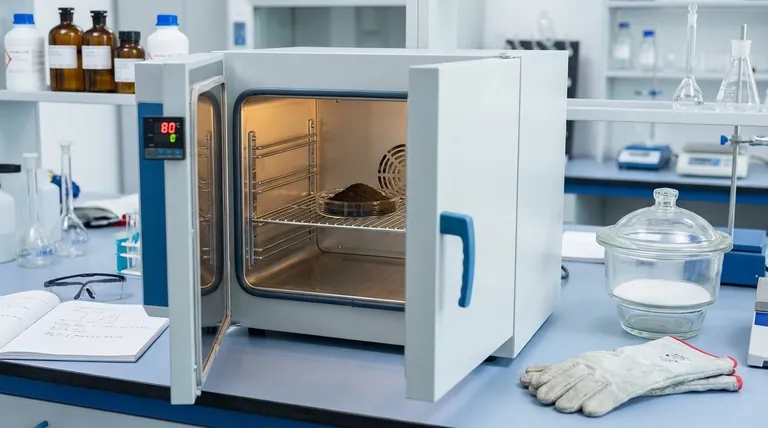
The laboratory drying oven serves as a critical stabilization tool in the preparation of C@TiC/SiO2 xerogels. It provides a stable thermal environment, specifically at 80 °C, to facilitate the complete and controlled evaporation of ethanol solvents from the mixture. This process is essential for converting the wet precursor into a dry, loose composite powder without compromising its physical architecture.
Core Takeaway: The value of the drying oven lies in rate control, not just heat application. By maintaining a precise temperature to ensure slow solvent volatilization, the oven prevents the structural collapse of the xerogel, ensuring the final material remains porous and easy to grind.
The Mechanics of Solvent Removal
Establishing a Stable Thermal Field
For C@TiC/SiO2 xerogels, the drying oven is set to a constant 80 °C. This temperature is specifically selected to target the boiling point and volatility characteristics of ethanol.
A fluctuating temperature can lead to uneven drying gradients. The oven ensures that the thermal energy is applied uniformly across the entire sample batch.
Facilitating Complete Evaporation
The primary chemical function of this step is the total removal of the liquid phase.
The oven drives off the ethanol solvent that was used during the initial mixing and synthesis. Leaving residual solvent can negatively affect the purity and performance of the final xerogel.
Preserving Structural Integrity
Preventing Structural Collapse
The speed at which the solvent leaves the material is the most critical variable.
If ethanol volatilizes too rapidly due to excessive heat, the capillary forces within the gel pores can become destructive. This causes the internal framework of the xerogel to collapse upon itself.
Enabling Slow Drying
The drying oven is utilized to enforce a "slow drying" regime.
By strictly limiting the temperature to 80 °C, the evaporation rate is kept in check. This gentle removal preserves the delicate pore structure of the composite.
Producing a Loose Powder
The physical outcome of this controlled process is a "loose composite powder."
Because the structure has not collapsed into a dense mass, the dry material is friable. This makes the subsequent grinding process significantly easier and more effective.
Understanding the Trade-offs
The Risk of Rapid Volatilization
It is often tempting to increase temperatures to speed up the preparation workflow.
However, in xerogel preparation, speed often creates density. Rapid drying leads to shrinkage and a hard, dense cake that is difficult to process and lacks the desired surface area.
Precision vs. Throughput
The trade-off here is time versus quality.
Achieving a stable, high-quality xerogel requires the patience of a slow drying cycle at 80 °C. Rushing this stage with higher temperatures introduces structural defects that cannot be fixed later.
Making the Right Choice for Your Goal
To optimize your C@TiC/SiO2 xerogel preparation, align your drying protocol with your specific processing needs:
- If your primary focus is Structural Integrity: Adhere strictly to the 80 °C limit to ensure slow volatilization prevents pore collapse.
- If your primary focus is Downstream Processing: Ensure drying is absolute and complete to produce a loose powder that minimizes mechanical effort during grinding.
Success in xerogel synthesis is defined by the discipline to prioritize controlled evaporation over rapid drying.
Summary Table:
| Process Parameter | Requirement | Role in Xerogel Preparation |
|---|---|---|
| Target Temperature | 80 °C | Aligns with ethanol volatility for controlled removal |
| Evaporation Rate | Slow / Gradual | Prevents capillary force damage and pore collapse |
| Physical Outcome | Loose Powder | Facilitates easy grinding and maintains surface area |
| Primary Function | Stabilization | Converts wet precursors into dry composite structures |
Elevate Your Xerogel Synthesis with KINTEK Precision
Precise thermal control is the difference between a collapsed mass and a high-performance xerogel. KINTEK provides industry-leading laboratory drying ovens and high-temperature systems designed for the rigorous demands of material science.
Why choose KINTEK?
- Expert R&D & Manufacturing: Our equipment is engineered for stable thermal fields and uniform heat distribution.
- Comprehensive Solutions: From Muffle and Tube furnaces to Rotary, Vacuum, and CVD systems, we cover every stage of your high-temp workflow.
- Customizable for Your Needs: We tailor our systems to meet your specific research or production requirements.
Don't let structural defects compromise your research. Contact us today to find your perfect thermal solution." Form)!"
References
- Yan Wang, Junyang Jin. Influence of Absorber Contents and Temperatures on the Dielectric Properties and Microwave Absorbing Performances of C@TiC/SiO2 Composites. DOI: 10.3390/nano14242033
This article is also based on technical information from Kintek Furnace Knowledge Base .
Related Products
- 1200℃ Muffle Oven Furnace for Laboratory
- 1800℃ High Temperature Muffle Oven Furnace for Laboratory
- High Temperature Muffle Oven Furnace for Laboratory Debinding and Pre Sintering
- 1400℃ Muffle Oven Furnace for Laboratory
- Laboratory Muffle Oven Furnace with Bottom Lifting
People Also Ask
- How does a high-temperature laboratory muffle furnace affect material properties? Transform Anodic Oxide Films Fast
- What is the primary function of a high-temperature laboratory muffle furnace in chemical synthesis? Achieve Precision.
- How is a laboratory muffle furnace used in 3D-printed PP-CF cross-linking? Achieve Thermal Stability at 150 °C
- How is a laboratory high-temperature muffle furnace used to evaluate porous Co-Al materials? Precision Thermal Analysis
- What role does a muffle furnace play in plant bark mineral analysis? Essential for Precise Dry Ashing & Trace Extraction











