
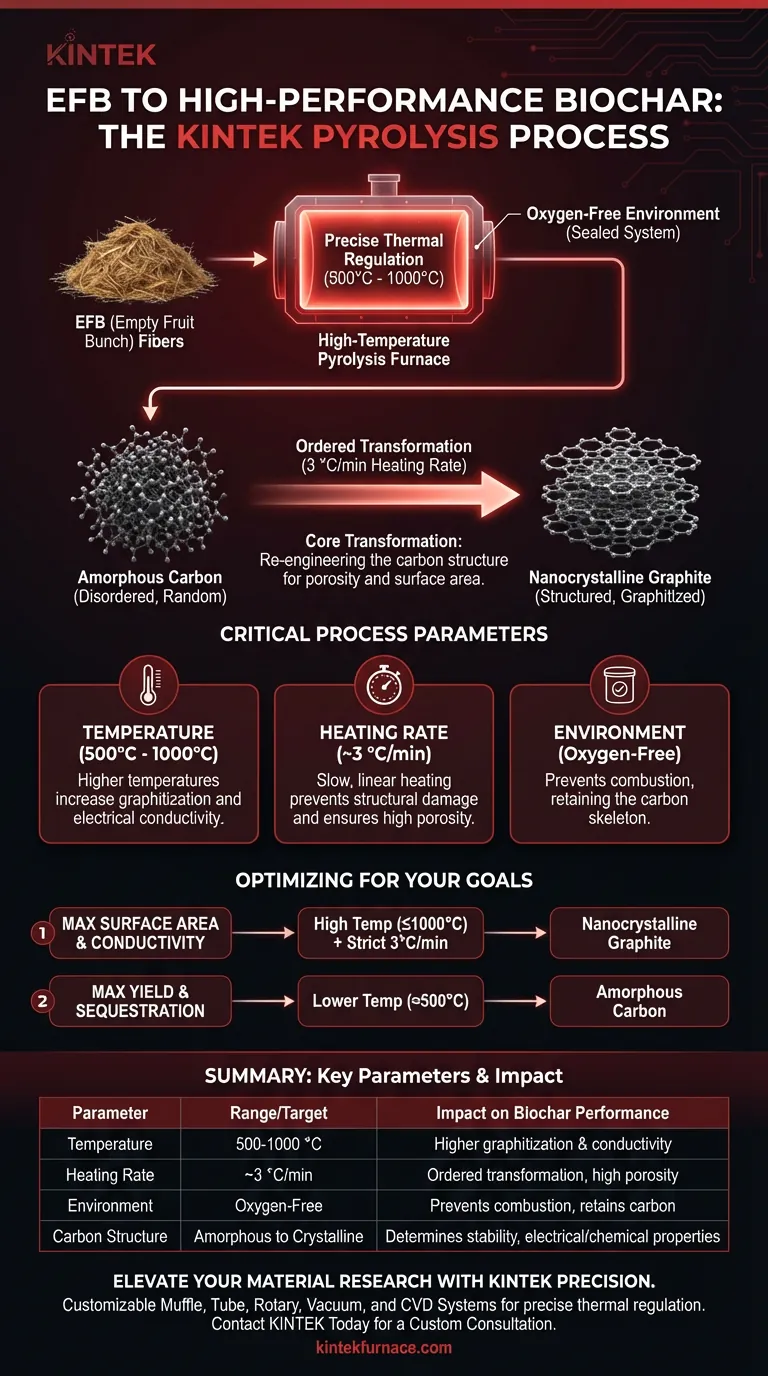
A high-temperature pyrolysis furnace facilitates the conversion of Empty Fruit Bunch (EFB) fibers into high-performance biochar by maintaining a strictly controlled, oxygen-free environment across temperature gradients ranging from 500 °C to 1000 °C. Through precise thermal regulation—specifically a heating rate of 3 °C/min—the furnace drives the ordered transformation of the biomass, shifting it from amorphous carbon into highly structured nanocrystalline graphite.
The Core Transformation: The furnace does not simply char the material; it re-engineers it. By managing the thermal ramp rate and maximum temperature, the process dictates the evolution of the carbon structure, directly determining the porosity and specific surface area required for high-performance applications.

The Mechanics of Controlled Pyrolysis
To convert EFB fibers into functional biochar, the furnace must execute a precise thermal protocol that prevents combustion while promoting structural rearrangement.
Establishing an Anaerobic Environment
The furnace operates as a sealed system to provide an oxygen-free environment. This is the fundamental requirement for pyrolysis.
By excluding oxygen, often through the use of stable gas flows (such as nitrogen), the system prevents the biomass from burning to ash. Instead, it forces the thermal decomposition of the organic material, retaining the carbon skeleton.
Precise Thermal Regulation
The distinction between low-grade char and high-performance biochar lies in the heating rate.
The furnace is equipped with a control system capable of maintaining a specific heating rate, such as 3 °C/min. This slow, linear increase in temperature is critical because it allows for the efficient devolatilization of lignocellulosic components without structurally damaging the developing carbon matrix.
Structural Evolution of the Biochar
The primary value of using a high-temperature furnace is its ability to manipulate the microscopic structure of the EFB fibers.
From Amorphous to Crystalline
As the temperature climbs between 500 °C and 1000 °C, the carbon undergoes a phase change.
Initially present as amorphous carbon (disordered and random), the heat induces an ordered transformation. The carbon atoms realign into nanocrystalline graphite structures. This graphitization is a hallmark of high-performance biochar, offering greater stability and electrical conductivity.
Determining Porosity and Surface Area
The physical properties of the final product are a direct result of this thermal history.
The specific combination of temperature and heating rate determines the material's porosity and specific surface area. By controlling the removal of volatiles and the ordering of carbon crystals, the furnace creates a vast network of pores, which is essential for applications like adsorption or soil amendment.
Critical Process Constraints
While high-temperature pyrolysis offers superior material quality, it requires rigorous adherence to process parameters to avoid inconsistent results.
Sensitivity to Heating Rates
The heating rate is a strict variable, not a suggestion. A rate that is too fast may cause rapid volatilization, leading to structural collapse or pore blockage rather than the desired ordered transformation.
Temperature-Dependent Outcomes
Higher temperatures (approaching 1000 °C) generally yield higher carbon content and better graphitization, but this comes at the cost of total yield. Operating at the lower end (500 °C) preserves more mass but results in a less organized, amorphous carbon structure with different performance characteristics.
Optimizing for Your Specific Goals
The pyrolysis furnace is a tool for tuning material properties. Your operational settings should reflect the specific requirements of your final application.
- If your primary focus is maximum surface area and conductivity: Prioritize higher temperatures (up to 1000 °C) and adhere strictly to the 3 °C/min heating rate to ensure the formation of nanocrystalline graphite.
- If your primary focus is yield and basic carbon sequestration: Operate at lower temperatures (closer to 500 °C) to maximize the mass of the biochar retained, accepting a more amorphous carbon structure.
Precision in thermal control is the single most important factor in upgrading EFB fibers from agricultural waste into advanced industrial materials.
Summary Table:
| Parameter | Range/Target | Impact on Biochar Performance |
|---|---|---|
| Temperature Range | 500 °C - 1000 °C | Higher temps increase graphitization and conductivity |
| Heating Rate | ~3 °C/min (Slow) | Ensures ordered carbon transformation and high porosity |
| Environment | Oxygen-free (Anaerobic) | Prevents combustion and ensures carbon skeleton retention |
| Carbon Structure | Amorphous to Crystalline | Determines stability and electrical/chemical properties |
Elevate Your Material Research with KINTEK Precision
Unlock the full potential of your biomass conversion with KINTEK’s industry-leading thermal solutions. Backed by expert R&D and manufacturing, KINTEK offers high-performance Muffle, Tube, Rotary, Vacuum, and CVD systems—all fully customizable to meet your specific pyrolysis protocols.
Whether you are targeting nanocrystalline graphite formation or optimized carbon yield, our furnaces provide the precise thermal regulation and anaerobic integrity your research demands. Our expert team is ready to help you engineer the perfect high-temperature solution for your lab.
Contact KINTEK Today for a Custom Consultation
Visual Guide
References
- Fairuz Gianirfan Nugroho, Abu Talha Aqueel Ahmed. Utilizing Indonesian Empty Palm Fruit Bunches: Biochar Synthesis via Temperatures Dependent Pyrolysis. DOI: 10.3390/nano15010050
This article is also based on technical information from Kintek Furnace Knowledge Base .
Related Products
- 1700℃ High Temperature Laboratory Tube Furnace with Alumina Tube
- 1400℃ High Temperature Laboratory Tube Furnace with Alumina Tube
- 1700℃ High Temperature Muffle Oven Furnace for Laboratory
- 1800℃ High Temperature Muffle Oven Furnace for Laboratory
- 1400℃ Muffle Oven Furnace for Laboratory
People Also Ask
- How do high-temperature laboratory tube furnaces ensure environmental stability? Precision Thermal Reduction Tips
- How are high-temp tube furnaces used to measure diffusion coefficients per Fick's law? Master Precision Annealing
- How are high-temperature laboratory tube furnaces applied in long-term vacuum homogenization heat treatments for intermetallic samples?
- How are high-temperature tube furnaces applied in testing ceramic-supported alloy membranes? Insights
- In what scenarios are laboratory high-temperature tube furnaces or muffle furnaces utilized? Study MgTiO3-CaTiO3 Ceramics



















